
Hands-on, practical education is the hallmark of engineering education at Michigan Tech. So when Samantha Cooper ’27 saw the opportunity to conduct research with Assistant Professor Maria Gencoglu in a part of the chemical engineering field unfamiliar to her, she jumped at the chance.
Cooper understands how valuable experiences are in addition to her coursework as a Husky. Having enjoyed chemistry, mathematics, and physics in high school, she set her sights on becoming a chemical process engineer. She chose to study chemical engineering at Michigan Tech because of all the Department of Chemical Engineering has to offer.
“The Unit Operations Lab is designed to prepare students for industry roles by familiarizing them with large-scale equipment,” says Cooper, now a junior in Tech’s College of Engineering. “I felt that experiencing the realities of process engineering through school would be the best way to prepare for working in that sector.”
With coursework in the Unit Ops Lab and a co-op experience already under her belt, she has a clear understanding of what life might look like post-graduation as full-time process engineer: designing, testing, and operating processes that convert raw materials into usable products. But Cooper is still working toward her degree and wants to make sure her chosen path is the right one.
Through the College of Engineering’s Research Experience for Undergraduate Students program, Cooper joined Gencoglu’s research group, where members are developing techniques to increase success in the early detection of ovarian cancer using circulating tumor DNA (ctDNA). Her work as a research assistant may be different from what she set out to do, but Cooper is invested because of the project’s potential impacts.
“I wanted to see what it was like to work in a research lab because I never have before,” says Cooper. “I wanted to know what other options I could have before committing to a plan. Plus, the research we do to develop screening techniques has the chance to really help people, and there isn’t anything more interesting than that.”
Tiny Fragments, Big Impact
Being a Tech alum herself, Gencoglu knows the value of research experience. After graduating with her PhD in Chemical Engineering from Michigan Tech in 2014, she spent several years as a faculty and industry researcher.
In 2024, Gencoglu returned to Tech as an assistant professor in the Department of Chemical Engineering, where she now researches cancer tissue engineering, disease modeling, and molecular mechanisms of diseases. Her current research investigates how ctDNA can be used to benefit ovarian cancer patients.
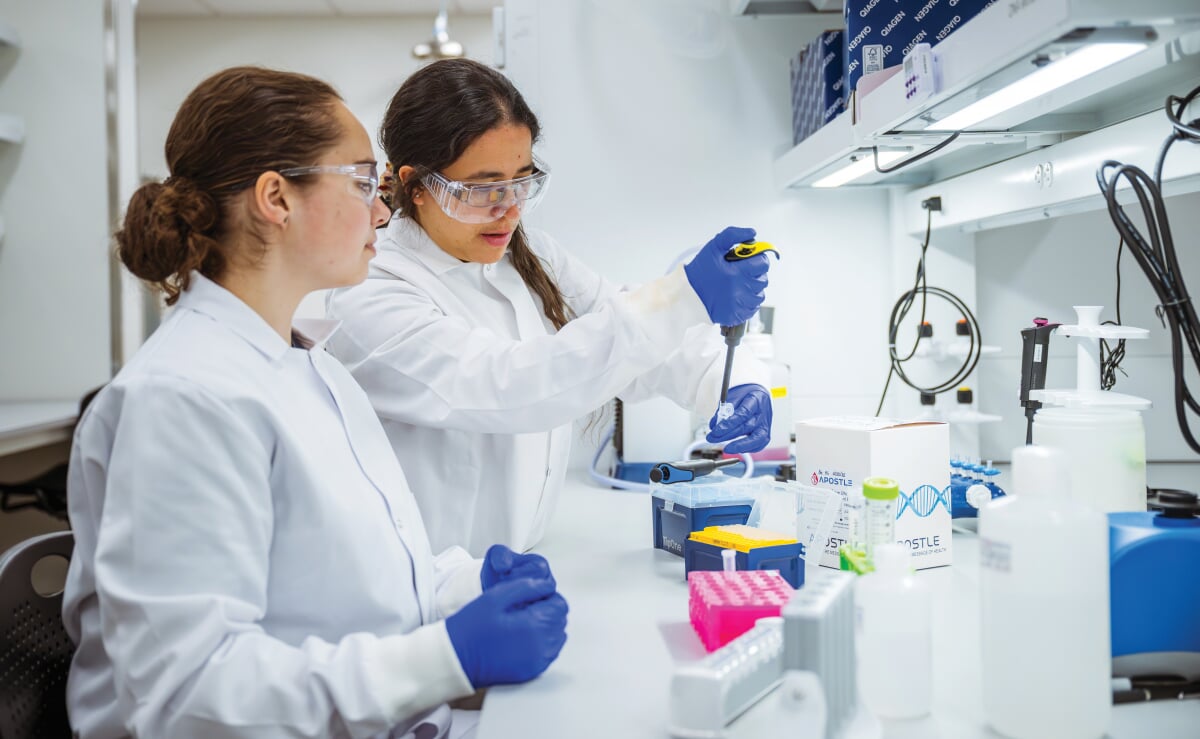
Ovarian cancer has a high survival rate—up to 90 percent—when diagnosed early. However, it is often detected late due to lack of symptoms. Instead of waiting for symptoms to appear, oncologists can order a blood test called a liquid biopsy to look for ctDNA fragments released by tumor cells into the bloodstream.
Gencoglu says liquid biopsies can help increase the success rate of early detection, but obtaining sufficient high-quality ctDNA from a blood sample is a challenge. Her research group is trying to change that.
“Cell lines can be modified to release tumor DNA fragments with characteristics similar to those found in the blood of ovarian cancer patients,” says Gencoglu. “In this research project we are trying to answer if we can generate ctDNA-like materials from ovarian cancer cell lines that can be used as reference materials for oncology tests.”
As part of her research assistant role, Cooper is working with ctDNA extraction platforms. Gencoglu is happy to have her on the team.
“Samantha is a great fit because she really wants to learn and make a difference,” says Gencoglu. “Her work is very significant to this project since she is finding the best conditions to obtain the highest yield of ctDNA.”
Practical Proofs
Cooper’s research work has integrated seamlessly with her studies—and in some cases expanded them. While serving as a research assistant, she’s also taking a required course on separation processes, which has helped her in the lab.
“As I progress through my separations course, I can see the different chemical separations I have to complete while conducting a ctDNA extraction,” says Cooper. “The separations I do in the lab are not discussed in class, but I think the nature of my responsibilities in the lab have allowed me to make some helpful connections between the class and my work.”
In addition to her specialized lab techniques, Cooper is gaining valuable skills in oral and written communication and data analysis—skills necessary for any career in the engineering profession. She’s loving her research work so much, she’s looking for ways to do more of it in the future.
“This research will help me decide if I want to apply for the accelerated master’s in chemical engineering program, which would allow me to specialize in my studies and possibly work in research and development,” says Cooper.
For Cooper and students like her, the College of Engineering’s Research Experience for Undergraduate Students program provides students not only with the opportunity to train and test their skills in dynamic laboratory settings, but a chance to do so while working on real projects that have a real impact on the world around them.