
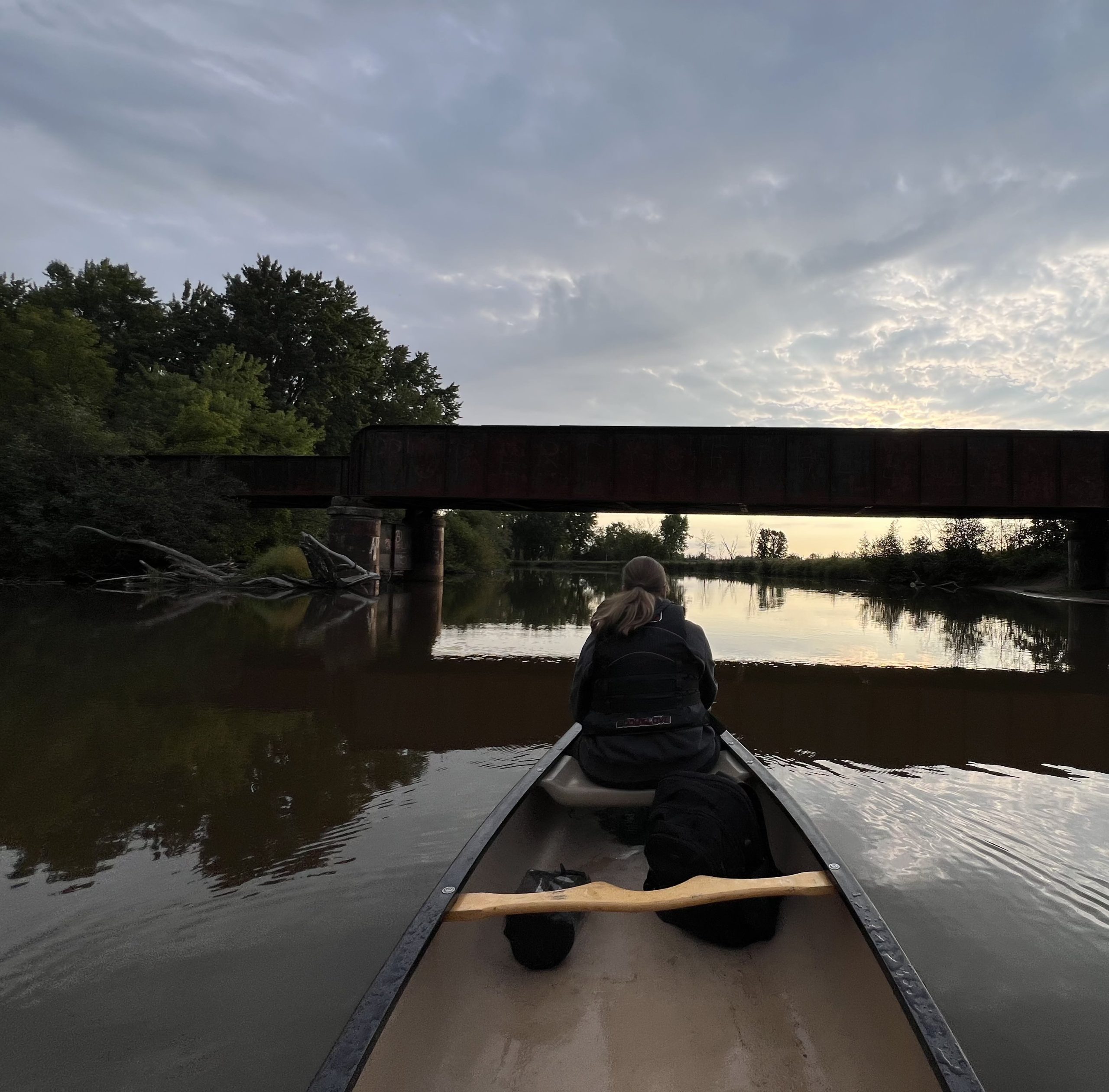
Hands-on research and data collection are essential preparation for a career as a wildlife professional. The wildlife capstone course offered by the College of Forest Resources and Environmental Science (CFRES) guides students through the joys and challenges of collecting data on some of nature’s most elusive research subjects. One of this year’s teams focused on how the bat population uses forest gaps, while another examined how environmental factors relate to bird sightings.
Wildlife Students Close the Gap on Bat Data
Stacy Cotey, assistant teaching professor for CFRES, leads the course, which this academic year included Meghan Boelens, Derek Weide, Jacob Sutter, Graham Bishop and Grace Simpson, all wildlife ecology and conservation students. The Huskies took a closer look at how forest gaps and the way those open spaces are used can affect the bat population.
“We’re testing a bunch of different habitat variables to see how that relates to the use of these gap areas that were cut into an experimental forest around yellow birch trees,” said Weide. Their outdoor lab is an experimental forest located on the Sturgeon River, part of Tech’s Ford Center and Forest.
Forest gaps can occur both naturally and due to land management practices that involve tree removal. Landowners may need to create access roads or hiking trails. Silviculturalists who manage forests for uses ranging from wildlife habitat to recreation use a technique known as Variable Density Thinning to mimic natural, unevenly aged forest structures, promoting ecological resilience and structural diversity.
No matter the reason, any disturbance to a forest habitat affects local wildlife.
Students collected data by placing Autonomous Recording Units (ARUs) at 18 sites in Tech’s experimental forest near the Sturgeon River and Ford Center. Each ARU was on site for four two-week periods, set to record sounds through the night. Students then collected the ARUs to analyze the sounds they recorded, looking specifically for bat calls.
Using a program called Kaleidoscope, the sound clips were turned into visual spectrograms, which students manually compared to waveforms of bat echolocation calls to identify which species were recorded, along with the time and number of calls.
“Going through the spectrograms, we got a lot of hoary bats and silver-haired bats,” said Boelens. “Whenever I got something less common, like an eastern red bat, that was an exciting moment for me.”
Each ARU captured anywhere between one and 150 sounds per recording, which made analysis a long and time-consuming process. Students checked each spectrogram manually and entered their findings into a spreadsheet, then double-checked their findings with help from Artificial Intelligence (AI).
“We used the AI as more of a third or fourth opinion to make sure everything was correctly identified and we hadn’t missed anything,” said Bishop. “We didn’t specifically rely on it, but it was nice to have another set of eyes, so to speak.”
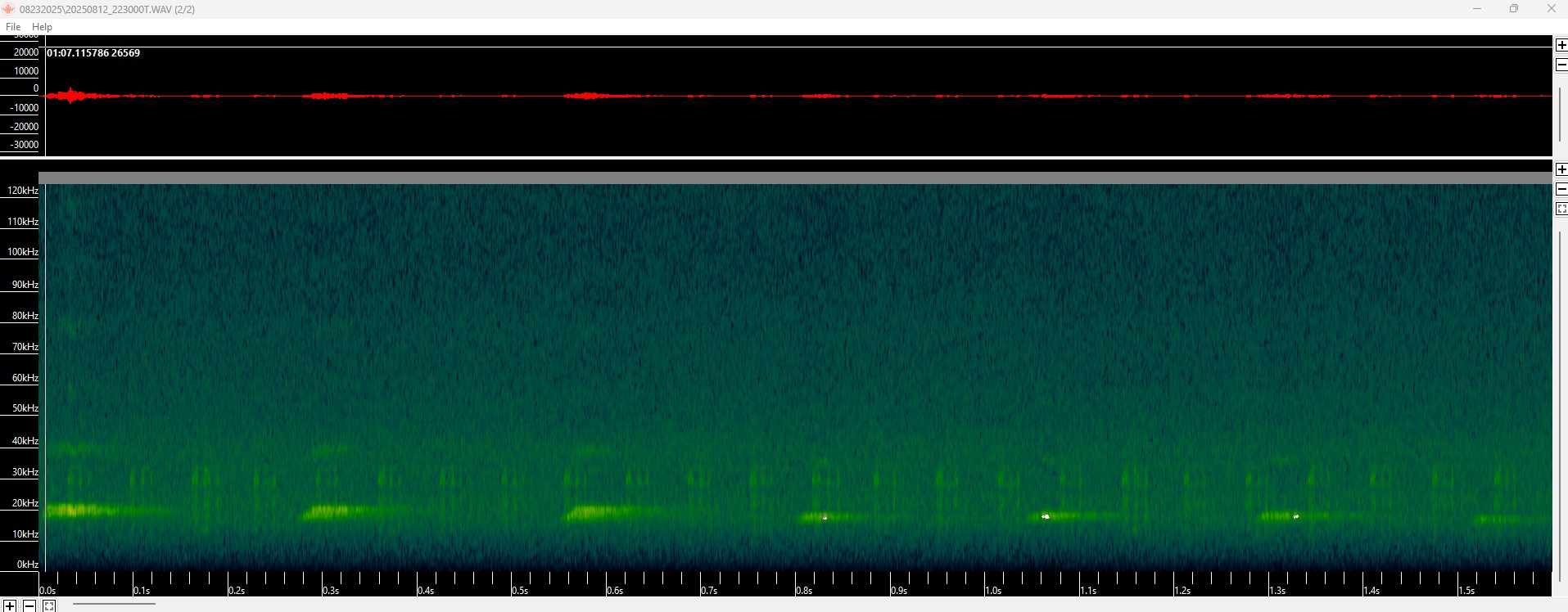
Students also had to distinguish bat calls from bird calls and other sounds. Long hours spent staring at green spectrograms on laptop screens built connections and engaged other Huskies.
“I’m converting my non-CFRES friends,” said Bishop. “My roommates would sometimes watch me going over the spectrograms, and started pointing out the shapes of a bat call. I would ask them things like, ‘Do you want to hear what a silver-haired bat sounds like?’ and they always said, ‘Yes, please!’”
The research team understands the fascination. An interest in bats is what drew most of them to this particular capstone project.
“Everyone loves bats, whether they are CFRES folks or not,” said Simpson
“Bats are something you don’t learn about in most of our classes. Also, a chance to go back to fall camp was really cool,” she said, referring to the Integrated Field Practicum that many CFRES students attend for a fall or summer semester.
Bishop knew very little about bats and appreciated the opportunity to learn more. “I was excited for the chance to apply my capstone to something I was academically interested in,” he said.
For Weide, the research was a continuation of his Earn and Learn research assistantship with Cotey. He spent the summer of 2025 checking drift nets in canopy gaps that funneled terrestrial wildlife within view of camera traps at either end of the nets. The goal was to get data on what creatures use the gaps for movement and foraging.
“The project collected a lot of data while being minimally invasive to the animals,” said Weide. “It’s a cool way to see what kinds of small mammals and other animals might be out in that stand without actually causing any harm to them.”
If a love of studying small, furry creatures with minimally invasive methods like ARUs and cameras isn’t enough to draw wildlife students to research, there’s always the trees.
“I just like the forest a lot out there,” said Weide. “Specifically, yellow birch is my favorite tree.”
Data is for the Birds!
Bird watching is a favorite pastime for many CFRES students. For their capstone project, wildlife ecology and conservation students Ashlynn Moler, Evan Karmis, and Manny Salas took the popular hobby to a scientific level. While canoeing on the Sturgeon River, the group collected data on environmental factors and their correlation to bird sightings. Over the course of a weekend, they surveyed 30 points along the river using two canoes about 15 minutes apart. Both canoes recorded the number and species of birds seen at each site. The group later compared data to see how many were counted by both. Each student also collected data on habitat factors at each survey point. Their goal was to discover which variables correspond to species detection, behavior, diversity, and frequency.
Moler began by using Geographic Information Systems (GIS) to determine the proportion of riparian areas— the area around the river that birds use—and the distance from anthropogenic areas, meaning the roads, farms, and other spaces used by humans.
“My theory was that where the anthropogenic areas were closer, there might be fewer birds as they either avoid human activity or seek out bird feeders and other human food sources nearby,” said Moler.
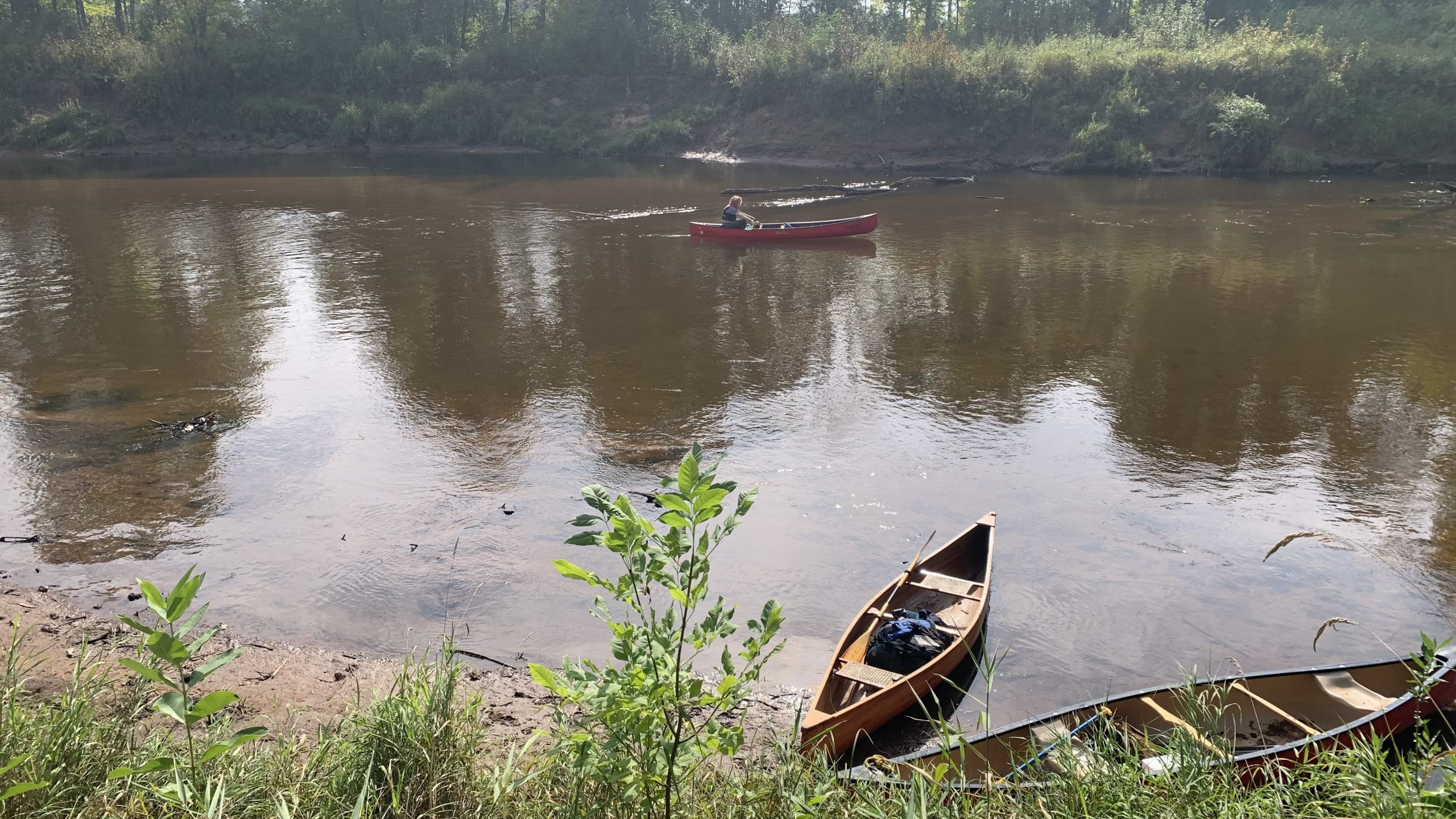
Since the study showed correlation rather than cause, each factor was measured as significant or insignificant within a five percent margin of error. Her data showed that both riparian area proportion and distance from anthropogenic areas were significant to species diversity. While out on the canoe, Moler also tested the water pH, nitrates, nitrites, clarity, and hardness at each site. All of the water variables were measured as significant when compared to bird sighting data, except for water hardness.
Where Moler focused on land and water, Salas collected data on the trees and brush themselves. He recorded data for the type of shoreline, the amount of brush, and how forested each survey site was. “I’d look at, for example, whether it was a brushy shoreline with tag alder up to 15 feet high, an open grassy meadow, a big sandbank, or a mixture of those habitats,” said Salas.
Though shoreline type leaned toward significance, it didn’t quite meet the narrow five percent margin of error that is standard for wildlife research. He theorized that additional survey days may have pushed his data over the mark. “I can’t exactly claim a direct correlation between shoreline type and bird abundance or species diversity,” said Salas. “I would need to go back and get more samples.”
While Salas kept his eyes on the brush and trees along the shore, Karmis’s data collection centered on the wind moving their branches. “I was looking to see if higher wind speeds correlated to how willing birds were to flush from cover as we passed,” said Karmis. “I also wanted to see if there was any correlation between bird activity and how warm or cold it was throughout the day.”
The temperature only varied about five degrees on the group’s river survey days, so he was unable to make a significant connection between temperature and bird activity. Wind speed had more variety, but didn’t show a significant correlation between wind speed and bird sightings.
Insignificant data findings didn’t dampen the young researchers’ spirits. The joy of wildlife research is spending time with all the creatures that fly, scurry, or swim in the field researcher’s living lab. In addition to birds, the group saw several turtles, including a wood turtle—uncommon this far north—and turtle eggs.
“People in our major just like having interactions with animals,” said Karmis. “We wouldn’t be here if we didn’t. I had never seen a wood turtle before, and he was really cool.”
About the College of Forest Resources and Environmental Science
Michigan Tech’s College of Forest Resources and Environmental Science brings students, faculty, and researchers together to measure, map, model, analyze, and deploy solutions. The College offers six bachelor’s degrees in forestry, wildlife ecology and conservation, applied ecology and environmental science, natural resources management, sustainable bioproducts, and environmental science and sustainability. We offer graduate degrees in applied ecology, forest ecology and management, forest molecular genetics and biotechnology, and forest science.
Questions? Contact us at forest@mtu.edu. Follow us on Facebook, Instagram, and LinkedIn for the latest happenings.