Department of Chemical Engineering

Posts under the ‘News’ category

Chemical Engineering Department Awards Convocation

Tuesday, April 16th, 2013

The Annual Chemical Engineering Department Awards Convocation was held in the Rozsa Center on April 11, 2013. This is an opportunity to thank the faculty, staff and students for their hard work and dedication. The department recognized the support of Mrs. Karen Hubbard, Kimberly-Clark, Dow Chemical, Dow Corning and UOP for their donations and services, which made this year’s Awards Convocation possible.


The guest speaker was Mr. James Mack. A native of Mackinaw City, Michigan, Mr. Mack received his BS degree in Chemical Engineering from Michigan Tech in 1959. Upon graduation, he joined Monsanto as a Project Engineer. While with Monsanto he received his MBA from Western New England College.

He spent almost twenty years with Sherwin-Williams where he was Product Manager, Organic Chemicals; Manager, New Business Development, Chemicals Division; and General Marketing Manager, Chemicals Division. He became President of Sherwin-Williams Chemicals in 1978. In 1982, Mr. Mack joined Oakite Products, Inc. as Executive Vice President and member of the doard of directors. In 1984, he joined Olin Corp. as Vice President and General Manager of their worldwide urethanes and specialty chemicals business. In 1990, he joined Cambrex as President and Chief Operating Officer, and in 1995 assumed his current position as President, Chief Executive Officer, and member of the board of Cambrex. Mr. Mack is past Chair of the Synthetic Organic Chemicals Manufacturers Association (SOCMA).

In October 2001, British American Business, Inc. gave him the Transatlantic Entrepreneur Award. In June 2002, Ernest and Young recognized him with the Entrepreneur of the Year Award for New Jersey.

Over the years, Mr. and Mrs. Mack have been tireless supporters of Michigan Tech. Within the Chemical Engineering Department, they have endowed the James and Lorna Mack Chair in Bioengineering to promote biotechnology research and education. Mr. Mack is also a trustee of the Michigan Tech Fund and a member of the Capital Campaign Committee, the Presidents Club, and the National Advisory Board.

Link to video of speech by Mr. James Mack


Awards were presented for Prevent Accidents With Safety (PAWS) Awards by Mr. David Caspary, Lab Facilities Manager: Jeff Graves, Tyler Gygi, Paige Kleinow, Tim Rossetto, Patrick Somers, Kelly-Anne Zayan, and Jeff Caspary


Dow Chemical Marriott W. Bredekamp Award was presented by Mr. David Caspary, Lab Facilities Manager: William Paddock, Daniel Spencer, Amanda Taylor, and Edward Duda


Kimberly-Clark Communication Award, by Dr. M. Sean Clancey, Senior Lecturer: Robert Parker


Kimberly-Clark Professional Ethics Award, Dr. M. Sean Clancey, Senior Lecturer: Tim Rossetto


UOP Davis W. Hubbard Plant Design Team Award, Dr. Tony Rogers, Associate Professor: Scott Kempainen, Kevin Osentoski, and Hans Sandholm

Student Reports were presented by AIChE Chapter President – Ms. Elizabeth Skultety; Consumer Product Manufacturing (CPM) President – Mr. Robert Parker; Alternative Fuels Group (AFG) President – Mr. Cory Schafer

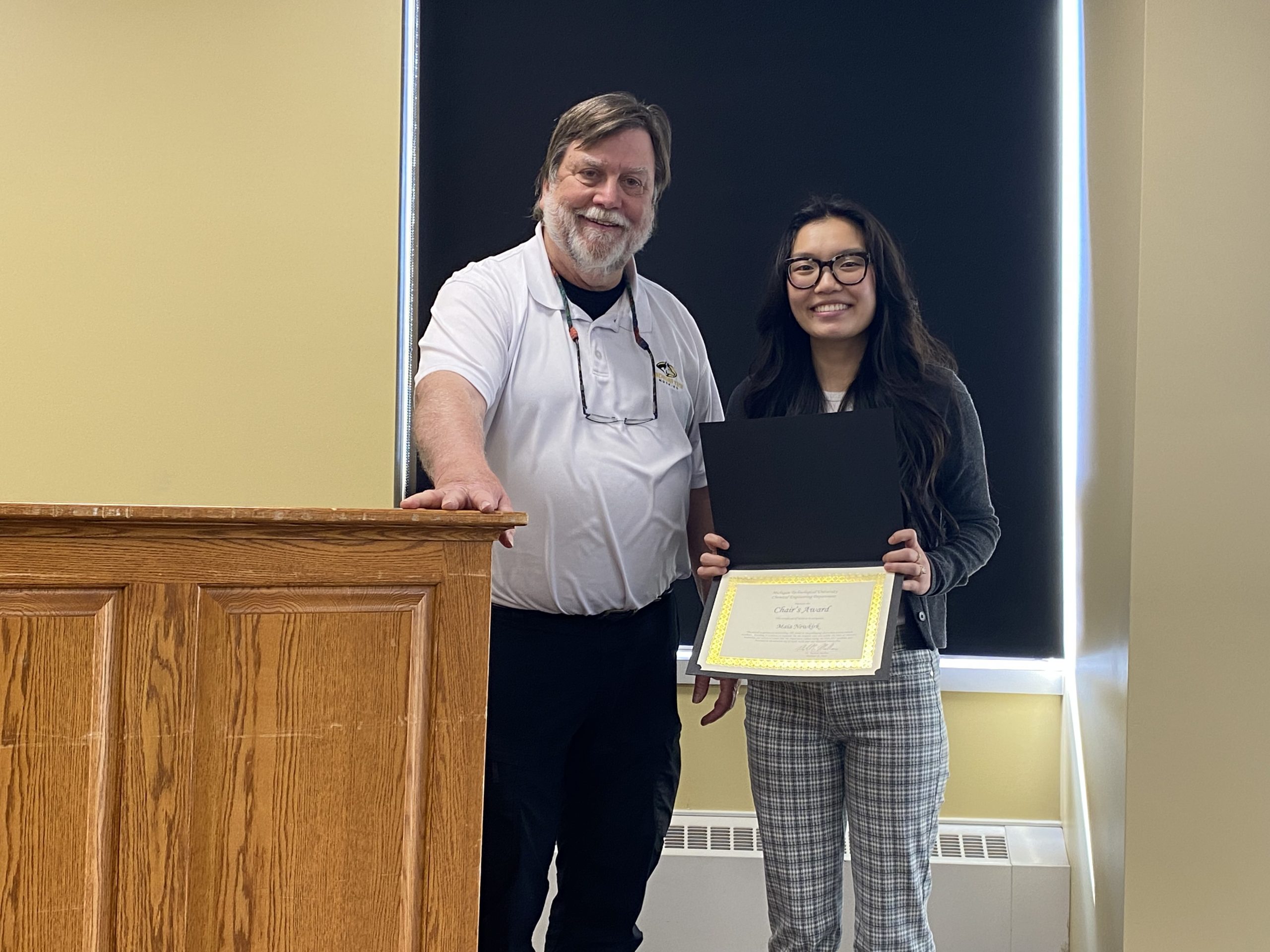
Faculty Awards were presented by Ms. Elizabeth Skultety, AIChE President presented the Teacher of the Year Award to Dr. Tim Eisele, Dr. Caryn Heldt received the “Research Mentor of the Year” award, and the Graduate Teaching Assistant of the Year was awarded to Wilbel Brewer.


Teacher of the Year Award to Dr. Tim Eisele


Dr. Caryn Heldt received the “Research Mentor of the Year” award.


Wil Brewer received the “Outstanding TA of the Year” Award.

See more photos at our Flickr Gallery

Adrienne Minerick Elected to ASEE Board of Directors

Tuesday, April 9th, 2013

Adrienne Minerick (ChE) was elected to the American Society of Engineering Education’s Board of Directors. She will serve as the Professional Interest Council I Chair. ASEE has over 12,000 members that include deans, department heads, faculty members, students, and government and industry representatives who hail from all disciplines of engineering and engineering technology.

2012-2013 Awards Convocation

Wednesday, April 3rd, 2013

The Department of Chemical Engineering 2012-2013 Awards Convocation will be on April 10, 2013
Rosza Center, 2:00-4:00 P.M.
The Keynote eakers will be Michigan Tech chemical engineering alumnus James A. Mack ‘59 and his wife, Lorna, donated $2 million to establish an endowed chair in cellular and molecular bioengineering. Mr. Mack retired as President and Chief Executive Officer of Cambrex Corporation, a developer and marketer of specialty chemicals. His company has successfully combined biology with engineering—especially in the rapidly emerging field of tissue engineering and cell therapy, and the development of small molecule therapeutics. Poster
James and Lorna Mack are dedicated to helping Michigan Tech achieve its vision—to grow as a premier research university of international stature, delivering education, new knowledge, and innovation.

ESC/BRC Student Research Forum Winners Announced

Sunday, March 31st, 2013

ESC/BRC Student Research Forum Winners Announced
The Ecosystem Science Center and the Biotechnology Research Center announced award recipients of the Ninth Annual ESC/BRC Student Research Forum, held March 27.
For the graduate students, two Grand Prize Awards and six Merit Awards were presented. They were selected from among the 59 posters and abstracts submitted by graduate students conducting research related to ecology, the environment and biotechnology at Michigan Tech.
Maria Tafur of the Chemical Engineering depaertment won a Merit Award for, “Reduction of Porcine Parvovirus Infectivity in the Presence of Protecting Osmolytes, ” Advisor: Caryn Heldt

Chemical Engineering Sweeps Poster Competition at SME Annual Meeting

Tuesday, March 26th, 2013

Four Michigan Tech Chemical Engineering students placed in the annual Minerals Processing division undergraduate and graduate poster competition during the Society of Mining, Metallurgy and Exploration (SME) Annual meeting in Denver on February 27. This annual poster competition showcases research from the top mining and mineral processing programs across the nation and is judged by some of the top engineers and scientists in industry and academia. It involved a five-minute oral presentation in a special session as well as a public poster display at a large SME gathering.

In the graduate student competition, Brett Spigarelli, a chemical engineering PhD candidate, took first place with his poster entitled “Increased Carbon Dioxide Absorption Rates in Alkali Solution by Addition of Surfactant.” Howard Haselhuhn, a chemical engineering PhD candidate, took second place with his poster entitled “Dispersant Adsorption and Effectiveness during Iron Ore Beneficiation Operations.” Both Spigarelli’s and Haselhuhn’s work have been locally, nationally and internationally recognized at many conferences over the past three years. Extended abstracts accompanying these two posters will be published in a special issue Minerals and Metallurgical Processing Journal this spring.


In the undergraduate student competition, Katrina Swanson, a fourth year chemical engineering undergraduate on an accelerated master’s track, took first place with her poster entitled “Biomass as a Renewable Alternative to Coal Fuel Sources in Iron Oxide Reduction.”


Paul Hagadone, a third-year chemical engineering undergraduate, took second place with his poster entitled “Effects of Scrubber Column Shell Geometry on Carbon Dioxide Removal Efficiency.” All four students are currently advised by S. Komar Kawatra, “I am very proud of my students,” he said. “They all have a bright future, and I am confident that they will succeed in all of their future endeavors.” Michigan Tech would like to congratulate these four students for their phenomenal success at this poster competition at SME this year.


Photos of students and poster from a previous poster presentation

Howard Haselhuhn – Water Chemistry Effects on Zeta Potential of Concentrated Hematite Ore


Brett Spigarelli – Surfactant Addition to Alkali Solutions for Increased Carbon Dioxide Absorption Rates


Dr. David Wood, Ohio State University- A Grain Processing Seminar in chemical Engineering

Tuesday, March 19th, 2013

Dr. David W. Wood

Ohio State University

Chemical & Biomolecular Engineering


Friday-March 22, 2013

10:00 a.m.

 MUB-Alumni Lounge


New Technologies from Engineered Self-Modifying Proteins

Professor Wood’s work seeks to apply biological concepts of protein function, cell metabolism, genetics and evolution to the molecular-scale development of new technologies.  These goals are achieved through the development of designer fusion proteins that combine domains and functions from unrelated proteins and enzymes.  We typically combine rational protein engineering with genetic selection to create and fine-tune the desired activities.  In oseparations, we have combined a previously developed pH-sensitive self-cleaving protein with a variety of purification tags to produce simple and economical methods for purifying recombinant proteins.  Our most recent work involves rational and evolutionary approaches to optimizing our self-cleaving tags for use in a wider variety of expression hosts.  In biosensing, we have developed allosteric proteins that incorporate human hormone receptors, and have used these proteins to generate Escherichia coli strains that are growth-dependent on hormones and hormone-like compounds.  Remarkably, this genetically simple bacterial sensor can differentiate agonist from antagonist activities and has been effective in detecting a wide variety of strong and weak estrogenic compounds.  More recently, we have applied this system to the discovery of thyroid active compounds, as well as the evaluation of environmental endocrine disruptors in humans and animals, and even the discovery of possible autism-associated environmental factors.  Applications of our designed proteins are far-reaching, and include drug discovery, biosensing, drug activation, reversible knockouts for metabolic research, new genetic selection systems, and advanced cellular control strategies.


Howard Haselhuhn: Outstanding Graduate Student Leader

Monday, February 25th, 2013

The Graduate Research Colloquium (GRC) was held on Feb 21-22, 2013. GRC was organized by the Graduate Student Government (GSG). Graduate students from all departments at Michigan Tech presented their research and ideas to other students and faculty in the form of oral or poster presentations. A group of judges that consists of faculty (and/or some invited members of industry) evaluated student’s presentations to award prizes to the best 1st, 2nd and 3rd presentations from each session (oral and poster). There are also three honorable mention awards given in both oral and poster presentation sessions.

In addition, at the Awards Banquet that was held on Friday evening February 23, the Graduate School presented several annual awards, including the Outstanding Graduate Student Leader award that went to Howard Haselhuhn of Chemical Engineering.


Outstanding Graduate Student Leader: Howard Haselhuhn, Shown here Kevin Cassell (GSG), Michigan Tech vice president Les Cook, Howard Haselhuhn, and Komar Kawatra, Department Chair, Chemical Engineering

Find out more about the Graduate Research Colloquium

Grain Processing Seminar February 22nd-Dr. Todd Przybycien,Carnegie Mellon University

Thursday, February 14th, 2013

Dr. Todd M. Przybycien

 Carnegie Mellon University

Departments of Chemical Engineering and Biomedical Engineering 

Friday-February 22, 2013

10:00am

MUB- Alumni Lounge


Unconventional Applications of Poly(ethylene glycol)-modified Proteins in BioProcessing and Drug Delivery

The covalent attachment of poly(ethylene glycol) (PEG) polymer chains, or “PEGylation,” improves the efficacy of protein drugs by extending their half-lives in the circulation without adversely affecting biological binding activity: the PEG chains are thought to hinder recognition by proteases, inhibitors and antibodies through steric interactions and to retard renal clearance through increased molecular size.  We used a more complete understanding of the solution and interfacial adsorption behavior of PEG-protein conjugates to explore new applications of protein PEGylation in bioprocessing and drug delivery. 

We have developed new, high selectivity protein affinity chromatography media by PEGylating immobilized protein affinity ligands outside of the target binding site.  This discourages the non-specific binding of contaminant species without decreasing target binding.  We find selectivity enhancements for IgG-class antibodies of 2x to 3x for Protein A affinity chromatography media modified with 5 kDa and 20 kDa PEG chains relative to the un-modified media, without loss of antibody binding affinity.  Increased contaminant rejection by Protein A media has important implications for simplifying downstream processing operations for monoclonal antibody production and for extending the operating lifetime of this expensive class of bioseparations media.

We have exploited PEGylation to reduce denaturing adsorptive interactions between proteins and interfaces that limit the successful delivery of protein drugs from poly(lactide-co-glycolide) (PLG) microsphere delivery systems. Oil/water interfaces are present during the generation of protein-loaded PLG microspheres by the double emulsion technique and solid/water interfaces are present as the microspheres erode during delivery.  The depressed adsorption isotherms of conjugates reduce the extent of adsorption at denaturing interfaces and the attached PEG random coils serve as steric diluents at interfaces.  While PEGylation with 20 kDa PEG has little effect on protein behavior at ethyl acetate/water interfaces, at PLG/water interfaces we find decreased extents of adsorption, increased reversibility of adsorption and decreased tendency to aggregate.  These results have translated to ~50% and ~100% improvements in active protein release for monoPEGylated and diPEGylated ribonuclease A, respectively.


Dr. Thomas Werner-Grain Processing Seminar February 8

Thursday, January 31st, 2013
Dr. Thomas Werner, Assistant Professor
Michigan Technological University
Department of Biological Sciences

Friday-February 8, 2013

MUB Ballroom B at 10:00am


The role of toolkit genes in the evolution of complex wing, thorax, and abdominal color patterns in Drosophila guttifera.

Animal color patterns such as zebra stripes, leopard spots, and the myriad variants of butterfly wing color patterns are known to play important ecological and physiological roles in the life of animals and are crucial for the survival of species. Scientists first tried to solve the secret of animal patterns with mathematical approaches to find models that could explain how these patterns developed. In 1952, Turing proposed the famous reaction-diffusion model in which a short-range acting activator molecule diffuses from a source to stimulate color production, while a long-range acting inhibitor molecule prevents pigmentation. Using the spectacularly ornamented fruit fly Drosophila guttifera, we developed a transgenic protocol to study the development and evolution of color patterns. We identified that the Wingless morphogen had evolved a new function in the D. guttifera lineage by activating the yellow gene on pre-existing structural landmarks on the wing, causing black melanin spots around sensory organs, tips of the veins, and crossveins. We are currently expanding this work by investigating if the melanin patterns on different body parts of D. guttifera evolved by the same mechanisms involving Wingless, or if they have independently evolved

Chemical Engineering Graduate Research Forum

Thursday, January 24th, 2013

The 1st Annual Graduate Research Forum for the Department of Chemical Engineering was held on January 24, 2013.
Judges for the Oral Presentations were:

  • Richard Donovan – Senior Research Engineer (Chemical Engineering)
  • Jay Meldrum – Director (Keweenaw Research Center)
  • Caryn Heldt – Assistant Professor (Chemical Engineering)
  • Debra Charlesworth – Assistant to the Dean (Graduate School)
    Awards will be announced on Friday, February 1, 2013, 12-1 in room 215 Chem Sci.
    Check the webpage for photos and award announcements.

  • Chemical Engineering

    Chemical Sciences and Engineering Building 203
    1400 Townsend Drive
    Houghton, MI 49931

    Ph. 906-487-3132
    Fax: 906-487-3213
    Email: ChemEng@mtu.edu

    Michigan Technological University

    1400 Townsend Drive
    Houghton, Michigan 49931-1295
    906-487-1885

    See a Problem?

    Email the Webmaster

    Protected by Akismet | Blog with WordPress