
The Center for Innovation and Incubation (CII) has awarded a $10,000 Research Seed Grant to the Keweenaw BirdSafe Living Lab project.
The CII operates as the Great Lakes Research Center’s (GLRC) main bridge between research, entrepreneurship, and real-world application. In addition to incubating specialized teams in environmental biotechnology, mass timber, and education, the Center invests directly in its members to help scale their big ideas. Through strategic tie-ins with campus and regional resources—including MTU’s Office of Innovation and Commercialization, the MTEC SmartZone, and NSF I-Corps—the CII helps transform early-stage concepts into tangible community impacts.
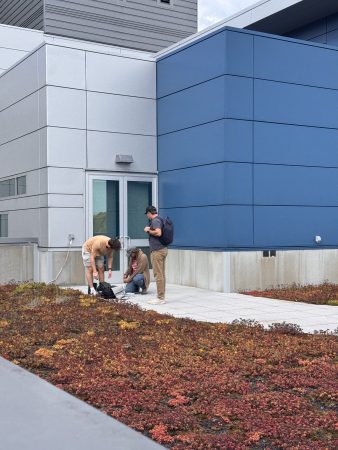
This latest seed grant reflects that mission by supporting a collaborative effort that bridges engineering, ecology, and commercial innovation. The project team is led by Shane Oberloier, assistant teaching professor in the Department of Electrical and Computer Engineering; Jared Wolfe, associate professor in the College of Forest Resources and Environmental Science; and includes senior Luke Pietluck ’27, computer engineering and member of the Wireless Communications Enterprise. The team is working in partnership with local startup Keweenaw Ecological Innovations and their Averta platform.
Innovation Built on Campus
The project focuses on deploying and testing next-generation bio-acoustic deterrents designed to prevent bird strikes against glass and urban infrastructure.
The newest generation unit—designed and built by Oberloier and Pietluck—has recently been installed directly at the Great Lakes Research Center (GLRC). This latest iteration marks a major leap forward in the technology:
- Full Customization & Mobile Control: Operators can configure sound profiles and schedules directly from a smartphone interface.
- Compact & High-Fidelity: The device is significantly smaller than previous prototypes while delivering noticeably cleaner, higher-quality audio output.
- Dynamic Acoustic Strategies: Rather than relying on a single sound, the unit employs a varying array of acoustic signals—including predator calls (creating a dynamic “landscape of fear”), pink noise (played during early morning hours to disrupt bird communication), and other biological signals adapted to specific bird behavioral patterns throughout the day and night.
This installation at the GLRC represents the first fully built-out unit of its generation. Installing it now allows the team to collect critical data following the peak fall migration season, refining the software and hardware ahead of spring migration.
Turning Houghton and Hancock into a Validation Ground
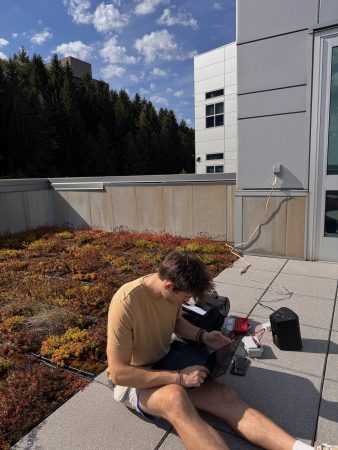
While the GLRC serves as a primary test location, the scope of the Keweenaw BirdSafe Living Lab extends beyond campus. Additional deterrent units are being deployed across other key locations, including the J. Robert Van Pelt and John and Ruanne Opie Library and select buildings in Hancock.
You’ll also see these deterrents pop up around the library and some buildings in Hancock to test the effects of a more community-wide bird collision management system. Right now, we are basically using Houghton-Hancock as a validation ground.
To measure the system’s real-world impact, student researchers will conduct daily morning site checks at each location to monitor fresh bird strikes and gather baseline data on device performance.
Beyond its primary ecological goal of reducing avian mortality, the project also examines human-tech interactions by evaluating how local residents, students, and property owners respond to the subtle soundscapes the deterrent devices create in their environments.
Located on Michigan Tech’s campus in Houghton, Michigan, the Great Lakes Research Center (GLRC) leads in interdisciplinary research excellence. Situated in a 55,000-square-foot waterfront facility opened in 2012, the GLRC is a dynamic part of Michigan Tech’s landscape as an R1 public research university. Home to five specialized research centers, the GLRC drives innovation across water, land, climate, and community systems.