
If you walk along the waterfront at Michigan Technological University, you can’t miss the Great Lakes Research Center (GLRC), including its research vessels and equipment. But what you may not see are our researchers working on autonomous submersibles, collecting crucial Great Lakes data, or analyzing complex information behind the scenes. The GLRC is an environment built for testing boundaries, solving environmental challenges, and understanding freshwater systems.
Now, our world-class research facility on the Keweenaw Waterway is playing a direct role in launching the next generation of water-tech startups.
Through a partnership supported by the Great Lakes Observing System (GLOS), the National Oceanic and Atmospheric Administration (NOAA), and nationally ranked accelerator gener8tor, the GLRC serves as the technical engine and real-world proving ground for the Great Lakes Innovation Accelerator.
Let’s take a look at how and why this unique collaboration came to be.
The Origin: Bringing a Technical “Swiss Army Knife” to the Table
When GLOS engaged the GLRC as a subcontractor on the NOAA-funded grant, the goal was clear: round out regional capacity and provide early-stage founders with serious engineering muscle.
In traditional accelerators, founders often get world-class business coaching but hit a brick wall when it comes time to test physical hardware, deploy sensors in turbulent water, or run high-performance algorithms.
The GLRC acts as an agile, multidisciplinary partner—a technical “Swiss Army Knife” capable of connecting fast-moving founders with specialized expertise across campus, from chemical and mechanical engineering to high-performance supercomputing to life cycle assessment.
“Michigan Tech functions as a research powerhouse that is flexible enough to quickly connect startups with faculty across departments and throughout industry, while staying nimble enough to keep pace with a fast-moving accelerator,” explains Hayden Henderson, GLRC Senior Research Engineer and Principal Investigator for the initiative.
Bridging Two Speeds: Startups, Academics, and “Technical Interrogations”
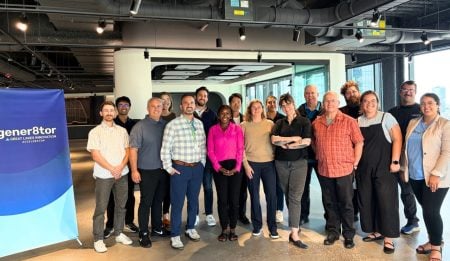
Matching the tempo of a high-speed business accelerator with an academic institution requires deliberate translation.
Startups in gener8tor’s intensive three-month program move at breakneck speed. Academic faculty, on the other hand, balance grant deliverables, teaching schedules, and long-term research cycles. As the primary liaison, Henderson helps bridge those timelines—negotiating project scopes so founders get quick answers while respecting faculty commitments.
However, that collaboration starts long before a startup works with the GLRC. During the Great Lakes Innovation Accelerator recruitment cycles, the GLRC team sits in on startup interviews as “technical interrogators,” vetting engineering feasibility and real-world durability before gener8tor selects the next cohort.
Once in the program, founders undergo a rapid transformation.
A major value of gener8tor’s curriculum is teaching technical founders how to craft clear, efficient requests. Over three months, you see incredible growth—watching founders evolve from asking broad, vague questions to bringing us highly focused, actionable development asks.
Putting Assets to Work: Real-World Proving Grounds
Instead of testing hardware in controlled lab tanks, startups gain direct access to the GLRC’s Marine Research Assets Facility (MRAF), shared laboratories, and field equipment. This setup ensures gear that might otherwise collect dust between scientific expeditions is constantly putting in work for the blue economy, giving founders authentic environments to test their innovations under real operating conditions.
Lasting Value Beyond the Lab
This collaboration isn’t just about supporting five startups for three months—it builds long-term momentum across every level of our mission.
On campus, it supports graduate research positions, generates revenue to maintain shared lab facilities, and gives Michigan Tech students front-row exposure to real-world tech commercialization. For Great Lakes communities, it means faster access to tools that protect coastal infrastructure—whether that’s predicting sewer overflows, monitoring aging seawalls, or tracking water quality in real time.
And because freshwater security and climate resilience are global challenges, testing these innovations in the demanding conditions of Lake Superior ensures that the solutions developed right here in the Keweenaw are ready to protect ecosystems around the world.
What’s Next
Over the coming weeks, we will dive deep into a few of the AI-driven startups in the current cohort. Stay tuned as we take you behind the scenes to explore their tech, their work with the GLRC, and how they are building the future of freshwater innovation.
Located on Michigan Tech’s campus in Houghton, Michigan, the Great Lakes Research Center (GLRC) leads in interdisciplinary research excellence. Situated in a 55,000-square-foot waterfront facility opened in 2012, the GLRC is a dynamic part of Michigan Tech’s landscape as an R1 public research university. Home to five specialized research centers, the GLRC drives innovation across water, land, climate, and community systems.