

From the snowy roads of Houghton to innovation hubs across the globe, Michigan Tech alum Peipei Zhao ’09 embodies Michigan Tech’s ethos of innovation, resilience, and fearless leadership where technology meets real-world impact.
The College of Business alumnus, who earned his master’s degree in Applied Natural Resource Economics, was shortlisted for the 2025 Reuters Automotive D.R.I.V.E. Visionary Leader Award. Zhao, the president of RoboSense North America, was honored and humbled to be among the nominees for the annual awards, which celebrate excellence in automotive innovation and leadership. Zhao’s nomination for executive excellence highlights his efforts to advance LiDAR technology and places him alongside leaders from global automotive giants such as BYD and General Motors—a remarkable achievement for a young leader in a rapidly evolving field.
“Even being shortlisted felt like a victory,” said Zhao. “We’re much smaller than our competitors, but we’re proving that innovation and agility can rival scale.”
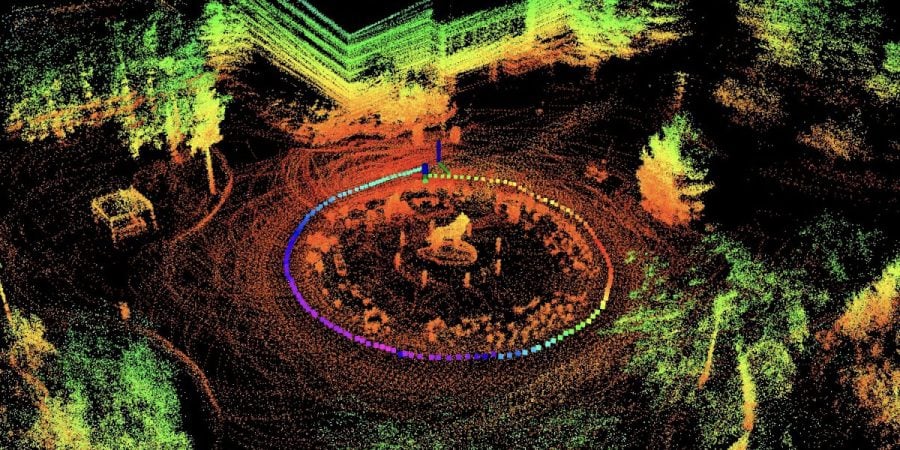
LiDAR—short for light detection and ranging—uses laser pulses to measure distances and produce precise 3D maps of the environment. Initially developed in the 1960s for space exploration, it now powers technologies that touch nearly every part of modern life. In vehicles, it enables emergency braking and semi-autonomous driving, detecting obstacles more than a quarter mile ahead. Beyond transportation, LiDAR supports warehouse automation, smart logistics, consumer robotics, and privacy-preserving security systems that can predict behavior without revealing identities. “LiDAR has evolved from aerospace applications into something that keeps people safe in their daily lives,” Zhao said. “And we’re only at the beginning of its potential.”
Roots That Stretch from Tech to Detroit
Headquartered in Asia, RoboSense bases it North American operations in Michigan. “Michigan has more than a century of automotive expertise,” Zhao said. “Here, we have validation resources, a trusted supply chain and access to research collaborators. It’s the best place to build the next generation of intelligent mobility.”
Zhao played a key role in establishing company offices in Plymouth, Michigan and fostering partnerships with universities including his Michigan Tech alma mater and the University of Michigan.
Through RoboSense, Zhao supported research collaboration with Associate Professor Jeremy Bos of electrical and computer engineering at Michigan Tech, focusing on LiDAR sensing and validation.
A Customer-focused Leadership Philosophy
In an industry defined by precision, Zhao attributes his success to what he calls the “Three Cs”: competency, customer comfort, and confidence. For him, competency means delivering reliable, high-performance LiDAR systems designed for mission-critical applications. Customer comfort comes from building trust through transparency, collaborative support, and the responsive reliability of U.S.-based teams. The final pillar, confidence, underscores the importance of demonstrating long-term viability and innovation in a rapidly evolving technology landscape.
“Customers don’t just want cutting-edge technology, they want partners they can count on,” Zhao said.
Looking toward the future, Zhao sees LiDAR expanding beyond premium vehicles into everyday robotics, smart cities, and same-day logistics. He predicts double-digit adoption of LiDAR in cars by 2035.
Finding His Home in the Heart of Keweenaw
A native of China, Zhao came to Michigan Tech seeking a university that values both technological and business acumen. For more than 95 years, the College of Business has taken advantage of its position at a STEM-focused university to provide students with technology-forward programs.
“I still remember my first call with Professor Gary Campbell. He told me they admit students who are suitable, not just excellent. That conversation convinced me this was the right place.”
— Peipei Zhao ’09, MS Applied Natural Resource Economics
At Tech, Zhao learned to merge engineering principles with business strategy, a combination that has guided his career in commercializing complex technologies. He also credits Christa Walck, emerita faculty member and former dean of what was then the Michigan Tech School of Business and Economics, for teaching him about corporate social responsibility. The lesson continues to shape his leadership philosophy today.
“Michigan Tech taught me resilience, critical thinking, and the importance of doing business responsibly,” Zhao said. “Those soft skills are just as essential as the technical ones.”
About the College of Business
The Michigan Tech College of Business prepares tomorrow’s business professionals through STEM-infused, AACSB-accredited degree programs and minors. The college offers nine bachelor of science programs in accounting, business analytics, construction management, economics, engineering management, finance, management, management information systems, and marketing; and four master of science programs in accounting and analytics, applied natural resource economics, engineering management, and the TechMBA®.
Questions? Contact us at business@mtu.edu. Follow the College of Business on Facebook, Instagram, and LinkedIn.