
Category: Research

Architect of a Wider Table: The Expansive Legacy of Sonia Goltz

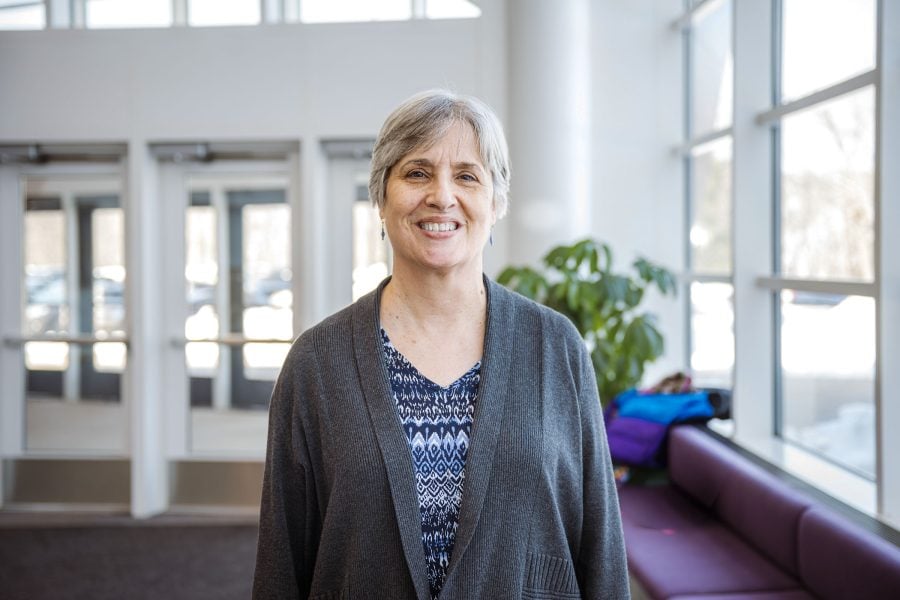
A Michigan Technological University Professor Emeita smiles at the Rozsa Center for the Performing Arts as people gather to celebrate her 30-year career.
Professor Sonia Goltz looks back on her career at Tech with a sense of fulfillment in what she’s accomplished and looks forward to a future that includes time for more writing and other creative pursuits—like her garage band.

Sonia Goltz doesn’t like to give the same presentation twice—but her support for students, colleagues, and community has been a constant since she came to the College of Business in 1996.

Recently named a professor emerita for her 30 years of distinguished service to the University and College, the trajectory of Goltz’s legacy is less of a straight line than it is an ever-expanding circle encompassing the people and places that have been positively impacted by her research, teaching, and service.
Goltz has taught dozens of courses at Michigan Tech, including classes in organizational behavior and change and human resources management. As a key committee chair, Goltz has also been a fundamental contributor to College of Business accreditation renewals. The 2021 co-recipient of the Michigan Tech Diversity Award, Goltz was co-principal investigator on a National Science Foundation ADVANCE Adaptation grant for Michigan Tech. In 2022, she was named the Mickus Endowed Faculty Fellow of Business Impact.

Goltz’s fascination with organizational behavior and why people do what they do began in Plainfield, Indiana, where her father worked with troubled youth at the Indiana Boys School, utilizing a system of rewards and reinforcements to reach students whom the rest of the world had written off. His success was so profound that a psychology professor from the University of Indianapolis visited his classroom just to see the results.

That same professor would later become Goltz’s undergraduate advisor, guiding an interest that led her to Purdue University for her PhD and eventually to the University of Notre Dame. By the time she arrived at Michigan Tech, Goltz’s career was moving from studies on the escalation of commitment—the psychological trap of throwing good money after bad—toward research at the forefront of gender equity, social power, and the subtle, often invisible ways that coercion operates within professional structures. 

In 2009, she was promoted to full professor, and her impact began to radiate far beyond the Keweenaw Peninsula. With citations exceeding 100 annually and numerous best paper awards, Goltz became a leading voice in understanding how organizations either raise people up or keep them down. Along the way she provided that uplift to her hundreds of students and many colleagues. And her no-repeat policy on presentations became a generator of new conversations and avenues of thought that inevitably drove her research forward.

In this Q&A, Goltz shares how she came to Tech, the message she has for colleagues and students, and shares a future that includes grandkids, gardening, and her garage band.

Q: What brought you to Tech from Notre Dame and what’s kept you here for a 30-year career?

SG: Notre Dame is a great school in many ways, but when I was there, it was not a good place to establish a career as a female faculty. We were only about 10% of the faculty in their college of business at the time and we had little support on a variety of fronts. For example, there was no maternity leave and there was no stop-the-tenure-clock policy for having children. The small female faculty cohort that was there with me in the late 80s and early 90s all left in one way or the other.

It was a painful time, but the experience helped me with my gender equity work here at Michigan Tech. It motivated me to start it and it gave me an understanding of how inequities operate.

When I was on the market, Michigan Tech had a job opening in my field. I knew someone who was here who had previously worked with me at Notre Dame. Also, my husband (Jim Northey) had thought about going here as an undergraduate and encouraged me to apply.

We told ourselves, “We will give it two years and see.” It was tough for us then because his job was in Chicago and remote work was not technologically feasible or culturally accepted back then. Well, we have been here for 30 years now.

Besides liking the area, which is very beautiful, I was treated more like an equal than an oddity by the faculty here. Also, the size of the university and School of Business (it was still a School back then) was good for forming bonds between faculty and with students.

Q: You’ve been very involved in both academia and the community. What have been some of the most memorable experiences? (If you wanted to say anything about 101 Quincy Coworking feel free!)

SG: Some of the more memorable experiences were when I was called in for some HR consulting in the local community. Usually it was when the organization had an issue with personnel. I’m not going to say I liked being involved in tough personnel issues, but I am glad I could be of some help. I also have served on some boards and volunteered in various capacities.

We own 101 Quincy, which has the co-working space and also several other businesses. We acquired it when my husband and son’s startup had to relocate from the business incubator in Hancock. It’s a very old building. When we first got it, it still had a lot of historical documents stored in the various bank vaults in it. Many of those were donated to the Keweenaw National Historical Park and others went to the Michigan Tech Archives.

We have been renovating the building over the past 10 years or so. I help do some weekly maintenance work there (cleaning, plant watering). I also have a space on the third floor, which is where our band practices in the winter. We are a true garage band in the summer that plays with the garage door open, but we need an enclosed building in the winter. I also have a desk there and have done some writing. I’m sure I will be hanging out there more after retirement.

Q: What are you most looking forward to post-Tech? Do your plans include consulting as well as gardening and grandkids?

SG: No, it is not in my plans to consult, but I am willing to share my expertise if asked. Once, in the past, I made a presentation about leadership for a local hospital group and confused them when I kept referring to “OB” because it meant something different to them (obstetrics) than to me (organizational behavior).

I want to spend more time on some hobbies I haven’t had much time for. Many are on the creative side, such as art, music, and poetry, besides gardening. I have been learning to play the harmonica this past year and have been doing that in a band that Holly Hassel in the humanities department pulled together about a year ago. We are all women and all faculty or previous faculty on the older side of things, so we call ourselves “A Certain Rage.”

I also plan to continue to write, but using a different platform. You can find me on Medium—I’m launching a series there.

Our grandchildren give us much joy–we have eight. It will be easier to see them now, hopefully, although the older ones are pretty busy with work and sports. Our oldest grandchild is finishing his first year at Tech and the youngest one is just a few months old. The best thing about them is that they make us laugh. One told me I’m a Disney Princess to her. Although that has never been my aspiration, it made my day.

Two professors in the Michigan Tech College of Business smile in front of a glass case displaying red ties sent to the College by their business students who have earned their CPA credentials.
Goltz shares a light moment with Dean Johnson, College of Business dean, in front of the case displaying the Tidwell Ties, red ties shared by business students who have earned their CPA credentials.

Q: Any parting words for your colleagues at Tech?

SG: I appreciate very much how hard my colleagues have worked to teach students and conduct their research and yet they are very friendly and collegial. So I would like to thank them for their dedication. I encourage them to hang in there when things get tough. Our careers are a mix of great times and tough times but we do eventually get through it all. Looking back, I’m satisfied with what I accomplished, and I think they will be too when they get to that point.

Q: Any message you’d like to leave with the students you’ve mentored over the years?

SG: To the students I personally taught, thank you for letting me be a small part of your lives and I wish you the best. It has been an interesting experience to witness young people of all kinds entering their adult years. I want all our students—past and current—to know that their faculty is very committed to their learning.

“We try to give you the tools you need to start your careers. We really do want you to be successful. Your success means more than your career achievements, of course. We want you to be able to put together a life that gives you meaning.”

— Sonia Goltz, Professor Emerita, College of Business

For our current students, I want them to know that although there is a lot of uncertainty going on today, they will be able to ride this wave. They are resourceful. They are persistent. They will need to rely more and more on their flexibility of thinking and interpersonal skills. They will need to be able to pivot if what they planned to do doesn’t pan out. These have always been important skills, but are even more important now. Things will settle at some point and they will find that they have survived a lot of change successfully.

Q: You’ve helped to shape the College of Business at Tech. What changes do you hope to see in the future and what is it about the College that you hope will stay the same?

SG: I was happy that I could play a small role in the evolution of the College of Business. There definitely is still a lot of change in the future of the COB as it strives to meet the demands of various stakeholders with the resources it has been provided. Its greatest resource, of course, is its people. There is a culture of dedication but also a joie de vivre. I hope that will continue.


 About the College of Business

The Michigan Tech College of Business prepares tomorrow’s business professionals through STEM-infused, AACSB-accredited degree programs and minors. The college offers nine bachelor of science programs in accounting, business analytics, construction management, economics, engineering management, finance, management, management information systems, and marketing; and four master of science programs in accounting and analytics, applied natural resource economics, engineering management, and the TechMBA®.Questions? Contact us at business@mtu.edu. Follow the College of Business on Facebook, Instagram, and LinkedIn.

Huskies Provide Marketing Solutions Close to Home

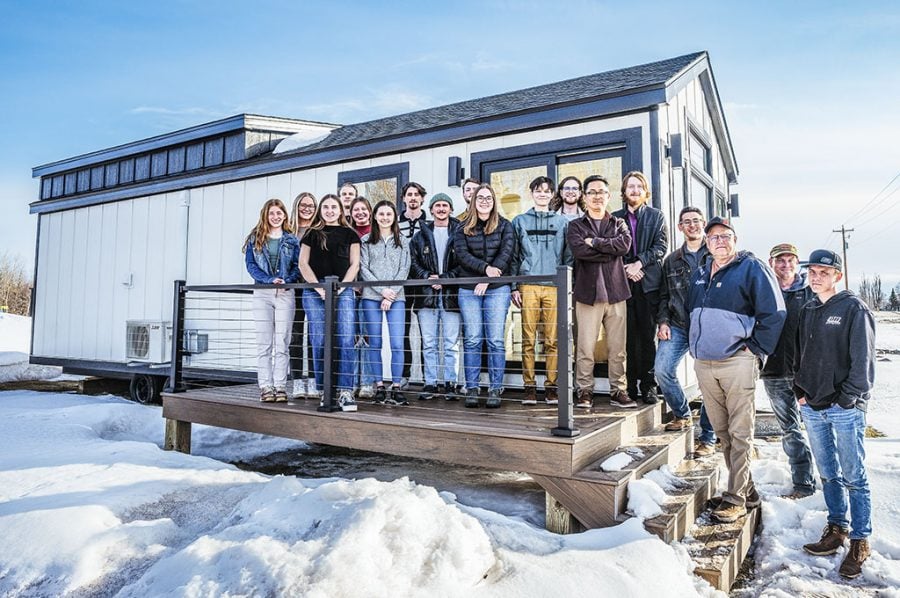
17 people stand on the porch of a model mini home surrounded by snow including a dozen students from Michigan Tech’s marketing capstone class, their professor, and Brockway Mini Homes team with a blue sky in the background and a car passing by on the road.
The College of Business marketing capstone class, complete with professor Soonkwan Hong, joins Brockway Mini Homes on the porch of the company’s model home.

Michigan Tech students are known for working with real clients to develop their professional skills and bring fresh perspectives to clients. That’s what Soonkwan Hong’s capstone course in marketing strategy is doing for a local construction company branching out into the small homes market.

Elham Asgari and Co-Authors Win Tariq Farid Franchise Institute Award for Best Paper

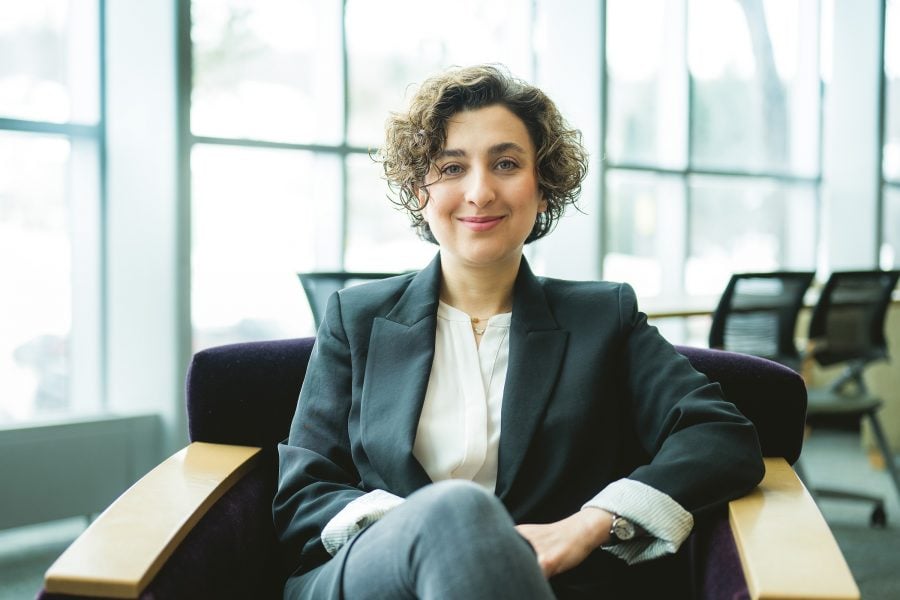
Elham Asgari, assistant professor of management and entrepreneurship in the College of Business, and co-authors Richard A. Hunt and S. M. Abidul Islam were awarded the Tariq Farid Franchise Institute Award for Best Paper on the Topic of Franchising at the 2024 Babson College Entrepreneurship Research Conference (BCERC). The award will be presented at the 2025 BCERC Conference, June 4-7 at Babson College.

The award-winning paper is titled, “Franchising in the Metaverse: Entrepreneurial Pathways for Virtual and Mixed Reality.” An abstract of the paper is below.

Asgari’s research interests include corporate entrepreneurship, technological innovations, star employees, and the small satellite industry. She is a Charles C. and John G. Gates Professor in Entrepreneurship and Innovation.

Soonkwan Hong Is Editorial Advisory Board Member of Journal of Social Impact in Business Research

Michigan Tech campus in the fall.
The Michigan Tech Campus in the fall season

Soonkwan Hong, associate professor of marketing in the College of Business, is an invited editorial advisory board member of the Journal of Social Impact in Business Research, which was founded in July 2024.

The journal explicitly responds to AACSB’s new standards, which underscore “Societal Impact” as encompassing “…activities undertaken by business schools that over time lead to meaningful, discernible change for the betterment of people, economies and the environment” (AACSB and Societal Impact: Aligning With the AACSB 2020 Business Accreditation Standards, February 2023, p.2).

Gary Campbell, Professor of Natural Resource Economics, Discusses Resources Policy Journal in Podcast

Gary Campbell, Professor of Natural Resource Economics

Gary Campbell, Professor of Natural Resource Economics in the College of Business, was recently a guest on the podcast “Journals 101,” which hosts discussions about the world of academic publishing.

The podcast was hosted by Dr. Brian Lucey, professor of international finance and commodities, at Trinity College, Dublin, Ireland.

Gary Campbell, Professor of Natural Resource Economics

Gary Campbell, Professor of Natural Resource Economics in the College of Business, was recently a guest on the podcast “Journals 101,” which hosts discussions about the world of academic publishing.

The podcast was hosted by Dr. Brian Lucey, professor of international finance and commodities, at Trinity College, Dublin, Ireland.