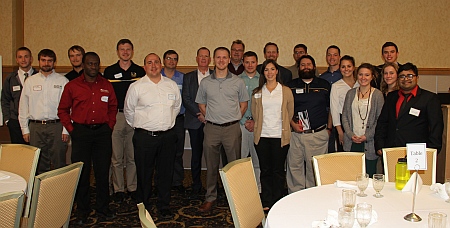
Civil Engineering Alumnus, Kathryn Lynnes, Is Doing her Part to Cleanup the Environment

Kathryn Lynnes is a 1979 graduate of Civil Engineering at Michigan Tech.

Inspired to get involved in environmental cleanup following a eye-opening experience in her youth, Michigan Tech alumnus Kathryn Lynnes has spent her career doing just that.  After years of working as an environmental consultant for private industry and municipal government, Lynnes is now the new senior program manager for the Kirtland Air Force Base fuel spill cleanup.  To read more about Kathryn Lynnes, her career, efforts and her baseball memorabilia, visit: http://www.abqjournal.com/699538/news/kafb-gets-major-league-help-on-spill.html

Michigan Tech SHPE Chapter heads to Detroit to spread the word about engineering

FamEngin Flyer AoA Nov.23.2015

While some folks are planning to relax over the Thanksgiving break, the Michigan Tech Student Chapter of the Society of Hispanic Professional Engineers (SHPE) will be spreading the word about engineering as a possible STEM career path. The MTU students will conduct a Family Engineering event on November 23 at the Academy of the Americas in Detroit. A free supper for families will be provided3:45-4:30 pm in the school cafeteria.Families will attendthree 35-minute activities from 4:30-6:30 pm. This event is made possible with a grant from John Deere to the Michigan Technological University Center for Science & Environmental Outreach who is helping the SHPE chapter prepare for this event. Michigan Tech is a co-developer of the Family Engineering program, along with the Foundation for Family Science & Engineering and the American Society for Engineering Education. To learn more, visit: http://www.familyengineering.org/  For more information, contact co-author Joan Chadde, Director, Michigan Tech Center for Science & Environmental Outreach, at 487-3341 or jchadde@mtu.edu    FamEngin Flyer AoA Nov.23.2015

Western Upper Peninsula Center for Science, Mathematics, and Environmental Education Teaches Kids About Energy-Saving Habits

Mystery Solved Gazette 11.04
Dan Roblee/Daily Mining Gazette Children attending the Sherlock “Homes” Energy Detective family science night at the Portage District Library check water temperatures to test the success of ice-cube insulator engineering projects (from right, Elena Tsenova, Christina You, mom Cheryl Kiley and Joshua You).

Mystery solved: Sherlock ‘Homes’ event teaches energy-saving skills for all ages

The Western Upper Peninsula Center for Science, Mathematics, and Environmental Education along with the Houghton Energy Team and Michigan Tech hosted an event at the Portage Lake District Library to teach kids the importance of energy-saving skills.


Environmental Engineering Seminar: Toward New Age Modeling and Management of Nuisance Cladophora in the Great Lakes

Slime

Toward New Age Modeling and Management of Nuisance Cladophora in the Great Lakes
Monday, November 2, 2015
3 PM
202 Great Lakes Research Cener

Anika Kuczynski, Ph.D. Candidate, Department of Civil & Environmental Engineering, Michigan Tech

Abstract:

A native to the Great Lakes, Cladophora glomerata is a filamentous, green alga that has proliferated and caused nuisance conditions especially in the lower Great Lakes, both historically and in the 21st century. Depending on currents affected by wind speed and direction, algal mats may clog cooling and drinking water intakes or wash up on beaches. The decaying plant material produces offensive odors and provides favorable environmental conditions for hosting pathogens. While Cladophora was not the target for P abatement, which began in the late 1970s, its biomass levels appeared to decrease by the early to mid-1980s in Lake Ontario. With the return of nuisance conditions since the zebra and quagga mussel invasion and an altered system at hand, current field monitoring and modeling efforts are necessary to establish a new baseline understanding and appropriate management approaches in this new age. The objectives of this dissertation will be 1) to establish that there has, in fact, been a Cladophora resurgence in the Great Lakes and to quantitatively characterize that resurgence and management implications, 2) to define a phosphorus standard or substance objective for Cladophora management in the Great Lakes; and to demonstrate the application of linked hydrodynamic-phosphorus-Cladophora modeling to define management strategies in two case studies, 3) the Ajax, ON nearshore of Lake Ontario and 4) the eastern basin of Lake Erie.


D80 Conference 2015: Making Connections

d80-logo-v1The 9th Annual D80 Conference, Making Connections: The Past, Present and Future of Design, was held Saturday in the Dow Building.

As a dialog and celebration of student efforts to solve issues that confront the world’s poorest 80 percent, this year’s conference featured presentations by the following: Pavlis Institute, Engineers Without Borders, Peace Corps Master’s International, Efficiency through Engineering and Construction Enterprise and International Senior Design. In addition, a faculty panel discussed the history of appropriate technology and design.

View Pictures of the 2015 D80 Conference on Flickr Photo Gallery

  • Welcome: Dr. Lorelle Meadows, Dean, Pavlis Honors College
  • Into India 2015 (J. Barker, S. Curtis, J. Cavins, E. Fernandez, Pavlis)

  • Quebrada Pastor Water Distribution System (D. Benoy, C. Carbary, A. Crispo, M. Ziols, iDesign)
  • Water Supply for Guatemalan Communities (R. Dougherty, EWB)
  • Water Sources in Valle Escondido, Panama (K. Blodgett, H. Henderson, K. Jung, D. Oldani, iDesign)

  • Our Experiences in Ghana and Tanzania (M. Cromie, J. Seaser, Pavlis)
  • Bridge Design for Quebrada Caracol, Panama (S. Lopez, J. Mathieu,, A. Romenesko, J. Schmitt, Y. Zeng, iDesign)
  • Houghton County Energy Efficiency Team (K. Abbott, L. Artman, ECET)
  • Keynote Panel: How Does Change Happen? Cases in Technology and Design

    • Sarah Fayen Scarlett – Introduction
    • Jonathan Robins – “175 years of Appropriate Technology: The West African oil palm industry in historical perspective”
    • Steve Walton – “The Rise and Fall of Appropriate Technology? How the social impacts the technical”
    • Laura Walikainen Rouleau – “Designing a Public Privacy: The Social and Cultural Construction of Public Restrooms in the United States”
    • Kari Henquinet – Comments and Q/A
  • Clean Water for Quebrada Caracol, Panama (M. Cherng, N. Rademacher, S. Stoolmiller, iDesign)

  • Water Supply in Quebrada Pinzón, Panama (J. Mack, R. Sachar, S. Thakur, N. Wienold, iDesign)
  • Workshop: Drill, Baby, Drill: Water Wells in Developing Contexts (E. Kunik, A. Wohlgemuth, PCMI)

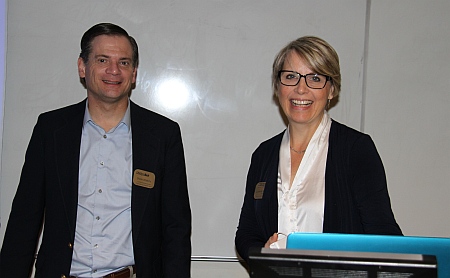
Lorelle Meadows, Dean, Pavlis Honors College with David Watkins, CEE

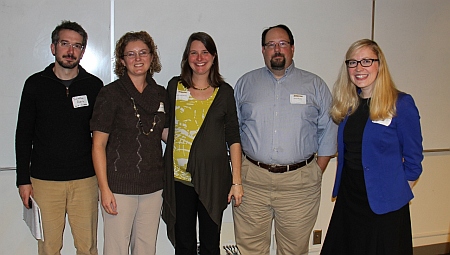
Jonathan Robins, Kari Henquinet, Sarah Fayen Scarlett, Steve Walton,  Laura Walikainen Rouleau: D80 Keynote Panel: How Does Change Happen? Cases in Technology and Design
Jonathan Robins, Kari Henquinet, Sarah Fayen Scarlett, Steve Walton, Laura Walikainen Rouleau: D80 Keynote Panel: How Does Change Happen? Cases in Technology and Design

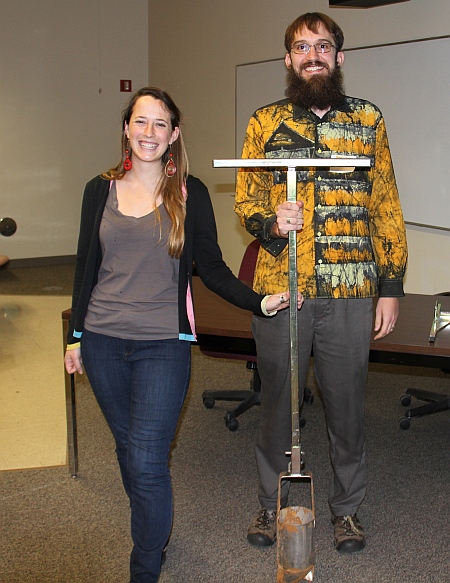
Workshop: Drill, Baby, Drill: Water Wells in Developing Contexts (E. Kunik, A. Wohlgemuth, PCMI)

View Pictures of the 2015 D80 Conference on Flickr Photo Gallery

Videos of the 2015 D80 Conference

Visit online more information.

An archive of past D80 Conferences
2014

2013

2012

2011

2010

2009

2008

2007

Rail Day Expo at Michigan Tech

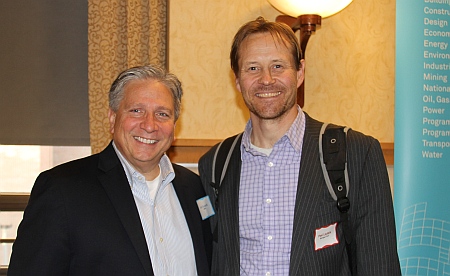
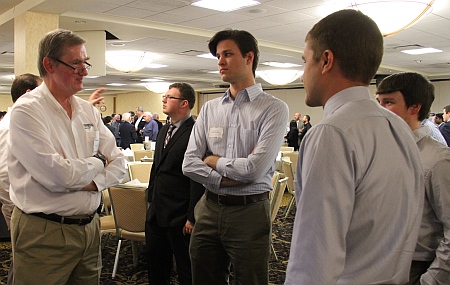
IMG_5208450The Rail Day and Expo is an awesome opportunity for both students and industry! Railroad companies and consultants have the opportunity to showcase the industry and the career opportunities available. This is also a targeted recruiting opportunity for the industry … students who attend already have some interest in railroading. For students, this is an opportunity to have focused discussions about the rail industry and what it has to offer.

Railroad Night is a networking opportunity for both industry representatives and students. The event features a relaxed evening of dining and conversation.

Mr. Art Guzzetti, Vice President-Policy of the American Public Transportation Association was the keynote speaker and provided a personal touch and insight into the rail industry.

Art Guzzetti, Vice President - Policy, American Public Transportation Association and Pasi Lautala, Director of Rail Transportatio 11th Annual Railroad Night at Michigan Tech
Art Guzzetti, Vice President – Policy, American Public Transportation Association and Pasi Lautala, Director of Rail Transportatio 11th Annual Railroad Night at Michigan Tech

According to the APTA website, Guzzetti is a 32-year veteran of public transportation at the local, state, and national levels.

Among other things, Guzzetti is responsible for APTA’s extensive policy research agenda, policy analysis and development, transportation information, and statistics. He and the APTA team work with the legislative and executive branches of all levels of government and with other national associations, think tanks, and interest groups to cultivate the ideas, relationships, and advocacy initiatives that will propel public transportation forward.

Prior to coming to APTA in June 1997, Guzzetti spent 16 years in management at two of the nation’s leading public transportation systems—New Jersey Transit Corporation and Pittsburgh’s Port Authority of Allegheny County—along with two years at New Jersey DOT. His duties focused on transportation policy, government affairs, capital programming, grants development, and grants management and advocacy. In short, the focus of his career has been on generating support for public transportation and the benefits it provides to communities and regions. Guzzetti has a political science degree from Edinboro State University and a master of public administration from the University of Pittsburgh.

Railroad Night is a networking opportunity for both industry representatives and students.  The event features a relaxed evening of dining and conversation.
Railroad Night is a networking opportunity for both industry representatives and students. The event features a relaxed evening of dining and conversation.

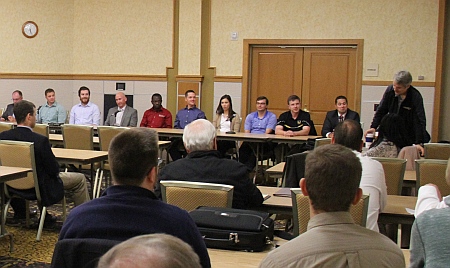
Michigan Tech Rail Industry Panel at Rail Day

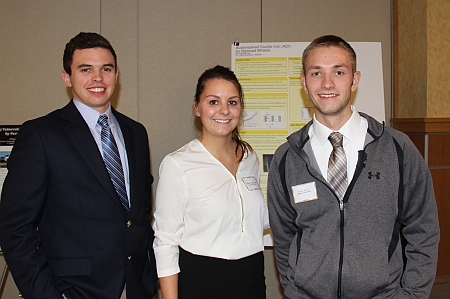
11th Annual Railroad Night at Michigan Tech:  Railroad Engineering and Activities Club at Michigan Tech,  Aaron Dean, Webmaster, Alex Lakenen, President, Derek Owen, Marketing Chair
11th Annual Railroad Night at Michigan Tech: Railroad Engineering and Activities Club at Michigan Tech, Aaron Dean, Webmaster, Alex Lakenen, President, Derek Owen, Marketing Chair

Michigan Tech Rail Industry Alumni at the 11th Annual Railroad Night

See more photos at the Rail Day Gallery

MORE INFORMATION

Videos of 11th Annual Railroad Night and Rail Expo Day

Civil and Environmental Engineering Joint Graduate Seminar

oct15cee2Civil and Environmental Engineering Joint Graduate Seminar
Thursday, October 15, 2015,
4-5pm, Dow 642

Title: A Tale of Two Careers in the Same Field

By: Dr. Kerry J. Howe, P.E., BCEE

Abstract

Completing a graduate degree in civil and environmental engineering opens the door to a variety of career paths: government agencies, consulting firms, universities. Dr. Howe has worked extensively in two of these arenas. First, as a design engineer for the engineering firm that is now Montgomery Watson Harza. After a 12-year stint there, he completed a PhD degree and starting working as a professor at the University of New Mexico, where his research has focused on membrane technologies, desalination, and water reuse, including the use of reverse osmosis and ozone/biofiltration to treat wastewater for water reuse applications. This presentation will use case studies from his career to describe a typical design project done by consulting engineers and a typical research project at a university. The presentation will then describe the skills needed by civil and environmental engineers in both career paths, and describe the similarities and differences between consulting engineers and academicians.

Biography

Dr. Howe is a professor and regents’ lecturer at the department of civil engineering, University of New Mexico. Dr. Howe is also a registered professional engineer (P.E.) and a board certified environmental engineer (BCEE) by the American Academy of Environmental Engineers. Prior to studying for his doctorate degree at University of Illinois at Urbana-Champaign Environmental Engineering, Dr. Howe worked for environmental engineering consulting firms for more than 12 years. During his time in consulting, he worked as project engineer or project manager on a wide variety of projects related to water treatment engineering, including treatability studies, regulatory compliance evaluations, facility evaluations, master plans, pilot studies, predesign, detailed design, construction management, and plant startup. His practical engineering experience has a strong influence on his research and teaching activities. He is a co-author of the textbooks Principles of Water Treatment and MWH’s Water Treatment: Principles and Design. Dr. Howe is a director for Center for Water and the Environment from the National Science Foundation Centers for Research Excellence in Science and Technology (CREST) program.

Lake Superior Water Festival

IMG_4231aby Joan Chadde

Nearly 500 high school students, in 19 classes from 11 schools in Houghton, Baraga, Gogebic and Ontonagon Counties will flood Michigan Tech’s Great Lakes Research Center today. The GLRC will be a hopping place on from 8:45 a.m. to 2:45 p.m. today for the Fourth Annual Lake Superior Water Festival. More than 15 different sessions will be offered throughout the day, presented by Michigan Tech faculty, staff, students, community organizations, government agencies, authors, artists and photographers.

The Water Festival provides an opportunity for students to learn about and celebrate our most precious natural resource – clean, fresh water. The Festival also serves to inspire interest in STEM careers in science, technology, engineering and math.

The 2015 Water Festival is made possible with funding from Earth Force, Michigan Tech Center for Water & Society, the Great Lakes Stewardship Initiative, and Lake Superior Stewardship Initiative.

See the 2015 Lake Superior Water Festival Photo Gallery

Lake Superior Water Festival Sep 30, 2015 at Great Kajes Research Center at Michigan Tech

Environmental Engineering Graduate Seminar: Air Pollution in Iran; A Case Study

sep21Environmental Engineering Graduate Seminar: Air Pollution in Iran; A Case Study
Monday, September 21th; 202 Great Lakes Research Center

Hossein Tavakoli, PhD Student, Michigan Tech Department of Environmental Engineering

Biography – I am a PhD student in Environmental Engineering with focus on air pollution. studying Environmental Engineering, I could see how air pollution had surrounded millions of people and it seemed policy makers were incapable. Picturesque Alborz hillsides, in which Tehran (Capital City) is located, were lost in smog. In the last 3 years, up to 7000 deaths in Tehran are caused by Airborne Particles. As a part of my research I have investigated the effects of air pollution of a steel complex -a case study- on surrounding area using air pollution dispersion modeling (AERMOD and CMB8.2); I have then investigated concentrations of PM10 in ambient air and Arsenic in air, water, soil, rice and meat downstream of the steel plant. In addition, I have studied lifetime risk assessment of Arsenic due to inhalation, ingestion and dermal exposure for residents.
Environmental issues regarding air pollution in Iran include, especially in urban areas, vehicle emissions, refinery operations, huge dust swirl from Iraq and industrial effluents which contribute to poor air quality. Industrial nature and the status of its environmental issues, regulation and management in Iran will be presented to expand the world vision of a developing country.
========================================
A regularly updated seminar schedule and download capabilities for Roundtable Discussion papers is available on CANVAS under ENVE5991 R01 Fall 2015.

sep21v

sep21w

Environmental Engineering Seminar: Environmental Systems Biology of Marine Oil Biodegradation

sep14Environmental Systems Biology of Marine Oil Biodegradation
Monday, September 14th 3 pm
202 Great Lakes Research Center

Dr. Stephen Techtmann , Assistant Professor
Michigan Tech Department of Biological Sciences

Biography – I am an environmental microbiologist who studies microbial communities in diverse ecosystems. Microbes (Bacteria and Archaea) are ubiquitous in the environment and play essential roles in the cycling of elements. These environmental microbes are capable of catalyzing a wide array of chemical reactions, many of which may have industrial applications. I study how complex microbial communities can cooperate to perform functions of industrial interest. The majority of microbes in the environment are difficult to grow in the lab. Furthermore, many industrially-relevant pathways are found in microbes not yet grown in the lab. I seek to employ both culture-based and culture-independent methods to understand how these microbial communities respond to anthropogenic activity and environmental change and how we might leverage these microbes for a biotechnological application. In the past, I have investigated how microbes from hot springs and geothermal vents could be used for biofuel production. Most recently, I have focused on microbial communities that respond to and aid in the clean up of crude oil contamination. I am also interested in engineering environmental microbes and microbial communities for enhanced biofuel production. I employ a combination of geochemical techniques, next-generation sequencing and other ‘omics approaches, with microbial physiology and biochemistry to better understand these microbial systems.