
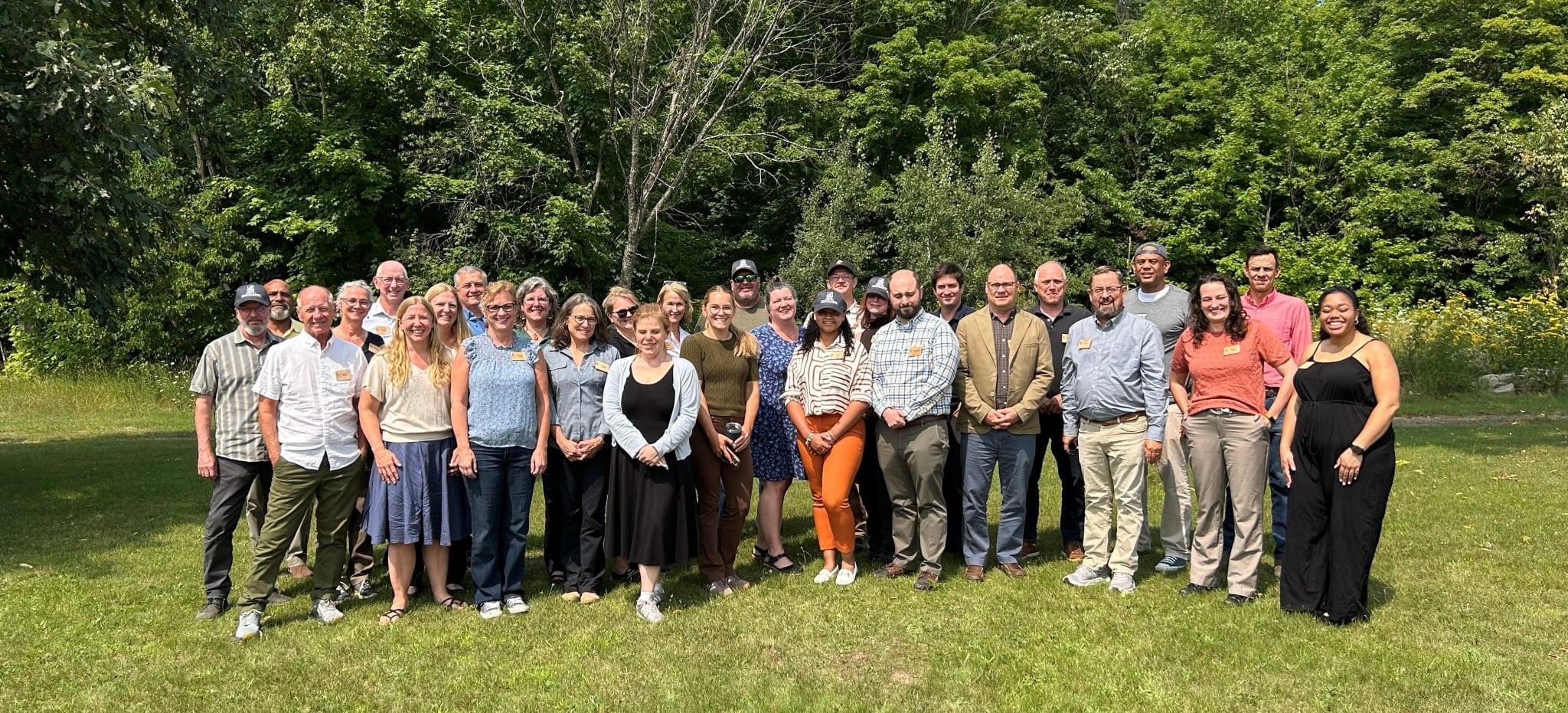
In a guest blog written by Tara Bal, associate professor in the College of Forest Resources and Environmental Science and President of the Society of American Foresters (SAF), shares insights from SAF’s ForestNext50 Leadership Summit.
Last week, I had the opportunity to participate in the ForestsNext50 Leadership Summit, which took place at Tech’s Ford Center and Research Forest in Alberta, Michigan. This gathering felt less like a standalone event and more like the next positive step in a conversation that has been building across the forest sector for many years. The goal of the convening was to discuss and identify actions aimed at sustaining healthy U.S. forests over the next 50 years.
ForestsNext50 was an opportunity to take previous conversations in forestry a step further by moving from talking about the future to making plans to build it. Earlier this year, I was also able to attend the Markets Matter Convening in Madison, Wisconsin, which brought together hundreds of people from across the forest sector to focus on a fundamental question: How do we strengthen markets, sustainably increase use of forest resources, create new opportunities for material that is currently underutilized, and increase science-based forest management on the ground? The 9th American Forest Congress was also held in 2025 and brought people together around the future of forests, forest management, and the communities and economies that depend on them.
Building on momentum from these other recent events, ForestsNext50 was designed for more candid discussions and strategic conversations to identify and commit to practical actions. We followed Chatham House Rules, which allowed participants to speak honestly about hard topics. Campfire chats in the evenings and breaks allowed partners to connect and dive deeper into conversations. Topics ranged from forest health restoration and wildland fire resilience, reforestation, wood markets and infrastructure, stewardship of non-federal lands, governance, and more.
About Chatham House Rule
The Chatham House Rule is a guiding principle that allows people to use information from a meeting while keeping speakers’ identities and affiliations confidential. Created in 1927 at Chatham House in London, the official wording is: “When a meeting, or part thereof, is held under the Chatham House Rule, participants are free to use the information received, but neither the identity nor the affiliation of the speaker(s), nor that of any other participant, may be revealed.” – Chathamhouse.org
One of the most valuable aspects of the summit was the opportunity to convene with people who have been part of these conversations and to meet others approaching the same challenges from different perspectives. There was a broad range of participants, representing over 30 different organizations, non-profits, public agencies, tribal communities, forestry professionals, and more, yet the total number of people in the room was around 40, so conversations felt like they went further. We could talk in a small group and share out easily. It was clear that the relationships and trust built between participants will have a significant impact on the future of forestry.
There was no shortage of ideas about what the future of forestry could look like. What was harder—and ultimately more important—was figuring out our next steps. That means moving beyond identifying the challenges to reach actions, including relationships, projects, investments, policies, research, and demonstrations that can address challenges and move the sector forward. For me, that is where the value of ForestsNext50 really stood out.
After three days of gathering, there was so much gratitude in the room for the time, reflections, and valuable ideas from the participants. It was also clear that folks were leaving with stated commitments and real actions for collaborations and partnerships that will continue after everyone goes home. Based on this meeting’s success, it is likely that there will be additional convenings going forward, allowing different voices in the room while continuing to build the relationships that will be crucial to projects and policies moving forward.
The value of events like ForestsNext50 isn’t simply the few days we spend together or getting another meeting in the books. The legacy of this and the meetings that preceded it will be what real actions flow from them. Michigan Tech College of Forest Resources and Environmental Science Dean David Flaspohler encapsulated this idea at the start of the conference.
“My great hope is that years from now, we will look back on this moment as a time when something truly impactful began, and the results, including healthier forests and a thriving renewable forest sector, will be the evidence of our collective success,” said Flaspohler.
Reaching those results requires following up with the people we met, continuing conversations that started in the room, working together, and turning shared priorities into specific next steps.
The forest sector is facing significant challenges, but there is also enormous opportunity to rethink how we manage forests, how we use forest resources, and how we build stronger communities and economies around them and within them. The conversations were not simply about where the forest sector is today. They were about what we can build together over the next five, 10, and 50 years, and what needs to happen now to get there.
ForestsNext50 reminded me that the future of forestry isn’t something that will simply happen to us. We have an opportunity, and a responsibility, to build it and help it grow. The work starts with what we do next.
Note: ForestsNext50 was facilitated by the USDA Forest Service National Partnership Office, Yale Forest Forum, and the Partnership and Community Collaboration Academy, and hosted by the Society of American Foresters and the College of Forest Resources and Environmental Science at Michigan Tech.
About the College of Forest Resources and Environmental Science
Michigan Tech’s College of Forest Resources and Environmental Science brings students, faculty, and researchers together to measure, map, model, analyze, and deploy solutions. The College offers six bachelor’s degrees in forestry, wildlife ecology and conservation, applied ecology and environmental science, natural resources management, sustainable bioproducts, and environmental science and sustainability. We offer graduate degrees in applied ecology, forest ecology and management, forest molecular genetics and biotechnology, and forest science.
Questions? Contact us at forest@mtu.edu. Follow us on Facebook, Instagram, and LinkedIn for the latest happenings.