
Tag: automation

From Dashboards to Decisions: AI for Business Information Systems

Your Business Systems Aren’t Just Software Anymore.

If you’ve ever thought, “Why does it take three dashboards, two spreadsheets, and a weekly meeting to answer a simple business question?” you’re already bumping into the problems that Business Information Systems are meant to solve. And you’ve probably already had a close encounter with how AI is changing the game.

A Business Information System (BIS) is the setup of tools, software, and processes organizations use to gather, store, and analyze business data. A BIS allows teams to understand information, such as sales trends, customer behavior, inventory levels, financial performance, and more.

Most organizations rely heavily on business information systems. Below are a few examples and their capabilities.

  • ERP (Enterprise Resource Planning): Integrates core operations (finance, purchasing, inventory, manufacturing, and HR) into one system (e.g., SAP, Oracle).
  • CRM (Customer Relationship Management): Manages customer data and interactions, such as sales pipelines, marketing campaigns, service cases (e.g., Salesforce).
  • HRIS (Human Resource Information System): Handles HR data and processes, such as payroll, benefits, recruiting, and performance (e.g., Workday).
  • SCM (Supply Chain Management): Plans and manages supply chain activities, such as procurement, logistics, warehousing, distribution.
  • BI (Business Intelligence): Tools for dashboards, reporting, and analysis to support decisions (e.g., Power BI, Tableau).
  • DSS (Decision Support System): Combines data and models to help evaluate options (pricing, capacity, risk scenarios).
  • WMS (Warehouse Management System): Tracks warehouse inventory, picking/packing, replenishment, and shipping.
  • POS (Point of Sale): Captures sales transactions in retail and often links to inventory and customer data.

The previous problem was this one: for the longest time, most of these systems still behaved like filing cabinets. They stored information, but they didn’t think with you. Or even like you.

But that scenario has been changing fast.

How AI for Business Information Systems Works (In Real Life).

That is, updated and new Business Information Systems are increasingly becoming adept at answering plain-English questions: Why are returns up? What’s driving churn? What happens if we change lead times? And then providing useful answers with recommended next steps.

These insights demonstrate how AI has transformed BIS. That is, instead of reporting only what happened, AI-enhanced BIS can learn from data, spot patterns, flag risks, forecast demand, and support better and quicker decisions through recommendations and automation. In other words, it can help teams move from “What happened?” to “What should we do next?”

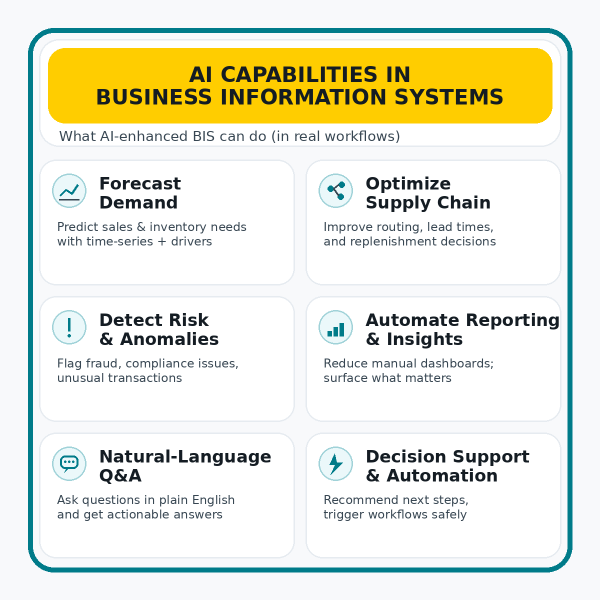
In day-to-day business operations, then, AI often shows up in several practical but high-impact ways:

  • Forecasting demand more accurately (so you’re not overstocked or out of stock)
  • Improving supply chain and logistics (inventory levels, shipping routes, lead times)
  • Assessing risk and detecting anomalies (fraud, compliance flags, unusual transactions)
  • Automating reporting and surfacing insights (less manual work, more usable information)
  • Helping teams interact with enterprise systems using natural language (ask a question, get an answer, think about next steps)
Some Recent Examples of AI Being Embedded into Platforms

Many organizations have already embedded AI into the software platforms on which they heavily rely.

Case Study: Embedding AI into CRM to Support Workflow and Reduce Response Times

Industrial Scientific’s support team was overwhelmed and morale was declining. Why? The team was handling upwards of 1,200 requests/month (device issues, troubleshooting, documentation). To fulfill these requests, employees often had to consult multiple departments. As a result, response times stretched to days, damaging the customer experience.

To solve this program, the organization built an AI support pipeline (“SensAI”) that connects Salesforce (CRM) with Oracle Cloud Infrastructure generative AI and a documentation knowledge base. When an inquiry lands in Salesforce, it triggers an automated workflow that uses RAG (retrieval-augmented generation) over product docs. Through Salesforce, it then returns a response that is tailored to the customer’s support contract.

As a result, response times dropped from days to minutes (near-immediate support for routine inquiries). The system responded to 2,230+ emails and cut 185+ hours of staff time, not only saving money but also reducing a ton of employee stress.

The Bottom line: AI is no longer just a tool on the side; it is quickly becoming the interface and accelerator for business systems.

Earn Michigan Tech’s Online Certificate in AI for Business Information Systems.

If you want to evaluate AI tools, implement them responsibly, and translate AI into measurable outcomes, you need a foundation in both AI concepts and business information systems. Michigan Tech’s online graduate certificate in AI for Business Information Systems is built to provide exactly that, demonstrating how AI integrates with core business systems to streamline decision-making, improve accuracy, and drive cost savings.

In just 9 credits, you’ll complete two required courses: BA 5200: Information System Management and Data Analytics and MIS 5000: Emerging Technologies. Then, choose one elective: MIS 4400: Business Intelligence and Analytics or MIS 5100: Information Systems Projects.

This certificate is a strong fit for leaders, business professionals, managers, and IT analysts who want to guide AI adoption, strengthen BI/analytics capabilities, or move into digital transformation and AI-enabled roles.
Drop By on February 19 to Learn More.

Join our virtual webinar to get a practical walkthrough of the AI for Business Information Systems certificate. If you have questions about how this certificate fits your career goals, you’ll get those answered too.

Details

  • Date: Thursday, February 19
  • Time: 11:30 a.m. – 12:30 p.m. (ET)
  • Location: Zoom

What You’ll Get from This Info Session:

  • A practical view of what “AI for Business Information Systems” looks like on the job
  • Details on how the coursework builds skills you can apply immediately
  • Examples of projects and career directions this credential supports
  • Admissions, application, and next-step guidance

Bring your curiosity and your questions. Leave with a clear sense of whether this certificate aligns with your goals and what to do next if you’re ready to move forward.

MTU’s Advanced Manufacturing Programs Prepare Graduates for Industry 4.0

The U.S. Bureau of Labor Statistics projects a 12% growth in manufacturing engineering jobs through 2033, indicating strong demand for professionals with these skills. ​ And many of these jobs will be derived from the advanced manufacturing of Industry 4.0.

Advanced manufacturing is the broad, encompassing term for the integration of innovative technologies, automation, cyber-physical systems, data analytics, and advanced materials into traditional manufacturing processes. One main goal of advanced manufacturing is improving products and processes in the manufacturing sector. Another is increasing efficiency and flexibility across the entire production lifecycle.

Both of these objectives are crucial to reshoring American manufacturing.

Take automation, for example. Automating processes reduces labor costs and makes industries more competitive, offsetting the incentive to outsource. Modern technologies also enable higher-quality, lower-defect products. This precision is especially important to high-tech industries that the U.S. is known and respected for: automotive, aerospace, defense, pharmaceuticals, and medical equipment and devices. Advanced manufacturing also supports innovation ecosystems by encouraging creativity through Research and Development (R & D), prototyping, and customization.

And then there are responses to global disruptions (COVID-19) and geopolitical tensions. Advanced manufacturing, better able to support local, just-in-time production, also helps make the U.S. supply chain more resilient.

Because of all its benefits, it is clear that advanced manufacturing is crucial to the growth and sustainability of American industries. Or to put in another way, to reshore US manufacturing while carefully managing labor costs and operational expenses, companies must make significant investments in advanced manufacturing.

Investments in Advanced Manufacturing Accelerate

The benefits of advanced manufacturing are clear. A 2023 Deloitte report indicated that AI-driven automation could reduce operational costs by up to 30% and increase productivity by 20-25%. Similarly, the National Institute of Standards and Technology (NIST) emphasized that embracing advanced manufacturing is essential for U.S. businesses to stay competitive while building resilient domestic supply chains. ​

Admittedly, certain sectors have long been poised for advanced manufacturing. For instance, the semiconductor industry has invested heavily in both AI and automation. On April 15, 2025, Nvidia made a promising announcement. For the first time ever, it would produce its AI supercomputers and Blackwell chips in the U.S. To meet this goal, it will invest up to $500 billion over the next four years while partnering with local suppliers, foundries, and data center builders. Taiwan Semiconductor Manufacturing Co. (TSMC) is putting $100 and Intel are also expanding domestic chip production.

These commitments mean that a large part of the computational power required for driving advanced manufacturing—that for robotics, predictive maintenance, or AI-driven production optimization—will be increasingly available on U.S. soil. This availability will support “smart factories” in America while helping to build the digital backbone of the United States.

But it’s not just semiconductor companies that are putting big dollars behind advanced manufacturing in the United States. For instance, Stellantis recently announced a $5 billion investment in its US manufacturing network. This plan includes re-opening its Belvidere, Illinois plant. Similarly, Kimberly-Clark has committed to expanding its U.S. operations, which includes a new advanced facility in Warren, Ohio. And closer to MTU’s home, Corning’s upcoming expansion of its Michigan manufacturing facility will mean 400 new high-paying advanced manufacturing jobs.

Advanced Manufacturing Requires a Highly Skilled Workforce

All of these examples across various industries underscore the critical role of advanced manufacturing in enhancing efficiency, reducing operational costs, and mitigating supply chain risks. These effects are pivotal to revitalizing domestic manufacturing in the era of Industry 4.0.

However, supporting advanced manufacturing goes far beyond building cool things and adopting new technologies. Companies must also put money into their workforces, training employees of all levels in advanced manufacturing techniques, AI, and robotics. Creating a U.S.-based ecosystem, then, that supports automated, lean, high-output production begins with this most important resource: PEOPLE.

Admittedly, low-skill jobs will be lost to AI and automation. But as industries incorporate new technologies, there will be a demand for high-skill occupations in engineering, software, and data science. For instance, when it comes to technical and engineering roles, companies will need engineers specializing in mechatronics, materials science, and additive manufacturing. To manage digitization and data, they will require more industrial data scientists, automation and controls systems engineers, and cybersecurity analysts.

Also, to troubleshoot automated and computer-controlled systems, companies must bring on additional robotics technicians and quality systems analysts. And of course, supply chain analysts must be on hand to manage the just-in-time inventory while mitigating possible disruptions. In other words, advanced manufacturing requires a highly skilled workforce composed of specialists and innovators from various fields.

Examples of MTU Programs that Support Industry 4.0 Manufacturing

Several programs at Michigan Tech, many of them interdisciplinary, reflect the university’s commitment to integrating advanced manufacturing concepts into its engineering education.

Thus, they prepare students for the evolving demands of manufacturing in Industry 4.0.

These include MTU’s bachelor’s degrees in Mechanical Engineering Technology, Mechatronics, and Robotics Engineering.

MTU also has specific minors directly related to manufacturing. For instance, the university’s Manufacturing Minor has intensive coursework related to machining processes, design with plastics, micromanufacturing, metrology, metal casting, robotics, and mechatronics. And MTU’s Manufacturing Systems Minor focuses on manufacturing fundamentals and automated systems. Courses cover topics such as programmable logic controllers, simulation modeling, and discrete sequential controls. Complementing various engineering majors, this minor enhances students’ understanding of manufacturing operations and automation.

And through the Global Campus, Michigan Tech offers several online graduate certificates relevant to advanced manufacturing and its associated challenges. These include 9-credit programs in Manufacturing Engineering, Quality Engineering, Foundations of Cybersecurity, and Safety and Security of Autonomous Cyber-Physical Systems

Advanced Manufacturing Graduate Programs at MTU

In addition, MTU’s Department of Manufacturing and Mechanical Engineering Technology has respected graduate degrees in manufacturing engineering. These programs are some of the few available in the United States. That is, as of 2025, there are only 75 industrial and manufacturing grad programs in the United States. And only 25 of these are available online.

MTU’s programs are not only unique, but also practical. They are created and taught by manufacturing engineers with decades of on-the-job experience from several industries.

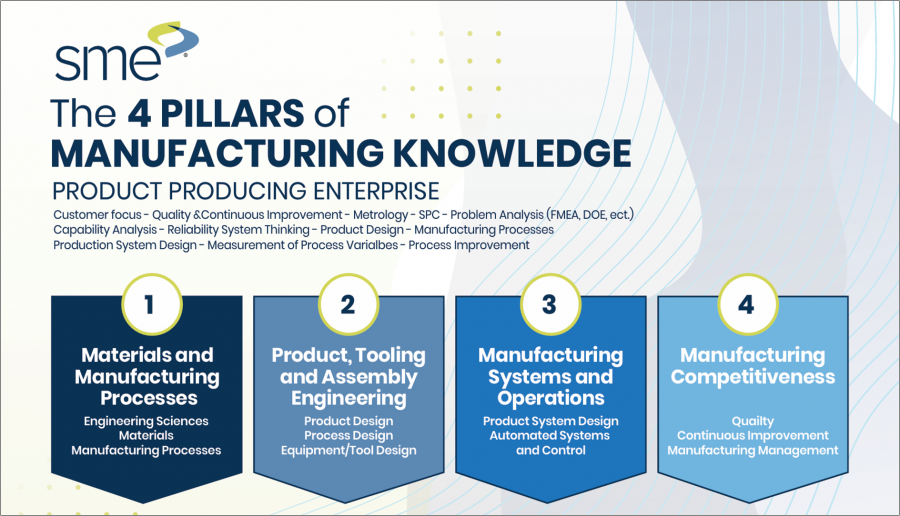
And their up-to-date curriculum is also based on The Society of Manufacturing Engineers’ Four Pillars of Manufacturing Knowledge.


In particular, MMET’s unique programs focus on the fourth pillar–Manufacturing Competitiveness–which is at the hub of smart manufacturing, modeling, simulation, sustainability, additive manufacturing, and advanced materials.

As well, the program also strongly emphasizes the third pillar, Manufacturing Systems and Operations, which includes the two key areas of Production System Design and Industry 4.0 and Automated Systems. Coursework covers Manufacturing System Design, Planning/Plant Layout, Human Factors, Environmental Sustainability, and Safety Production. 

Furthermore, the program also supports several of the key knowledge areas that are integral to supporting advanced manufacturing: smart manufacturing, modeling and simulation, sustainability and additive manufacturing, advanced materials, and leadership.

Coursework Designed for Advanced Manufacturing and Industry 4.0

In fact, several core courses address these knowledge areas while preparing students for the specific challenges of as well as leadership roles in advanced manufacturing. Take Industry 4.0 Concepts) (MFGE 5200), for instance. This course covers smart factories, sensor networks, and intelligent decision-making systems. In so doing, it teaches students how to model and simulate digital factories and how to integrate these systems into existing operations.

And Organizational Leadership (MFGE 5000) helps students develop communication, emotional intelligence, and ethical decision-making. Educating engineers in communication and decision-making is key to the complex, changing tasks of not only training employees but also integrating advanced technologies and tools in the advanced manufacturing environment. This course prepares students for technical leadership roles, such as those of team leads, project managers, and cross-functional coordinators.

In addition, the content of Statistical Methods (MA 5701) prepares students to lead Six Sigma and continuous improvement initiatives. Other core courses are Tolerance Analysis with Geometric Dimensioning & Tolerancing (MFGE5100) and Industrial Safety (MFGE5500).

Beyond these required courses, others prepare students for some of the specific challenges of advanced manufacturing. For instance, Operations Management (BA 5610), which focuses on lean systems, ERP integration, and demand forecasting, trains students to analyze operations holistically, from inventory to logistics to production. Furthermore, Introduction to Sustainability and Resilience (ENG 5515) recognizes that sustainability is more than just a buzzword. Its content introduces engineers to ecological economics, sustainability metrics, and policy-driven design. Therefore, it builds those systems-thinking skills necessary for leading green transitions, which are crucial for industries like automotive, energy, aerospace, and consumer goods.

Examples of Current Students in MTU’s Online Manufacturing Program

According to John Irwin, Professor and Chair, Manufacturing and Mechanical Engineering Technology, MTU’s online program is ideal for working professionals. Two of Global Campus’s current students are engineers at top-tier automotive companies. In their projects, they are supporting advanced manufacturing by developing methods for increased part production and safety.

For instance, shared spaces where humans and robots work and interact in close proximity are common in advanced manufacturing. One student is working to increase safety for collaborative robotic systems. Another MS Thesis student is collaborating with Pettibone, which produces material handling equipment. They are conducting a lean energy study to pinpoint both direct and indirect energy waste in production. The goal: increasing efficiency without sacrificing productivity.

Since the introduction of graduate degrees in MMET, we’ve had many full-time engineers pursue our programs. And these programs are growing. The Global Campus Fall 2025 enrollment has increased 100% over last spring semester. At MMET, we’re always looking to provide more opportunities for working professionals to pursue their research while earning a respected degree from Michigan Tech.

John Irwin

Learn More About Michigan Tech’s Online Graduate Program in Manufacturing Engineering

All in all, Michigan Technological University has programs that are strategically aligned to support the upskilling needed for manufacturing for Industry 4.0. Graduates of MTU’s online graduate manufacturing program, for instance, are well-positioned for various roles–especially those in leadership–across advanced manufacturing. 

Learn more and talk to subject matter experts by attending an upcoming virtual information session on Michigan Tech’s online graduate program in manufacturing engineering.

DETAILS:

  • Date: Thursday, June 19
  • Time: 11:30 AM (EDT)
  • Location: Zoom