
Tag: business information systems

From Dashboards to Decisions: AI for Business Information Systems

Your Business Systems Aren’t Just Software Anymore.

If you’ve ever thought, “Why does it take three dashboards, two spreadsheets, and a weekly meeting to answer a simple business question?” you’re already bumping into the problems that Business Information Systems are meant to solve. And you’ve probably already had a close encounter with how AI is changing the game.

A Business Information System (BIS) is the setup of tools, software, and processes organizations use to gather, store, and analyze business data. A BIS allows teams to understand information, such as sales trends, customer behavior, inventory levels, financial performance, and more.

Most organizations rely heavily on business information systems. Below are a few examples and their capabilities.

  • ERP (Enterprise Resource Planning): Integrates core operations (finance, purchasing, inventory, manufacturing, and HR) into one system (e.g., SAP, Oracle).
  • CRM (Customer Relationship Management): Manages customer data and interactions, such as sales pipelines, marketing campaigns, service cases (e.g., Salesforce).
  • HRIS (Human Resource Information System): Handles HR data and processes, such as payroll, benefits, recruiting, and performance (e.g., Workday).
  • SCM (Supply Chain Management): Plans and manages supply chain activities, such as procurement, logistics, warehousing, distribution.
  • BI (Business Intelligence): Tools for dashboards, reporting, and analysis to support decisions (e.g., Power BI, Tableau).
  • DSS (Decision Support System): Combines data and models to help evaluate options (pricing, capacity, risk scenarios).
  • WMS (Warehouse Management System): Tracks warehouse inventory, picking/packing, replenishment, and shipping.
  • POS (Point of Sale): Captures sales transactions in retail and often links to inventory and customer data.

The previous problem was this one: for the longest time, most of these systems still behaved like filing cabinets. They stored information, but they didn’t think with you. Or even like you.

But that scenario has been changing fast.

How AI for Business Information Systems Works (In Real Life).

That is, updated and new Business Information Systems are increasingly becoming adept at answering plain-English questions: Why are returns up? What’s driving churn? What happens if we change lead times? And then providing useful answers with recommended next steps.

These insights demonstrate how AI has transformed BIS. That is, instead of reporting only what happened, AI-enhanced BIS can learn from data, spot patterns, flag risks, forecast demand, and support better and quicker decisions through recommendations and automation. In other words, it can help teams move from “What happened?” to “What should we do next?”

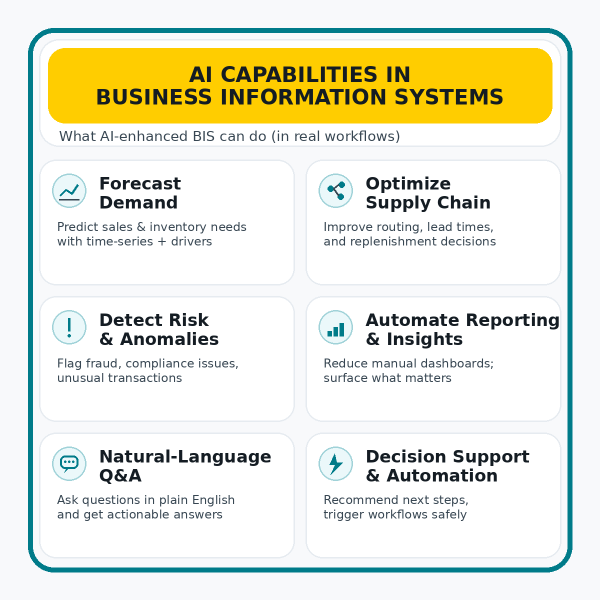
In day-to-day business operations, then, AI often shows up in several practical but high-impact ways:

  • Forecasting demand more accurately (so you’re not overstocked or out of stock)
  • Improving supply chain and logistics (inventory levels, shipping routes, lead times)
  • Assessing risk and detecting anomalies (fraud, compliance flags, unusual transactions)
  • Automating reporting and surfacing insights (less manual work, more usable information)
  • Helping teams interact with enterprise systems using natural language (ask a question, get an answer, think about next steps)
Some Recent Examples of AI Being Embedded into Platforms

Many organizations have already embedded AI into the software platforms on which they heavily rely.

Case Study: Embedding AI into CRM to Support Workflow and Reduce Response Times

Industrial Scientific’s support team was overwhelmed and morale was declining. Why? The team was handling upwards of 1,200 requests/month (device issues, troubleshooting, documentation). To fulfill these requests, employees often had to consult multiple departments. As a result, response times stretched to days, damaging the customer experience.

To solve this program, the organization built an AI support pipeline (“SensAI”) that connects Salesforce (CRM) with Oracle Cloud Infrastructure generative AI and a documentation knowledge base. When an inquiry lands in Salesforce, it triggers an automated workflow that uses RAG (retrieval-augmented generation) over product docs. Through Salesforce, it then returns a response that is tailored to the customer’s support contract.

As a result, response times dropped from days to minutes (near-immediate support for routine inquiries). The system responded to 2,230+ emails and cut 185+ hours of staff time, not only saving money but also reducing a ton of employee stress.

The Bottom line: AI is no longer just a tool on the side; it is quickly becoming the interface and accelerator for business systems.

Earn Michigan Tech’s Online Certificate in AI for Business Information Systems.

If you want to evaluate AI tools, implement them responsibly, and translate AI into measurable outcomes, you need a foundation in both AI concepts and business information systems. Michigan Tech’s online graduate certificate in AI for Business Information Systems is built to provide exactly that, demonstrating how AI integrates with core business systems to streamline decision-making, improve accuracy, and drive cost savings.

In just 9 credits, you’ll complete two required courses: BA 5200: Information System Management and Data Analytics and MIS 5000: Emerging Technologies. Then, choose one elective: MIS 4400: Business Intelligence and Analytics or MIS 5100: Information Systems Projects.

This certificate is a strong fit for leaders, business professionals, managers, and IT analysts who want to guide AI adoption, strengthen BI/analytics capabilities, or move into digital transformation and AI-enabled roles.

Drop By on February 19 to Learn More.

Join our virtual webinar to get a practical walkthrough of the AI for Business Information Systems certificate. If you have questions about how this certificate fits your career goals, you’ll get those answered too.

Details

  • Date: Thursday, February 19
  • Time: 11:30 a.m. – 12:30 p.m. (ET)
  • Location: Zoom

What You’ll Get from This Info Session:

  • A practical view of what “AI for Business Information Systems” looks like on the job
  • Details on how the coursework builds skills you can apply immediately
  • Examples of projects and career directions this credential supports
  • Admissions, application, and next-step guidance

Bring your curiosity and your questions. Leave with a clear sense of whether this certificate aligns with your goals and what to do next if you’re ready to move forward.

Tech Disruptions, AI-Driven Revenue, and Wildfires: Why Hybrid Technical Skills Matter Now More Than Ever

Hybrid technical skills, such as those used in GIS and urban planning, are increasingly in demand in the workplace.

On Feb 21, 2024, Change Healthcare—a main medical clearinghouse for United Healthcare Group—was hit by a ransomware attack that crippled electronic payments. Change Healthcare handled 15 billion dollars of claims annually. How did this attack happen? By exploiting a lack of industry-standard multifactor authentication on a legacy server, hackers took down a large chunk of United’s Healthcare system while compromising the health data of nearly 190 million Americans.

As a result, hospitals couldn’t process prescriptions or bills, forcing patients to pay out-of-pocket. This incident led to $100 million of daily losses for healthcare providers, supply-chain uncertainty, and an eventual federal investigation. The fallout exposed the shortage of cybersecurity professionals who can protect infrastructure while navigating the regulatory risks of healthcare data systems.

Old legacy systems were almost the downfall of online ticket vendor TickPick as well. In 2024, the company lost millions when its outdated fraud system blocked legitimate big-ticket purchases. For instance, someone buying high-value $20,000 Super Bowl tickets might be flagged as suspicious. As a fix, TickPick adopted Riskified’s “Adaptive Checkout.” This AI-powered fraud-detection system uses risk assessments to approve, decline, or flag transactions for verification. It helped TickPick recover three million dollars in revenue in only 90 days. The main point: online businesses require professionals who can strategically apply AI while balancing security, customer experience, and profit.

It’s not only healthcare and old legacy systems in need of employees with flexible, data-driven skills.

Fast forward to September 2024 and California’s Bridge Fire. This fire burned through 55,000 acres, threatening communities in San Bernardino County. Emergency crews used advanced GIS mapping tools to track fire spread, analyze terrain, and coordinate evacuations, saving both lives and property. As climate-driven disasters increase, the ability to interpret spatial data and translate it into actionable plans is more crucial than ever.

What Are Hybrid Technical Skills?

These three incidents, though seemingly disparate, highlight the increasing need for hybrid technical skills.

If you haven’t heard the phrase “hybrid technical skills,” the term originates from discussions in workforce development, education, and labor economics—especially since the early 2000s. The concept, a response to changing demands in the modern labor market, describes the fusion of technical (hard) skills and non-technical (soft) skills.

In short, hybrid technical skills comprise a blend of domain expertise (such as business, cybersecurity, and environmental science) with communication, digital literacy, and applied knowledge that cuts across industries.

People with these in-demand skills can understand the technology while speaking the language of strategy. For instance, if you’re a problem-solver with hybrid technical skills, you might not be coding AI models from scratch. But you know how to select the right tools, interpret data outputs, and apply them to diverse problems. You’re not solely a coder or an analyst—you’re an integrator, a translator. You know how to apply the right technology to solve the right problem.

For example, in the workplace, an employee with hybrid technical skills might be a

  • business analyst who can leverage AI models to optimize workflows
  • forester who can analyze GIS data to support conservation efforts
  • security professional who understands both network vulnerabilities and organizational risk
  • healthcare cybersecurity expert with compliance and regulatory knowledge

Workplace Demand for Those with Hybrid Technical Skills

To put it another way, hybrid technical professionals are the translators between advanced technologies and real-world impact. And you can tap into the demand for them, which is definitely soaring.

Professional IT Programmer Working in Data Center on Desktop Computer with Three Displays.

MTU’s Newest Programs Help Fill the Hybrid Technical Skills Gap

Whether you want to defend digital infrastructure, leverage AI to drive smarter business decisions, or use GIS to protect natural resources, Michigan Technological University’s latest online graduate programs offer targeted, flexible pathways to equip you with hybrid technical skills for making that transition.

Why choose these programs?

  • Take 100% online programs designed for you, the working professional.
  • Learn from expert faculty with real-world experience.
  • Earn stackable credentials. Or choose to move on to an advanced degree.
  • You can apply for FREE and skip the GRE and GMAT.

Online MS in Cybersecurity

Cybercriminals are growing increasingly savvy and destructive. And cybercrime damages are expected to hit $10.5 trillion annually by the end of 2025. Therefore, adaptable cybersecurity professionals are in high demand across industries. Along with ransomware, cybersecurity professionals must be ready to battle Advanced Persistent Threats (APTs), Phishing and Social Engineering, Zero-day attacks, high-profile data breaches, DDoS attacks, and many other types of cyber crime. The changing nature of cyber threats also requires organizations to continually improve their defenses and adapt to new attack vectors.

Cybersecurity professionals work in defense, finance, government, healthcare, and manufacturing. With MTU’s online master’s degree in cybersecurity, you can prepare you for several roles, such as security analyst, risk manager, cyberoperations specialist, cybersecurity architect, cybersecurity manager, cybercrime analyst, and more. And in this program, you can also earn a certificate in the Foundations of Cybersecurity along the way.

Need more details? Want to take a closer look at this program? Attend our virtual information session on Thursday, Sept. 18, 2025.

Online Graduate Certificate in Artificial Intelligence in Business and Information Systems

Artificial Intelligence is obviously not just for tech companies anymore. In business and information systems, AI can accelerate predictive analytics, identify patterns, trends, and correlations. All of these tasks can help businesses make detailed forecasts. Artificial Intelligence, then, adds “smart” capabilities. That is, instead of just collecting information, an AI-enhanced system can learn from data, spot patterns, and even make decisions or recommendations.

With Global Campus’s online certificate in AI in Business and Information Systems, you can bring advanced AI skills to decision-making, project management, and operations. This 3-course credential is ideal if you want to lead AI transformation projects, bridge business and technical teams, and advance into product and leadership roles. It also gives you the expertise to transition into careers, such as AI strategist, business intelligence analyst, or digital transformation lead. You can also apply these credits towards an Online Master of Business Administration.

Online Graduate Certificates in Advanced GIS and Remote Sensing

With climate change and land management in the spotlight, advanced GIS skills are becoming critical. To meet this demand, Global Campus previously rolled out the Online Foundations in Geographic Information Science Certificate in 2024. Joining it in 2025 are two new certificates for natural-resource professionals: Advanced GIS and Remote Sensing.

In the Advanced GIS certificate, you will master sophisticated GIS concepts and methodologies, which are central to analyzing large and complex datasets, automating routine geospatial workflows, and effectively managing geodatabases. You’ll also get exposure to designing, executing, and communicating comprehensive geospatial projects. Remote sensing, the process of collecting information from the Earth’s surface and atmosphere without making physical contact is the focus of the second certificate. As a GIS professional, you’ll need to combine remotely sensed data with ground-based research to provide timely, accurate, and spatially extensive information that allows them to plan, predict, model, and make decisions.

All these GIS certificates empower you with hybrid technical skills for addressing real-world challenges, delivering innovative solutions, and excelling in professional and industry-level geospatial roles. They give you career choices: preparing you for roles in environmental consulting, forestry and land use planning, and emergency management and disaster response.

Upskill for the Careers of Tomorrow—Starting Today

From ransomware attacks to wildfire mapping to AI-driven business strategy, the workforce is facing a major skills gap. And as a professional with hybrid technical skills, you could be there to fill it. Several organizations are seeking flexible employees who blend tech fluency, critical thinking, communication skills, and domain-specific expertise. They want employees who can connect digital tools to business goals, apply AI in strategic decision-making, interpret cyber threats through an operational lens, or leverage GIS systems for environmental analysis.

Whether you’re looking to switch careers or elevate your current role, Michigan Tech’s Global Campus gives you the tools to lead in a world defined by data, systems, and strategic decision-making. These previously mentioned programs, though, are more than credentials—they’re launchpads for meaningful, future-ready work. And don’t forget our other flagship program that prioritizes hybrid technical skills: the Online MS in Applied Statistics.

We’d love to connect with you and have a conversation about one of these programs. Global Campus has a committed, knowledgeable admissions manager, Amanda Irwin. Amanda is available to help you evaluate programs and to find the right fit for you. She’s also adept at answering tough questions and helping people navigate the application process.

And don’t forget: applying online is free. And you don’t require GRE or GMAT scores, either.