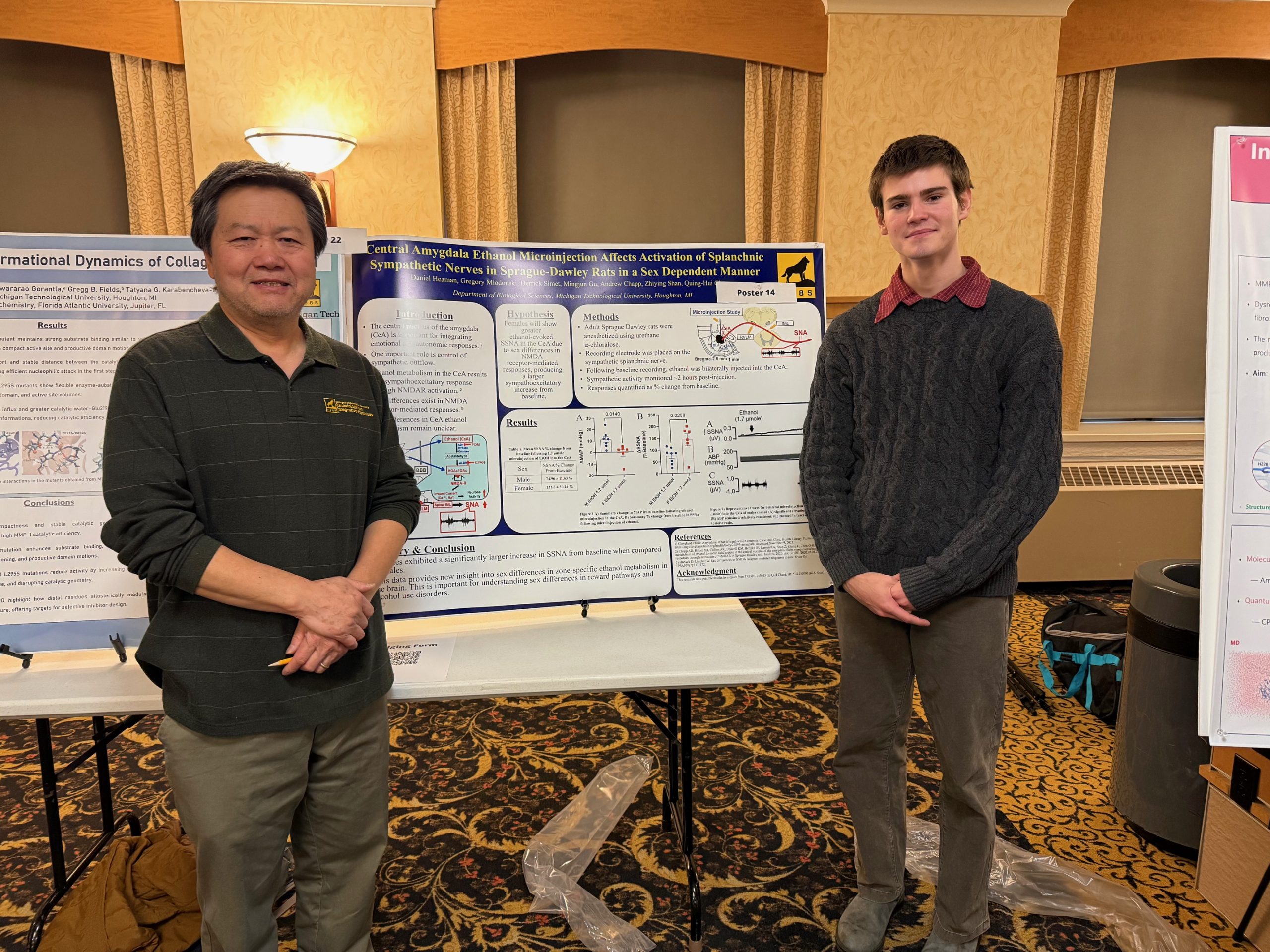
Daniel Heaman, a biological sciences undergraduate student, recently presented his research from Dr. Qing-Hui Chen’s Laboratory at Michigan Technological University’s 2025 Fall Health Research Institute (HRI) Student Forum. Here, undergraduate and graduate students from laboratories across campus come together to share their research. For his poster presentation on the sex-dependent metabolism of alcohol in the brain, Daniel received highest marks & received first prize. The alcohol metabolism project Daniel works on is a collaborative effort with Dr. Andrew Chapp (MTU 2017), an assistant professor in the Department of Neuroscience at the University of Minnesota.
Abstract
Central Amygdala Ethanol Microinjection Affects Activation of Splanchnic Sympathetic Nerves in Sprague-Dawley Rats in a Sex Dependent Manner
The central amygdala (CeA) plays a critical role in integrating emotional and autonomic responses, including sympathetic outflow. Ethanol is known to influence amygdalar activity and autonomic regulation, but potential sex differences in its central effects remain unclear. This study examined the influence of ethanol microinjection into the CeA on splanchnic sympathetic nerve activity (SSNA) in male and female rats. Adult male and female Sprague–Dawley rats (n=3 for each group) were anesthetized using urethane and α-chloralose. Using a recording electrode placed on the splanchnic sympathetic nerve, SSNA was continuously recorded. Following baseline recording, 1.7 µmol of ethanol was bilaterally microinjected directly into the CeA. Nerve activity was monitored for approximately 2 hours post-injection. SSNA responses were quantified as the percent change from baseline. Ethanol administration in the CeA produced an excitatory effect on SSNA in both sexes, but the magnitude of response was significantly greater in females. Females displayed a significantly greater SSNA response to ethanol (133.6 ± 30.24 %) compared to males (74.96 ± 11.63 %) relative to baseline. This data indicates that ethanol acts within the CeA to elevate sympathetic drive, with a more pronounced
effect in females. Microinjection of ethanol into the CeA elicits a robust increase in splanchnic sympathetic nerve activity, demonstrating the CeA’s pivotal role in central autonomic regulation. The exaggerated response in females suggests sex-dependent differences in CeA sensitivity to ethanol, potentially reflecting hormonal modulation of CeA circuitry or neurotransmitter systems influencing sympathetic output. These findings provide new insight into the neural mechanisms by which ethanol modulates autonomic activity and highlight the importance of considering sex as a biological variable in studies of central ethanol effects.