Tag: #mtu

Student Daniel Heaman Recevies Award for Research Presentation

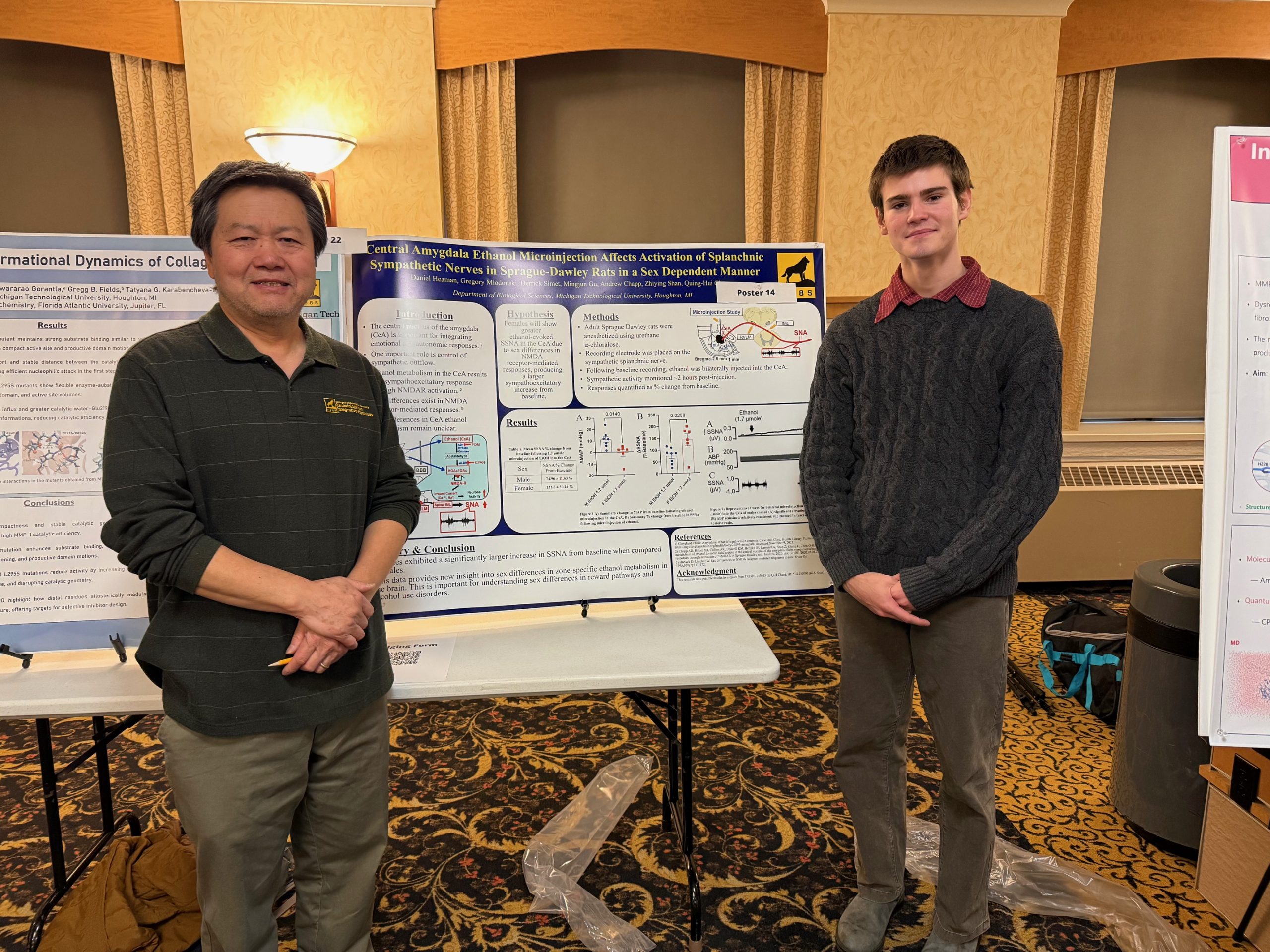
Daniel Heaman, a biological sciences undergraduate student, recently presented his research from Dr. Qing-Hui Chen’s Laboratory at Michigan Technological University’s 2025 Fall Health Research Institute (HRI) Student Forum. Here, undergraduate and graduate students from laboratories across campus come together to share their research. For his poster presentation on the sex-dependent metabolism of alcohol in the brain, Daniel received highest marks & received first prize. The alcohol metabolism project Daniel works on is a collaborative effort with Dr. Andrew Chapp (MTU 2017), an assistant professor in the Department of Neuroscience at the University of Minnesota.

Dr. Chen (left) with Daniel Heaman (right) at Poster Presentation

Abstract

Central Amygdala Ethanol Microinjection Affects Activation of Splanchnic Sympathetic Nerves in Sprague-Dawley Rats in a Sex Dependent Manner

The central amygdala (CeA) plays a critical role in integrating emotional and autonomic responses, including sympathetic outflow. Ethanol is known to influence amygdalar activity and autonomic regulation, but potential sex differences in its central effects remain unclear. This study examined the influence of ethanol microinjection into the CeA on splanchnic sympathetic nerve activity (SSNA) in male and female rats. Adult male and female Sprague–Dawley rats (n=3 for each group) were anesthetized using urethane and α-chloralose. Using a recording electrode placed on the splanchnic sympathetic nerve, SSNA was continuously recorded. Following baseline recording, 1.7 µmol of ethanol was bilaterally microinjected directly into the CeA. Nerve activity was monitored for approximately 2 hours post-injection. SSNA responses were quantified as the percent change from baseline. Ethanol administration in the CeA produced an excitatory effect on SSNA in both sexes, but the magnitude of response was significantly greater in females. Females displayed a significantly greater SSNA response to ethanol (133.6 ± 30.24 %) compared to males (74.96 ± 11.63 %) relative to baseline. This data indicates that ethanol acts within the CeA to elevate sympathetic drive, with a more pronounced
effect in females. Microinjection of ethanol into the CeA elicits a robust increase in splanchnic sympathetic nerve activity, demonstrating the CeA’s pivotal role in central autonomic regulation. The exaggerated response in females suggests sex-dependent differences in CeA sensitivity to ethanol, potentially reflecting hormonal modulation of CeA circuitry or neurotransmitter systems influencing sympathetic output. These findings provide new insight into the neural mechanisms by which ethanol modulates autonomic activity and highlight the importance of considering sex as a biological variable in studies of central ethanol effects.

KIP Graduate Student Attends 72nd Annual American College of Sports Medicine Conference in Atlanta, Georgia

Third year KIP doctoral student, Kyle Wehmanen, recently returned from attending the 72nd Meeting of the American College of Sports Medicine (ACSM). This year’s conference was held in Atlanta Georgia, home of the Centers for Disease Control (CDC), a keystone of the Civil Rights Movement, and birthplace of Martin Luther King Jr.

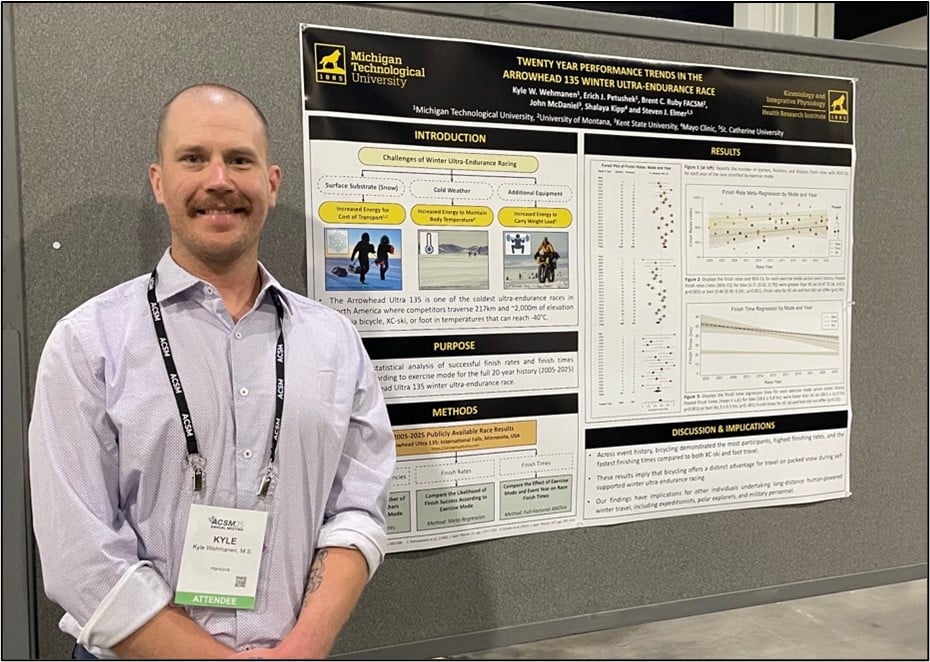
A big highlight of the trip was when Kyle presented his research, titled “Twenty Year Performance Trends in the Arrowhead 135 Winter Ultra-Endurance Race.” This data explores a portion of Kyle’s dissertation work which seeks to determine if a particular mode of travel (e.g., bicycles, XC-skis) offers a performance advantage when humans travel long distances on packed snow. Describing his presentation experience, Kyle said, “Sharing portions of my dissertation research, for which I’ve worked so hard, with a new, interested, and inquisitive audience was fun and invigorating. I met some wonderful people and possibly made contacts that will lead to future collaborations.”

Kyle Wehmanen presenting his research

The conference was also a fantastic opportunity for Kyle to catch up with several of his committee members in person and listen to them present on their cutting edge work. This included listening to Dr. Shalaya Kipp speak on her respiratory research which she conducts at the Mayo Clinic in Rochester, Minnesota.

In the time away from the conference, Kyle took opportunity to explore Atlanta and was even able to attend a Braves’ baseball game at Truist Park in the vibrant Battery Atlanta complex. Although the Braves lost, it was amazing to visit one of the newest ballparks in America.

View of the field from inside Truist Park, Atlanta Georgia

In the end, spending four days in Atlanta at the ACSM annual meeting was a great opportunity for this KIP graduate student to share their research and learn from the best in the field. The speakers, panel discussions, and poster presented by others at the conference covered a wide range of topics and offered ample opportunity to learn about new and exciting topics across realms of physiology. Overall, the trip to Atlanta was an illuminating experience and it reinforced the importance of contributing to the field while providing new tools and connections to do so.

New minor in Public Health approved

The Kinesiology and Integrative Physiology Department at Michigan Tech proudly announces that a Minor is Public Health is now an option for all of our students.

Faucet with running water

Human health is impacted by our individual biology as well as the natural, built, and social environments in which we live, work, and play. Thus, the ability to be health literate and able to integrate a health perspective is important in disciplines beyond traditional health-related and clinical fields. In the past 15 years there has been a growing recognition of the importance academia plays in teaching these skills. In 2002, an Institute of Medicine report recognized the need to better educate the public health workforce and partners that play key roles in the health of our communities who are not in traditional public health positions. A subsequent report expanded that call for public health education, recommending that “all undergraduates should have access to education in public health”. This widespread need to understand population health and health impacts was further highlighted when, in 2011, the U.S. federal government adopted a “Health in All Policies (HiAP)” strategy. A HiAP approach recognizes the importance of considering health across all fields in both the public and private sectors. The new Minor in Public Health will introduce students to the growing field of public health and the need to include a population health perspective in many of the university’s existing degrees. 

The audit check list is being created

Award Winning student

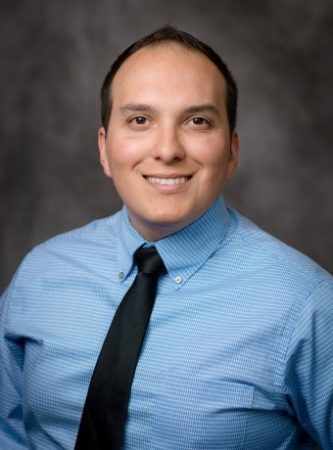
Joshua Gonzalez

Congratulations to our PhD Candidate, Joshua Gonzalez, who has been selected as a recipient of the 2020 Caroline tum Sudent/Frances Hellebrandt Professional Opportunity Award from the American Physiological Society!

This award is for his abstract, Acute Effects of the JUUL E-cigarette on Blood Pressure and Peripheral Sympathetic Activity in Young Non-Smokers, which was co-authored by Dr. William Cooke and Stephanie Jewel, undergraduate research assistant.

We are so proud of you all!