ACMAL Facility Closed (Except CIF)

Due to the intermittent power outages, in addition to the planned power outages, ACMAL will be closed for the remainder of this week. The Confocal Imaging Facility (CIF), will be available unless there is another unplanned power outage during the day. 

The X-ray facility will be open beginning Friday morning. All other facilities will be opening next week. Just a reminder, the FIB and FESEM annual maintenance will be occurring next week (5/9 – 5/11).

We apologize for any inconvenience.
X-Ray Laboratory Shutdown Wednesday pm to Friday am

Due to the scheduled building power outages and in the best interest of the instruments and computer systems the x-ray laboratory will be electrically shut down from Wednesday 5-4-2022  beginning at 3 pm until 7 am Friday 5-6-2022. If you need XRD computing during this time please see me prior to shutdown. 
Regards,Ed

Dr. Edward A. LaitilaSenior Research Engineer/Scientist II/Adjunct Assistant Professor Michigan Technological University Dept. of MSERoom 628 M&M Building(906) 369-2041

FESEM / FIB Annual Maintenance and End of Semester Lab Cleaning

Next week, the HITACHI technician will be on campus to perform an annual preventative maintenance check on the FESEM and FIB. The instruments will be unavailable during that time. If all as planned they will be available for reservation starting on Thursday May 12th.

Also, we will begin our end of semester lab cleaning next Wednesday. Any unlabeled samples will be disposed of.

E-SEM AZTEC Updates

I have good news and better news. Good news is we have a work around for the software issue with AZtec. We will be able to capture images and perform EDS using another software package called INCA. The even better news is that our new EDS detector, which comes with a computer upgrade, will be here in May.

I can assist with training on the INCA software. It is very similar to AZtec so most usera will pick it up quickly.

FESEM Down

April 19

Good news. The parts have arrived and the technician will be on site tomorrow. Hopefully repairs will be completed soon.

April 18

The FESEM is down due to computer issues. I’m working to resolve the problem and will update you as soon as I can.

Unfortunately we will need to bring in a service engineer to repair the FESEM. The FESEM will be unavailable until the repairs are completed. They are currently ordering the necessary parts and will be scheduling repairs ASAP.

Who is Studying the Failure Mechanisms of Electrical Wire Terminals at Michigan Tech?

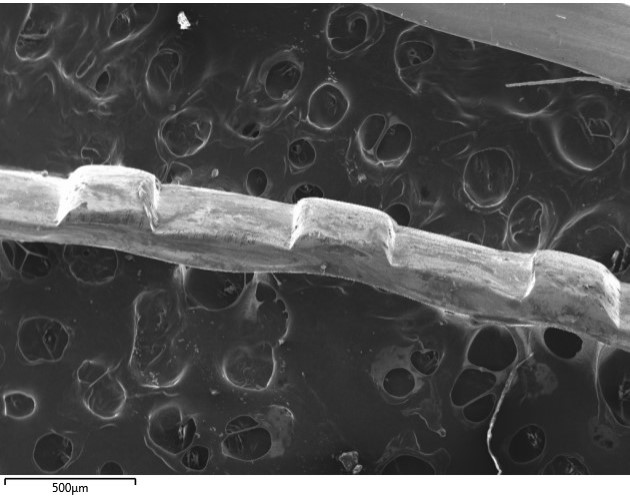
Micrograph of a wire on a substrate with a 500 micron scale marker.

An Advanced Metalworks Enterprise undergraduate student team, sponsored by Lear Corporation, is studying the performance of copper electrical wires in automobiles. Corrosion is the most common failure mechanism of wires used in crimp connectors; deformation in the wire terminal’s tin plating can cause additional contact issues within the connector. Electron microscopy aids in pinpointing the location of corrosion products on the wire and observing deformation in the tin plating. With this analysis, the team can now explore ways to improve the wire quality or crimping mechanism to minimize wire failures.

Image taken by Eli Harma and Reese Eichner, senior undergraduate materials science and engineering students, on Philips XL 40 ESEM.

Learn more about the Advanced Metalworks Enterprise at MTU: AME Website

Visit the Applied Chemical and Morphological Analysis Laboratory’s webpage to learn more about our shared facility and instruments available to the Michigan Tech research community: ACMAL

Who is Studying Miniature Magneto-optic Devices at Michigan Tech?

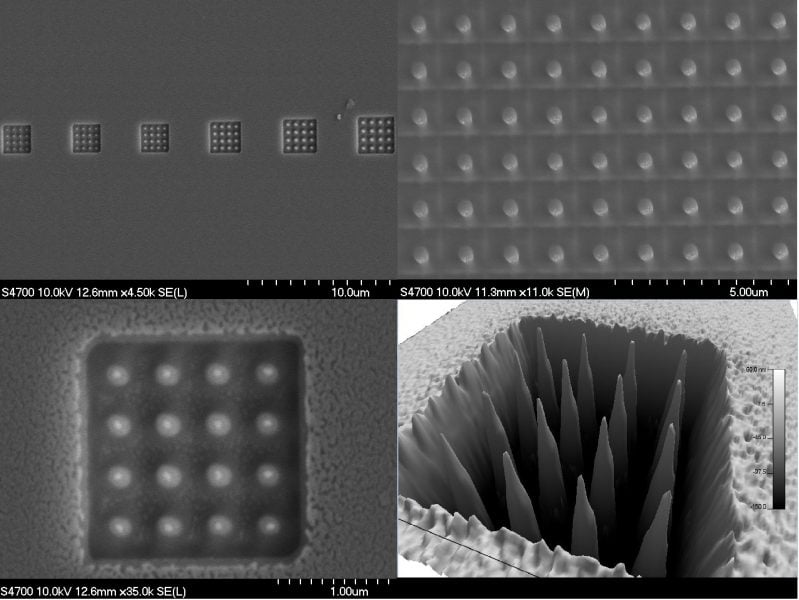
Four images on different scales showing pillar arrays on a surface.

The successful fabrication of miniature optical components is key for progressing current optical technologies. A family of such miniature optical components must be able to efficiently rotate linearly polarized light at small scales. Estefanio Kesto, under the guidance of Dr. Miguel Levy, is studying the interaction between light and ferromagnetic iron garnet nanostructures. It has been observed that the polarization rotation of linearly polarized light, known as the magneto-optic response, traveling through such a nanostructure will be enhanced. The ferromagnetic iron garnet nanostructures pictured above, which enhance the magneto-optic response, are being studied to further miniaturize polarization rotators and other interferometric components. Additionally, Professor Levy and his research group are diving into the unexplored region of magneto-optic beam splitting and its applications in classical and quantum computing.

Pillars fabricated and image taken by Estefanio Kesto, undergraduate student in electrical engineering, using ACMAL’s Hitachi FB-2000A FIB, Hitachi S-4700 FE-SEM, and Asylum Research MFP-3D Origin+ AFM.

Read more about the Dr. Miguel Levy’s research in the following articles:

All-dielectric magnetic metasurface for advanced light control in dual polarizations combined with high-Q resonances

Nonreciprocal magneto-optic beam splitting

Two-dimensional array of iron-garnet nanocylinders supporting localized and lattice modes for the broadband boosted magneto-optics

Visit the Applied Chemical and Morphological Analysis Laboratory’s webpage to learn more about our shared facility and instruments available to the Michigan Tech research community: ACMAL