Welcome New MCFF Staff: Murphy Mallow

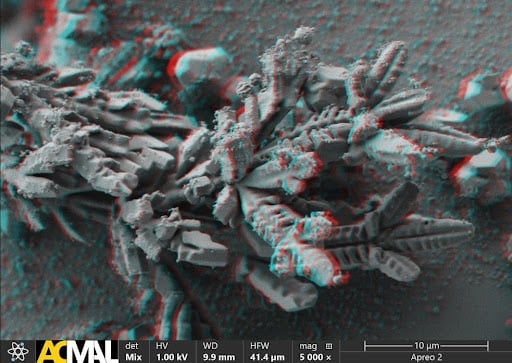
Murphy has been working as a Research Technician for MCFF since November of 2025. He is an operator for the Apreo2 FE-SEM and confocal microscope, manages the MCFF metallographic sample prep lab, and works on canvas course development.

Since joining MCFF, Murphy has enjoyed learning to operate the Apreo2, expanding his knowledge of SEMs, and getting to work with new people on their projects.

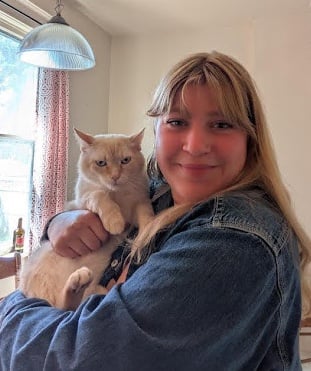
In his free time, Murphy enjoys spending time outdoors, especially mountain biking, trail running, and nordic skiing. He also spends time working on bikes and hanging out with his cat, Chopper.
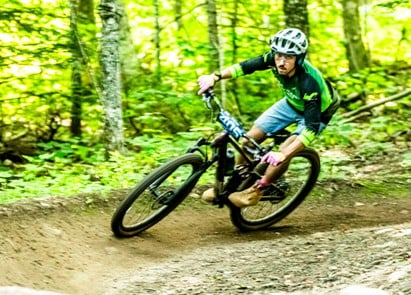
Murphy Mallow riding on dirt trail on mountain bike

Microfabrication Core Laboratory Reengagement

The Microfabrication Core Laboratory (previously the Microfabrication Facility) is part of the Materials Characterization and Fabrication Core Facility (MCFF). We are pleased to confirm that the facility is open and staffed, and all instruments are online and available in FOM (Facility Online Manager).

From March 30 to June 30, the MicroFab Core Laboratory is running a facility reengagement period to support our users as we strengthen operations and implement FOM.

A key part of the reengagement period, initial instrument training — including both instrument use fees and staff time — will be covered by the Vice President for Research Office (VPR). We are also offering tours, sponsored by VPR, to anyone who would like to become acquainted with what the MicroFab has to offer.

Access Costs After Training:
Once your initial instrument training is complete, the following cost structures apply. Use rates for the MicroFab are available online.

  • Trained User Operated Analysis: Instrument use fees will be covered by your principal investigator (PI).
  • Staff-Operated Analysis: The total cost will include the applicable instrument use fee and staff time, both of which will be covered by your PI.

The MicroFab’s reengagement period is designed to facilitate your access to the facility’s capabilities. To initiate training, create or log into your FOM account and request access to a new resource.

Reach out to microfabrication@mtu.edu with any questions you may have about facility access, training or the reengagement period. We look forward to seeing you utilize the MicroFab Core Laboratory.

Shared Facilities Reorganized Under VPR’s New Materials Characterization and Fabrication Core Facility

A new Materials Characterization and Fabrication Core Facility (MCFF) has been formed at Michigan Tech under the Vice President for Research Office (VPR).

The MCFF brings expertise and equipment from three existing shared facilities:

  • Microfabrication Facility (MFF)
  • Microanalytics Facility (MAF), including:
    • Laboratory for Environmental Analysis of Forests (LEAF)
    • Chemical Advanced Resolution Methods Lab (ChARM)
    • Aquatics Analysis Lab (AQUA)
  • Applied Chemical and Morphological Analysis Laboratory (ACMAL)


The MCFF’s unified structure allows for streamlined operations, strengthened staff capacity, improved access to instrumentation and continued support for Michigan Tech researchers.
The MCFF will be directed by Elizabeth (Liz) Miller, who brings six years of experience managing shared facility operations. During this transition, Miller will collaborate closely with the previous shared facility directors. Current staffing remains unchanged, preserving decades of combined experience in operating shared facilities. Users can continue working with the same knowledgeable staff they have relied on.

Thank you to Miller, Paul Bergstrom and Andy Burton for all their hard work over the past year to envision and execute the creation of this new core facility. Special appreciation to the previous shared facility directors for their years of leadership and dedication:

  • Paul Bergstrom (ECE), faculty director of MFF
  • Andy Burton (CFRES), faculty director of LEAF and MAF
  • Michael Gretz (BioSci), faculty director of ChARM
  • Amy Marcarelli (BioSci), faculty director of AQUA
  • Liz Fraki (AVPRIF), director of ACMAL


Any questions or feedback? Contact Fraki at eafraki@mtu.edu to start a conversation.

Lunch & Learn: The Future of Fluorescence Imaging Live Demo

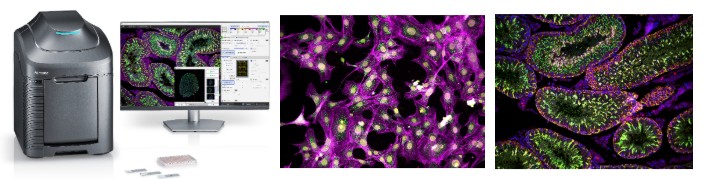
KEYENCE BZ-X Series All-in-One Fluorescence Microscope

Please join the Materials Characterization and Fabrication Core Facility (MCFF) for a free Lunch and Learn seminar with Keyence!

Event Overview

  • Date: Tuesday, February 17, 2026
  • Time: 11:30 am – 12:30pm
  • Location: GLRC 202 and the testing sessions in HSTEM 355
  • Register by: Friday, February 6, 2026
  • Bring your own sample for analysis! Testing sessions will be every 45 minutes following the seminar.


KEYENCE BZ-X Series Fluorescence Microscope Highlights:


Ultra-Fast Multi-Channel Imaging
Motorized filter wheel enables imaging 5× faster than conventional systems

High-Resolution Imaging
10-MP CMOS camera delivers 3.5× more detail than standard microscopes

Auto-Navigation Mapping
Automatically generate precision maps for faster imaging workflows

No Darkroom Needed
Vibration-isolated, compact design fits any benchtop. Ideal for any lab
Data Ready for Analysis
Supports OME-TIFF, JPEG, and TIFF export for compatibility with 3rd-party tools

Integrated Analytical Software Suite
Automated quantification tools for cell counts, intensity measurements, etc. Supports macro
analysis for large datasets

microscopic view of cells, image of laboratory equipment

Re-Discovering Drosophila Narragansett, a Tiny Fly With Huge Details

We at the MCFF house a variety of scientific instruments for electron microscopy and materials analysis. We are proud to help many students, professors, and guests alike. Perhaps one of the more notable guests we have recently helped is Professor and published author Thomas Werner.

Thomas Werner is best known for his research and documentation of drosophilids, which are more commonly referred to as fruit flies. In his career, Werner has published three volumes (and a fourth one in the works) that delve into detail about drosophilids across North America. During his fieldwork, Werner had amazingly found a species once thought to be extinct, called Drosophila narragansett. This species had not been seen for 60 years.

Keyence Brunch and Learn

MCFF is pleased to extend an invitation to the MTU research community for a Brunch and Learn session with Keyence on Thursday, November 13th, 2025. The event will be held from 9 – 11 a.m. in Chem Sci 310. Lunch will be provided. Please RSVP by Tuesday, November 11th, 2025 if you would like to attend.

Learn about the capabilities and operation of the Keyence elemental analyzer, metallograph, and digital microscope.

Notable features of these instruments include:

  • Elemental analysis that requires no coating or vacuum
  • Automatic element identification
  • Analysis that can be performed over multiple layers, points, or angles
  • High resolution images for microstructures

Event Overview

  • Date: Thursday, Nov 13, 2025
  • Time: 9 – 11 a.m.
  • Location: Chem Sci 310
  • Registration Deadline: Tuesday, November 11th, 2025

Cryo-SEM Day

Please join MCFF for a cryo-SEM open demonstration day from 9 a.m. – 3 p.m. on Wednesday, October 29 in MM630

One of the features available on the Apreo2 FESEM is cryo-SEM analysis. Cryo-SEM is a technique used to analyze samples that are air sensitive or cannot withstand a high vacuum environment. This includes liquids, reactive metals, biological samples, etc. Samples are frozen using liquid nitrogen and are ready for analysis.

We encourage you to bring your own samples for imaging and analysis. Samples will be prepped by staff during the event.

Meet Katherine Jarvis, The New ACMAL Staff

Katherine Jarvis

As an ACMAL Lab assistant Jarvis will be working on electron optics analysis, sample preparation, cleaning and other duties. 

What made you want to work at ACMAL?

Jarvis got a bachelors in material science and wanted to use her degree for hands-on work with the instruments.

What are some of your hobbies and interests?

Jarvis enjoys doing outdoor activities, riding bikes, hanging out with her friends and playing the yard game Kubb. Cooking is always fun for her, and her favorite food is pasta.

Learn How to Break The Ice and Analyze Frozen Samples with Cryo-SEM Training

Image of a snowflake under a Cryo-scanning electron microsope.
Image taken by Joey Tomei, Masters Student and ACMAL staff, on Apreo2

ACMAL staff and guests alike are making the decision to get trained on the Cryo-SEM. Getting trained on these instruments allows for the opportunity to use a scanning electron microscope to analyze frozen samples. A wide range of sample types can be used with this instrument including magnetic materials, powders, and biological materials. Using this method to examine biological material samples can be especially efficient because freezing them can leave them in a closer to natural state. In the most recent training, snowflakes were used as samples (as pictured). 

Visit the Applied Chemical and Morphological Analysis Laboratory’s webpage to learn more about our shared facility and instruments available to the Michigan Tech research community.

To book a Cryo-SEM session or discuss a potential project contact: Elizabeth Miller – ACMAL Director Email: eafraki@mtu.edu.