
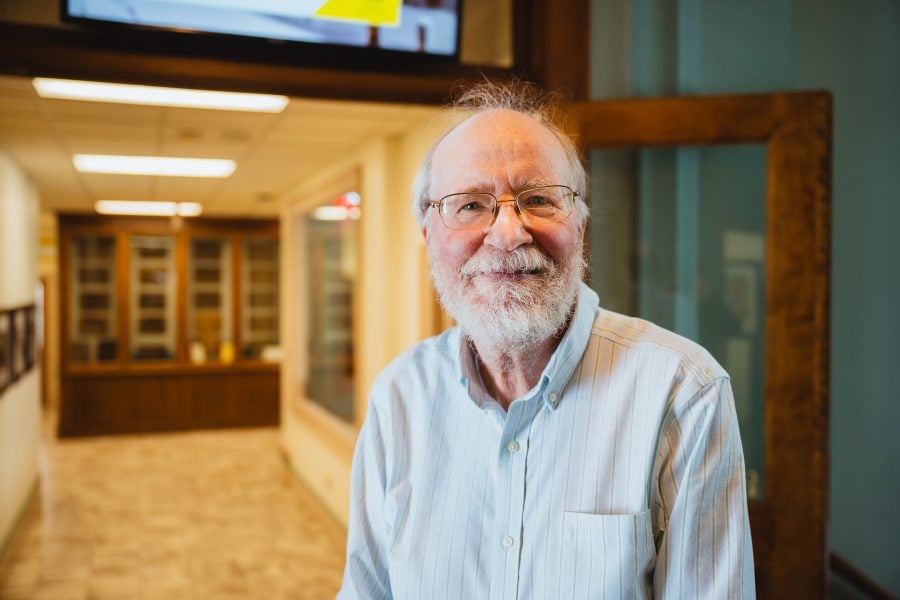
In the summer of 1982, a young economist from Penn State pulled out a paper map to check the coordinates of Houghton, Michigan. He had one specific requirement before accepting a job at Michigan Technological University: it couldn’t be next door to Detroit. Seeing the vast blue of Lake Superior and the green expanse of the Upper Peninsula, Gary Campbell packed his bags.
He didn’t know then that he was beginning a 44-year journey—one that would take him a mile underground in a South African gold mine, into the editorial offices of the Resources Policy journal, and onto the boardwalks of Nara Nature Park with a macro lens in hand.
Celebrating Faculty Contributions
College of Business Professors Emeriti Campbell and his colleagues Mari Buche and Sonia Goltz will be celebrated at a retirement party from 4-6 p.m. Tuesday, April 7, at Michigan Tech’s Rozsa Center for the Performing Arts. Campus and community members who wish to honor the distinguished trio’s contributions to the College and Michigan Tech are welcome to attend. Hors d’oeuvres and drinks will be served, with a short program taking place at 5:30 p.m.
RSVP requested. Email Laura Shawhan, director of administration at lshawhan@mtu.edu or call 906-487-2668.
As the newly appointed Professor Emeritus prepares to transition to life beyond Tech this July, he’s looking forward to a change in focal length. For four decades, he has helped the world understand the macro—the massive, often “exploitive” global markets of minerals and metals. In retirement, he’s turning his attention to the “micro”—the intricate veins of a dragonfly wing and the silent bloom of a Keweenaw wildflower.
The Science of Metals Markets
When Campbell is asked what he’s taught the 10,000-plus students who have sat in his lecture halls, he leads with the kind of unsentimental logic required to navigate the volatile landscape of the field in which he’s established his expertise.
“Economics is the science of social decision-making,” he says, explaining that in a world that routinely pits “industry” against “environment,” he’s spent 44 years teaching students how to navigate the uncomfortable middle.
Campbell arrived at Tech at a time when the College of Business was increasing cross-collaboration with the technological side of campus, including geology, mining, and engineering. Campbell was a bridge. He founded the Master’s in Mineral Economics program, now Applied Natural Resource Economics, which is designed to give technical experts the economic tools they need to understand the value of what they’re pulling out of the earth.
Campbell illustrates the cyclical nature of his work with a dry wit. “In the 80s, we were worried about cobalt for permanent magnets because it came from unstable parts of the world. Forty years later, we’re worrying about the exact same thing for lithium-ion batteries. We had the problem, we forgot about it, and now it’s back.”
Campbell’s career has taken him to mines all over the world, including one mile down a South African gold mine where the heat was so intense that he described it as “close enough to hell.” He’s also worked with regional mines, like the Eagle, which is currently the nation’s only nickel mine.
He recalls the debates over the Eagle Mine with an anecdote that illustrates the complex interplay of metal market realities and societal concerns: “There were medical professionals protesting the mine,” he says, “and I remember thinking: All of their stainless steel surgical tools are made with nickel.”
From Campbell’s perspective, mining is neither a “good” or “bad” industry—it’s a necessary one. “There is no question that mining is destructive,” he says. “But how do we balance that with the fact that we want stuff? You can’t have modern society without materials.”
This pragmatic approach is what he passed on to his students. Whether he was teaching a hall of 150 undergraduates the principles of econ or advising one of his 70 graduate students who have gone on to become CFOs and Central Bank leaders in Mongolia and Turkey, Campbell’s goal was always the same: provide students with the resources they need to understand all the factors in play and successfully contribute to solving the challenges faced by both industries and communities.
Finding the Balance in Nature
Like Keweenaw, where the remnants of mining and the bounty of nature co-mingle throughout the landscape, there’s a striking contrast between Campbell’s professional life and his personal passion. He jokingly refers to his career in resource extraction as the “pillaging side” and his photography as the “nature side.”
But look closer at his photos, like the Twelve-Spotted Skimmer dragonfly, the Horned Grebe in its breeding colors, or the American Lady butterfly, and it’s clear that Campbell applies the same precision required to analyze the volatility of the silver market to capture the eyes on a butterfly wing. The avid shutterbug’s favorite subjects are birds, dragonflies, and butterflies. But he won’t turn down a serendipitous photo opp, be it a blooming Iris or a sassy chipmunk.
“I don’t go out looking for them,” Campbell says. “But if an animal walks in my way, I’m ready.”
His favorite haunt is Nara Nature Park, where the open space allows him to catch birds during migration without the clutter of branches. In his photography, Campbell finds a stillness that the global metal markets lack. While metal prices swing wildly based on renewable energy demands, a dragonfly at Nara stays perfectly still, if only for a second.
The Human Element in an AI World
As Campbell departs, he leaves a university fully embracing the potential of Artificial Intelligence (AI). His take? It’s another tool, but no substitute for the human soul. He shares an anecdote about his son, a philosophy professor, who can “instantly tell when it’s a machine talking.”
By The Numbers
10,000+: Students taught.
44: Years at Michigan Tech.
12: Years as Editor-in-Chief of Resources Policy.
1: Mile underground (the deepest he’s traveled into a mine).
Countless: Dragonflies captured on film.
Campbell sees the value of AI for streamlining mundane tasks like boilerplate financial plans and conducting other routine data analysis, but cautions vigilance and warns of the loss of discernment. “I never accept what it says,” Campbell says, regarding AI’s attempt to identify the insects in his photos. “It’ll tell me about a bug in Indonesia when I’m in Arizona. You still have to do the thinking.”
That thinking is the primary export of Campbell’s 44-year career. He went beyond teaching students how to read a supply-and-demand curve. He taught them that while markets are “chaotic and fascinating,” applied knowledge is invaluable in helping industries and communities have constructive dialogues that lead to informed decisions and strides in sustainability.
The Next Chapter: In Higher Resolution
On July 1st, Campbell officially wraps up his time at Tech. But he’s not putting his camera away. He’s already looking forward to visiting Florida in the spring—a time of year usually stolen by the academic calendar—to catch the dragonflies he’s missed for decades.
To his colleagues at Tech, he leaves a message of gratitude for get-togethers in a collegial atmosphere. “It’s been a comfortable place to work,” he said. To his students, he leaves a legacy of well over 25 theses and 10,000 transformed perspectives.
And if his past 44 years are any indication, he’s going to capture the beauty of his next chapter with perfect clarity.
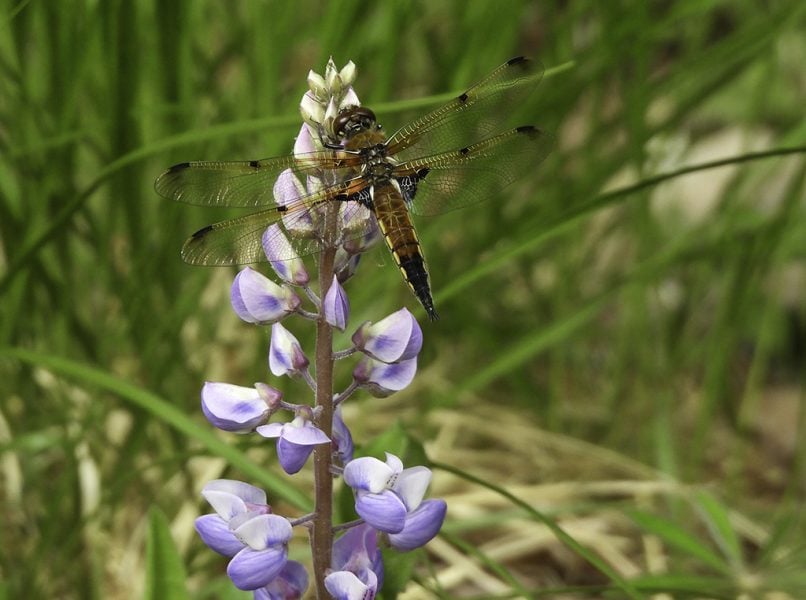
Four-Spotted Skimmer
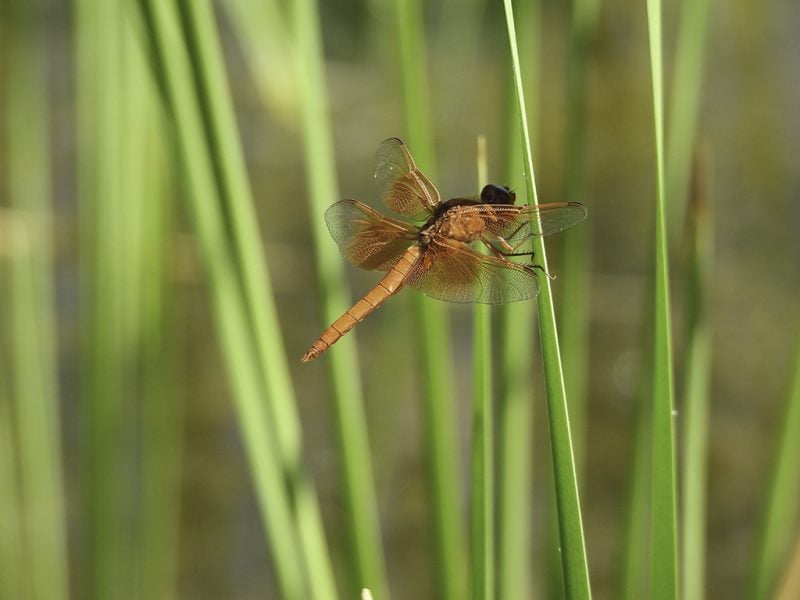
Flame Skimmer

River Jewelwing
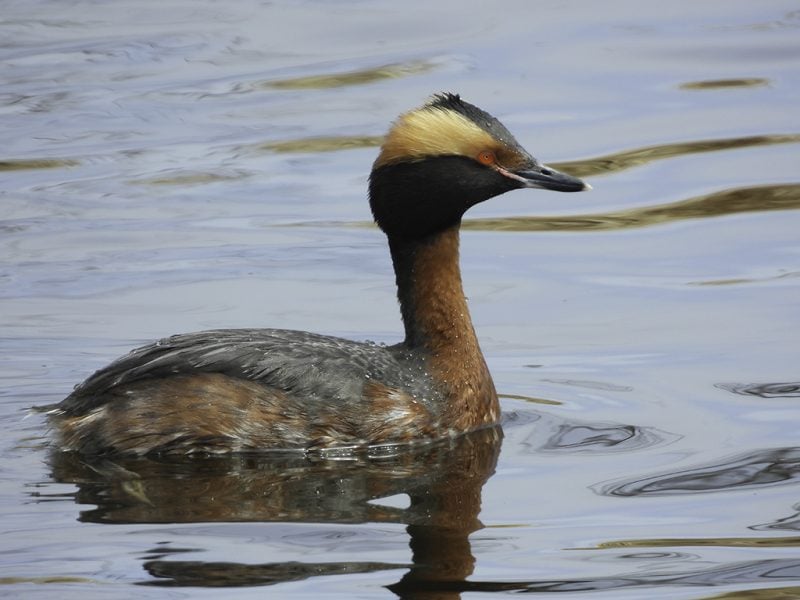
Horned Grebe

Woolly Bear – Photo by Gary Campbell

Joe Pyle

Chipmunk

Monarch
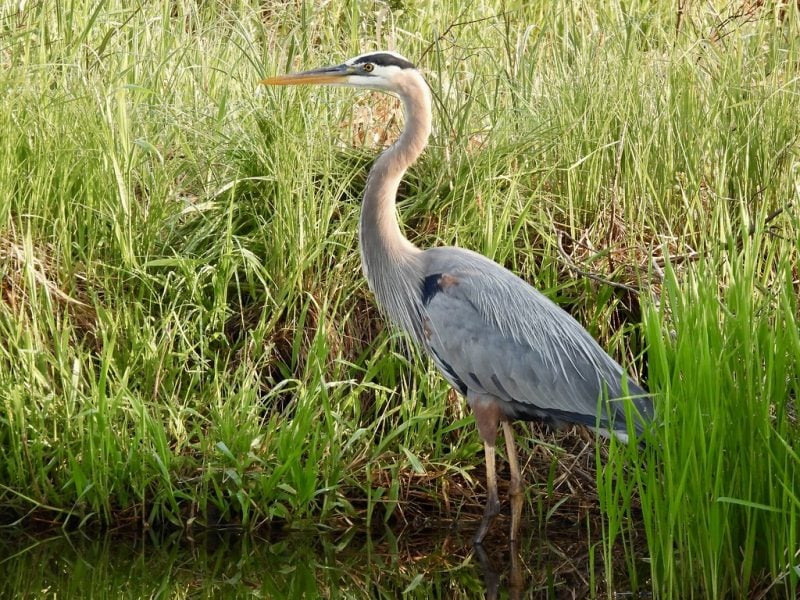
Great Blue Heron

American Lady
Gary Campbell has captured imagery across the globe and close to home. His favorite subjects are birds, dragonflies, and butterflies. Beyond this gallery, you can explore more of Campbell’s photos on Flickr. (Images credit: Gary Campbell)
About the College of Business
The Michigan Tech College of Business prepares tomorrow’s business professionals through STEM-infused, AACSB-accredited degree programs and minors. The college offers nine bachelor of science programs in accounting, business analytics, construction management, economics, engineering management, finance, management, management information systems, and marketing; and four master of science programs in accounting and analytics, applied natural resource economics, engineering management, and the TechMBA®.
Questions? Contact us at business@mtu.edu. Follow the College of Business on Facebook, Instagram, and LinkedIn.