Civil Engineering Graduate Seminar: Porous Materials

Civil Engineering Graduate Seminar, Thursday, September 12, 2013, Room 641 Dow
4pm to 5pm
Speaker: Dr. Zhen Liu, assistant professor of civil engineering, MTU

Title of Presentation: “Modeling the Multiphysical Phenomena in Porous Materials”

Abstract:
Porous materials (geomaterials, cementitious materials, etc.) are among the most abundant engineering materials that serve different disciplines. A thorough understanding of their behaviors is challenged by their susceptibilities to multiphysical processes as the result of their porous nature. Further advancements in porous materials research call for holistic multiphysics models and innovative characterization techniques. This study
investigated the multiphysical phenomena in three different types of porous materials (i.e., soil freezing, cement hydration, and dissociation of methane hydrate) based on their common features. Theoretical frameworks were first developed to couple the thermal, hydraulic and mechanical fields. Thermo-hydro-mechanical models were implemented using the finite element method. The simulation results cast light on engineering applications such as the safety and sustainability of pavement and buried pipes, the hydrating mechanisms of cement-based materials, and the recovery of gas hydrates. On the other hand, new instrumentation techniques were developed and utilized to characterize porous materials. These include a thermo-TDR sensor for the measurement of soil water characteristic curves, a modified capillary rise method for measuring apparent contact angles of soils, and an ultrasonic wave sensor-based method for measuring the pore-size distributions in concrete.

Environmental Engineering Seminar: Acid and Metal-contaminated Lakes

Environmental Engineering Seminar: 9/9/2013; Monday, 3-4 pm, Great Lakes Research Center 2013;

Norman Yan, FRSC, Department of Biology, York University, Toronto Canada,

“Regulators of recovery of acid and metal-contaminated lakes in Sudbury, Canada

I employ 35 years of data from 4 urban lakes in Sudbury, Canada, to explore whether the ecological recovery of lakes from massive historical acid and Cu and Ni contamination is controlled more by regional or local processes, i.e. by colonist arrival or by colonist establishment success and growth. Average zooplankton species richness has tripled in the lakes, a very promising trend, although it has not quite reached recovery targets. Somewhat surprisingly, average species richness increased more rapidly in the two more heavily metal-contaminated lakes, Middle and Hannah Lakes, than in the less heavily contaminated Clearwater and Lohi lakes. An examination of species accumulation curves suggests that Middle and Hannah lakes have not received more colonists, indicating that recovery is not controlled by this regional process: however, within-year persistence of these colonists is much higher in Middle and Hannah lakes than in Clearwater and Lohi lakes, suggesting a local, lake-scale process is regulating recovery. The more rapid recovery in Middle and Hannah lakes is consistent with the long-term trend of metal “toxic units” in the lakes, i.e. with the sum of the ratios of Cu, Ni and Zn LC50’s calculated with the Biotic Ligand Model, divided by metal levels in the lakes. This suggests that metal toxicity is the key factor regulating colonist establishment. Since 2007 we have been assessing the toxicity of Clearwater Lake in lab bioassays, and these results are consistent with the modelling results. After 8 decades of metal damage in Sudbury’s urban lakes, we are approaching a time when metal toxicity will no longer be the main determinant of zooplankton community composition. This will indeed be a welcome day, given that these lakes were among the most severely contaminated of Ontario’s quarter million lakes.
Co-sponsors: Biological Sciences, the Center for Water & Society, and the Great Lakes Research Center

Ride the Waves with GM on Michigan Tech’s Research Vessel Agassiz

General Motors Corporation is siupporting the Summer 2013 “Ride the Waves with GM”. This is an educational program that invites Copper Country youth in Grades 4-12 to explore Lake Superior and adjacent waters aboard Michigan Tech’s research vessel, the Agassiz. Explorations are led by a member of Michigan Tech’s Great Lakes Research Center with expertise on the topic, assisted by undergraduate student mentors.

Find out more about Ride the Waves with GM

Civil and Environmental Engineering Professor Awarded the Fulbright-VTT Grant

Associate Professor Yue Li (CEE) has been awarded the Fulbright-VTT Grant in Science, Technology and Innovation to conduct research in Finland for the duration of six months during 2013–14. VTT Technical Research Centre of Finland is the largest multidisciplinary research organization in Northern Europe. Li will conduct research on structural design for improving earthquake performance of nuclear power plants at the VTT in Espoo, Finland.

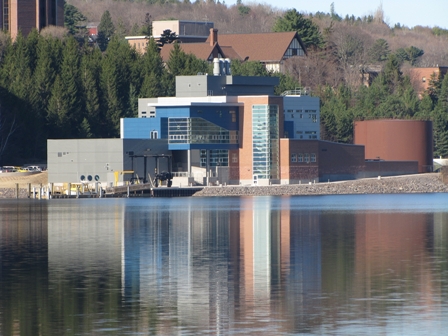
Great Lakes Research Center: One Year Old and Growing

This time last year, the finishing touches were just being put on Michigan Technological University’s Great Lakes Research Center (GLRC). Researchers were starting to move in, and plans were being made for a mid-summer building dedication.

What a difference a year makes. Now celebrating its first anniversary, the GLRC is fast becoming the go-to source for data about the Great Lakes and the home of pioneering investigations into solutions to the challenges facing them.

“This is a unique, amazing place,” says Guy Meadows, director of the GLRC. Meadows came to Michigan Tech from the University of Michigan to lead the Great Lakes research efforts here. “Scientists from all across the basin have their eyes on us. The future of Great Lakes research is based right here.”
MORE

Brian Barkdoll New Co-Head of Civil and Environmental Engineering PCMI

Associate Professor Brian Barkdoll (CEE) is joining Professor David Watkins (CEE) as co-coordinator of the Civil and Environmental Engineering Peace Corps Master’s International Program (PCMI). Barkdoll will replace Associate Professor Kurt Paterson (CEE), who is leaving Michigan Tech to head the Engineering Department at James Madison University in Harrisonburg, Va.

Paterson founded and built the Civil and Environmental Engineering PCMI program, the largest of Tech’s eight PCMI programs and the first PCMI Civil and Environmental Engineering program in the nation. Barkdoll has been advising students in this program for some time, adding his unique perspective as a returned Peace Corps volunteer who served in Nepal.

“We are grateful to Kurt for his numerous contributions to our PCMI program over the years and look forward to working closely with Brian as the new department co-coordinator,” said PCMI Campus Director Kari Henquinet (SS).

Rail Transportation Program (RTP) News Briefs

Rail Transportation Program Announces AREMA Scholarship Recipients

Pasi Lautala, Director of the Rail Transportation Program (RTP), co-authored a spotlight article on the USDOT Research and Innovative Technology (RITA) the only Tier 1 University Transportation Center (UTC) focused on rail. Lautala is associate director of education for the NURail (National University Rail Center) center, a consortium of seven universities including Michigan Tech, led by the University of Illinois at Urbana-Champaign (UIUC) and collaborating on the research theme of shared rail corridors. Lautala’s article, “NURail – Developing a Generation of Railway Professionals” is located online.

Lake Superior Youth Symposium 2013


More than 200 teachers and students from Michigan, Wisconsin, Minnesota and Ontario came to Michigan Technological University for the 10th Biennial Lake Superior Youth Symposium. Students and teachers from 24 schools in three Great Lakes states and Canada spent four days at the symposium, Thursday to Sunday, May 16-19, 2013.
Read more in Michigan Tech News Article

Click here for photos and all of the information, booklet list of Field Trip and Presentation Descriptions, etc.