
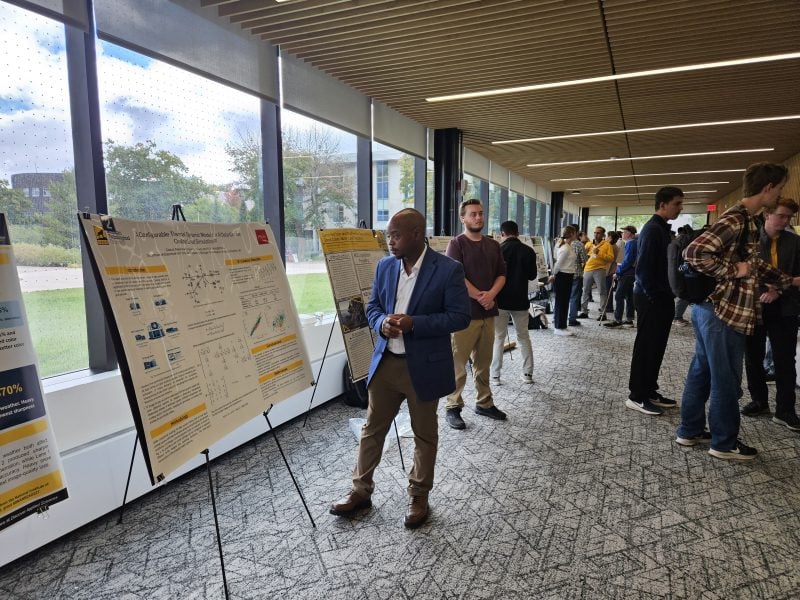
On Friday, Oct 2nd, the ICC student poster competition commenced at 2 PM and concluded at 4 PM. The competition took place in the H-Stem building on Michigan Technological University’s campus, and was open to all students and faculty. Participating students (graduate and undergraduate) were scored based on clarity and their ability to explain the overall concepts and ideas of their research to the judges. Topics ranged from Camera Image-Quality Assessment for Autonomous Driving Perception Under Lens Variation and Winter Weather Conditions, to Pattern Language of Systems of Code Critiquers.
Based on the tallied results, the following undergraduate students were awarded:
Jennifer Celeste – Benchmarking Compact Language Models for Poroacoustic Material Design
Celeste ranked first place with a final score of 4.79 points out of 5 points total. The following abstract summarizes Celeste’s research:
“This study benchmarks compact, domain-adapted language models for poroacoustic material design using an evaluation framework informed by Bloom’s revised taxonomy. Prior work showed that compact models can reproduce acoustics terminology yet remain unreliable on numerical and physical-reasoning tasks. The proposed benchmark evaluates models across four levels of increasing complexity: terminology recall, quantitative application, physical reasoning, and design-constraint reasoning. Models trained on porous-acoustics literature are compared across scale and architecture, including GPT-2 variants from 124 million to 1.5 billion parameters and a parameter-efficient fine-tuned LLaMA-2 model with 7 billion parameters. Performance is reported by category rather than as a single aggregate score to reveal specific strengths and failure modes. The study aims to clarify where compact language models can assist poroacoustic research and where physics-based calculations or hybrid retrieval-and-solver architectures are required for reliable material design in practical scientific design workflows.”
Adyn Skowronski – Multimodal Augmented Reality Typing: Integrating Eye Tracking and Autocorrect for Accurate Input
Skowronski ranked second place with a final score of 4.67 points out of 5 points total. The following abstract summarizes Skowronski’s research:
“Our study aims to significantly expand upon this previous research. Eye tracking input has a much larger role in typing when done in AR as opposed to a physical keyboard; without tactile feedback, it’s much harder for the brain to maintain spatial awareness of the finger’s position relative to the keyboard without looking directly at the keys themselves. To properly understand how we can improve AR typing, we find it imperative to incorporate eye tracking data into evaluation of how we can improve AR typing. Moreover, our study also incorporates eye tracking data in conjunction with our autocorrect system to take a multidimensional approach to word prediction. To conclude, in contrast to previous studies done, we now have the capacity to perform data capture and analysis with multiple methods of input that haven’t been easy to obtain previously.”
Alisa Teige – Computer Vision-Based Shadow Detection and Mapping for Agrivoltaic Systems
Teige ranked third place with a final core of 4.50 points out of 5 points total. The following abstract summarizes Teige’s research:
“Agrivoltaic systems co-locate solar photovoltaic (PV) energy production and crop cultivation, where panel position strongly influences both PV power production and the amount and distribution of sunlight reaching crops. Agrivoltaic tracking strategies can balance these competing objectives, but require methods to quantify how crops are shaded under different panel positions and environmental conditions. Physical, geometry-based shading models can provide this information but require detailed measurements of panel geometry, site layout, and terrain. Computer vision-based shadow detection provides an alternative that can characterize ground-level shading directly from site imagery while reducing the need for detailed site measurements and geometric modeling. In this work, we apply and evaluate two computer vision-based approaches to detect and map shadows from the PV system over time: a U-Net++ model and a probabilistic brightness-ratio model. We find that the two approaches provide similar shadow detection performance; however, the probabilistic brightness-ratio model does not require training or labeled data and is therefore selected for full-scale processing. Using this approach, we develop a tool that produces spatial shade-frequency maps and shading time series at specific ground locations. This provides information needed to characterize crop-level light conditions and can support the development and evaluation of agrivoltaic tracking strategies.”
Based on the tallied results, the following graduate students were awarded:
Ahmad Bshennaty – A Novel Mesh Morphing Approach Using Radial Basis Functions to Model Left Atrial Wall Motion
Bshennaty ranked first place with a final score of 4.60 points out of 5 points total. The following abstract summarizes Bshennaty’s research:
“Left atrial (LA) flow stasis is a major contributor to thrombus formation and stroke in atrial fibrillation (AF). Computational fluid dynamics (CFD) can characterize patient-specific flow, but most studies assume a rigid LA wall, which may misrepresent physiologic flow patterns. This work evaluated the impact of patient-specific LA wall motion on clinically relevant hemodynamic metrics.”
Majid Rostami – CellADE: Training-Free Cell Segmentation with Competitive Accuracy
Rostami ranked second place with a final score of 4.58 points out of 5 points total. The following abstract summarizes Rostami’s research:
“Deep learning methods for cell segmentation achieve high accuracy but require annotated training data, GPU hardware, and retraining when applied to new imaging conditions. We present CellADE, a signal-processing pipeline that segments specular microscopy images of corneal endothelium without training or GPU. The method combines FFT-based adaptive cell size estimation, multi-scale Laplacian-of-Gaussian seed detection, and local fuzzy C-means foreground extraction. On 324 expert-annotated corneal endothelial images, CellADE achieves an F1 score of 0.50 and cell density correlation of R² = 0.74, competitive with Cellpose-SAM (F1 = 0.48, R² = 0.52) while running on a single CPU core in 3 seconds. Unlike deep learning approaches, CellADE generalizes across specular microscopes without retraining. When segmentation quality is insufficient, two parameters (blob scale range and foreground membership threshold) provide direct, interpretable control over the output, making failure diagnosable and recoverable without data collection or model retraining.”
Kevin Li – Benchmarking LiDAR Odometry for GPS-Denied Navigation of Autonomous Surface Vessels in Wave, Wind, and Rain Conditions
Li ranked third place with a final score of 4.58 points out of 5 points total, tying with Rostami. The following abstract summarizes Li’s research:
“Accurate state estimation is fundamental to reliable autonomous navigation of marine surface vessels. Fused Global Positioning System (GPS) and high-rate inertial measurements are the default localization sources for autonomous surface vessels (ASVs) because they provide a global reference. Yet GPS is also the most exposed component of the navigation stack: jamming, spoofing, shoreline occlusion, and multi-path can degrade or corrupt the system without warning. ASVs must operate nearshore for docking, resupply, and inspection, precisely where GPS is least reliable. Light Detection and Ranging (LiDAR) odometry and LiDAR-inertial odometry (LIO) are candidate alternatives that require no external infrastructure, but existing benchmarks assume the structured geometry of ground and aerial environments. In an ASV scan, the dominant feature is a near-planar, wave modulated water surface and the platform itself is agitated by waves and wind. We present a simulation framework for evaluating localization methods—originally developed for ground and aerial robots—on an ASV across a diverse set of sea states spanning wave heights, wind speed, and rainfall. With guidance, planning, and low-level control held fixed, we ask whether LiDAR-only or LIO estimators can close the navigation loop on point-to-point tasks well enough to substitute for GPS in nearshore operations. Six back-ends without a GPS prior—FAST-LIO2, Point-LIO, DLIO, KISS-ICP, Cartographer, and FLOAM—are compared against a GPS-IMU extended Kalman filter reference over eight sea states, with six or ten repeats per condition depending on the task. Preliminary results show that LIO back-ends are more robust and maintains task completion, but degrade sharply under the heaviest, most-challenging conditions. The framework and results establish a baseline for future field validation and comparative studies of GPS-denied ASV localization.”
Closing Remarks
Congratulations to all the winners of the 2026 ICC Student Poster Competition! Students’ creativity, dedication, and hard work was showcased throughout the competition, resulting in excitement and a zone for harboring more knowledge. Thank you to everyone who participated and contributed in order to make this competition a great success. We look forward to seeing many more ideas and creative work in the future.