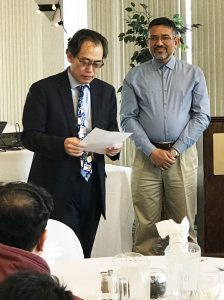
The ICC hosted its first TechTalk on February 16. Each presenter had 2-5 minutes to present his or her research using under five slides. This TechTalk was also a platform for researchers submitting proposals for the Paul Williams Seed Grant Competition. Eight researchers discussed their proposals for the competition that awards two $50K grants to the project that best fulfills the mission of the ICC and shows the most promise for future funding. Topics discussed include exascale computing, marine mobile networking, effective clustering algorithms, cybersecurity, on-body sensing, and the IOT implementation. The winners will be announced by February 23, 2018.
Tim Havens, ICC Associate Director and Director of the Center for Data Sciences, will present his research on Sensor-fused Explosive Hazard Detection at the U.S. Capitol in Washington D.C. this week at “STIx on the Hill.” STIx, which stands for science, technology and information exchange, brings together leading experts in the defense research community to discuss innovative areas for research and development for the Department of Defense. Read more in the Michigan Tech News.
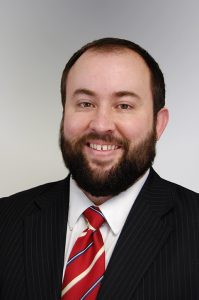
Jeffrey Wall (SBE/CyberS) is a finalist in the 2018 Distinguished Teaching Awards presented by The William G. Jackson Center for Teaching and Learning. Nominees are recognized for their outstanding contributions to the instructional mission of the University. Based on more than 50,000 student ratings of instruction responses, 12 finalists have been identified for the 2018 awards. This is Wall’s second year in a row being nominated.

Sumit Paudyal (ECE/CPS) has been awarded an NSF CAREER Award for a project entitled “CAREER: Operation of Distribution Grids in the Context of High-Penetration Distributed Energy Resources and Flexible Loads.” Sumit joins the ranks of 9 other ICC members who have won the prestigious award.
Saeid Nooshabadi (SAS)is the principal investigator on a project that has received $349,988 from the National Science Foundation. This three-year project is entitled, “Collaborative Research: ACI-CDS&E: Highly Parallel Algorithms and Architectures for Convex Optimization for Realtime Embedded Systems (CORES)”.
Philart Jeon, Director of the Center for Human-Centered Computing (HCC), received a research grant from KATRI for his project entitled, “Development of the safety assessment technique for take‐over in automated vehicles.” The goal of the project is to design and evaluate intelligent auditory interactions for improving safety and user experience in the automated vehicles. Research tasks include developing a driving simulator for automated driving model, modelling driver states in automated vehicles, design and evaluating discrete auditory alerts for safety purpose, and the development of real-time

Jianhui Yue (SAS) has been awarded a 3-year NSF grant with a total budget of $176,876. One PhD student will be supported for two years. The project is titled “Improving Reliability of In-Memory Storage”. The project addresses two challenges of in-memory storage: 1) Memory cells have limited write endurance (i.e., the total number of program/erase cycles per cell), and 2) Nonvolatile memory has to remain in a consistent state in the event of a system crash or power loss. This project will take a holistic approach, spanning from low-level architecture design to high-level OS management, to optimize the reliability, performance, and manageability of in-memory storage.
Chee-Wooi Ten (CPS) is the lead Principal Investigator on a research grant from NSF for a project entitled, “An Actuarial Framework of Cyber Risk Management for Power Grids,” in collaboration with University of Wisconsin-Milwaukee with a total amount of $700,975. Michigan Tech Tech is composed of Chee-Wooi Ten and Co-Pi Yeonwoo Rho. This project aims to establish an actuarial framework for strategizing technological improvements of countermeasures against emerging cyberattacks on wide-area power networks.

Elena Semouchkina (CPS) is the principal investigator on a project that has received a $337,217 research and development grant from the National Science Foundation (NSF). The project is “Developing Anisotropic Media for Transformation Optics by Using Dielectric Photonic Crystals.” This is a three-year project.
Keith Vertanen (HCC), has been identified as one of only 71 instructors who received an exceptional “Average of 7 Dimensions” student evaluation score during Spring semester 2017. Keith’s score is 4.53 (out of 5.0) with an enrollment of 105. Keith received the same recognition in Spring 2016 with a score of 4.49 with an enrollment of 85.