Category: Uncategorized

From Digital Twins to Sustainable Manufacturing: MMET Research at MSEC/NAMRC 2026

Estimated reading time: 6 minutes

Michigan Technological University’s Department of Manufacturing and Mechanical Engineering Technology (MMET) was represented by faculty and graduate students at the 54th NAMRI/SME North American Manufacturing Research Conference (NAMRC) and the ASME International Manufacturing Science and Engineering Conference (MSEC) June 14-18, 2026, where researchers presented work spanning digital twins, additive manufacturing, energy efficiency, supply chain resilience, and sustainability. This premier international advanced manufacturing research conference was hosted by Penn State Department of Mechanical Engineering and the Harold and Inge Marcus Department of Industrial and Manufacturing Engineering.

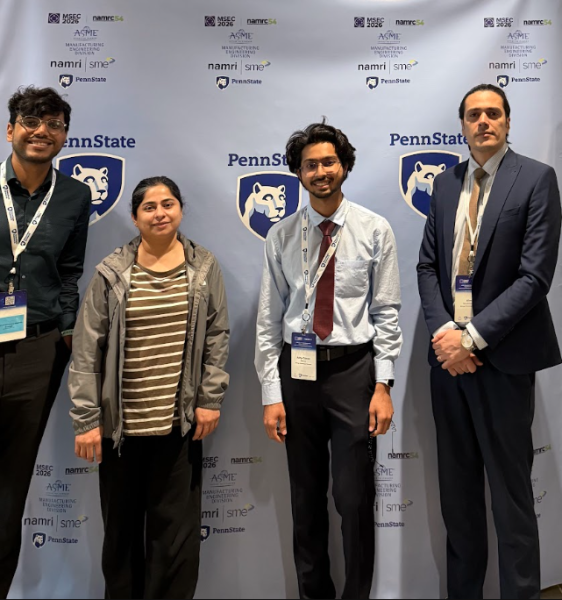
The presentations included work by MMET Assistant Professor Dr. Anis Fatima, PhD candidate Shammas Shafi, and PhD students Alireza Moradimasjedbari and Aditya Sairam Cheruvu. Together, their research highlights the department’s growing contributions to advanced manufacturing, process optimization, and sustainable engineering systems.

Pictured left to right: Shammas Shafi, Dr. Anis Fatima, Aditya Cheruvu, and Alireza Moradimasjedbari

Anis Fatima presented research titled “Process Improvement Using Digital Twins: A Lean Case Study in Sensor Manufacturing.” The paper was coauthored by Muhammad Shamikh Khan of Soluzione Solare in Vicenza, Italy, and Vinh Nguyen of Michigan Tech. This study investigated how digital twin technology can be used to optimize stamping processes for energy-sector components. By comparing traditional hammering, manual pressing, and automated stamping through CAD modeling and Siemens Tecnomatix, the researchers demonstrated the value of virtual experimentation in identifying more efficient manufacturing methods.

The digital twin-enabled automated process reduced cycle time by 31%, improved system efficiency from 10% to 99.95%, and achieved a Six Sigma yield with zero defects per million opportunities. The results show how digital twins can support lean manufacturing strategies by reducing waste, improving efficiency, and enabling continuous process improvement before changes are implemented on the shop floor.

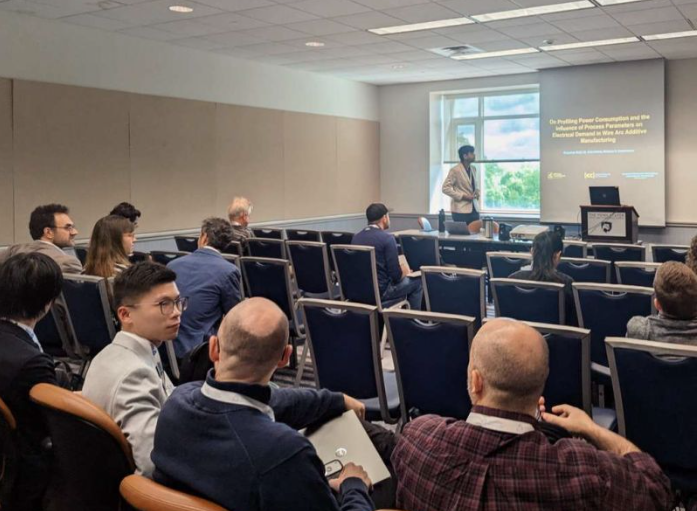
Shammas Shafi presented his NAMRC paper, “On Profiling Power Consumption and the Influence of Process Parameters on Electrical Demand in Wire Arc Additive Manufacturing.” The paper was coauthored by Fatima and Nicholas V. Hendrickson, both faculty from Michigan Tech’s MMET Department. The study focused on Wire Arc Additive Manufacturing, which is an emerging metal additive manufacturing process known for high deposition rates and material efficiency in producing large-scale components.

The research experimentally measured electrical power consumption from both the welding power source and robotic system during startup, idle operation, robot motion, active welding, and shutdown. The team also studied how voltage, wire feed speed, and travel speed affected electrical demand. Their findings showed that the welding system accounted for approximately 80% of total system power consumption, while the robotic system contributed about 20%. Voltage had the greatest influence on power demand, followed by wire feed speed, while travel speed primarily affected total energy input by changing welding time.

The study established a system efficiency of approximately 62% and a process-level specific energy consumption of 10.5 MJ/kg. These findings provide a clearer picture of where energy is consumed during Wire Arc Additive Manufacturing and create a foundation for future sustainability studies, including life cycle assessments and energy-efficient process optimization strategies. Shafi also co-chaired a conference session, marking a memorable milestone during his first time attending both NAMRC and MSEC.

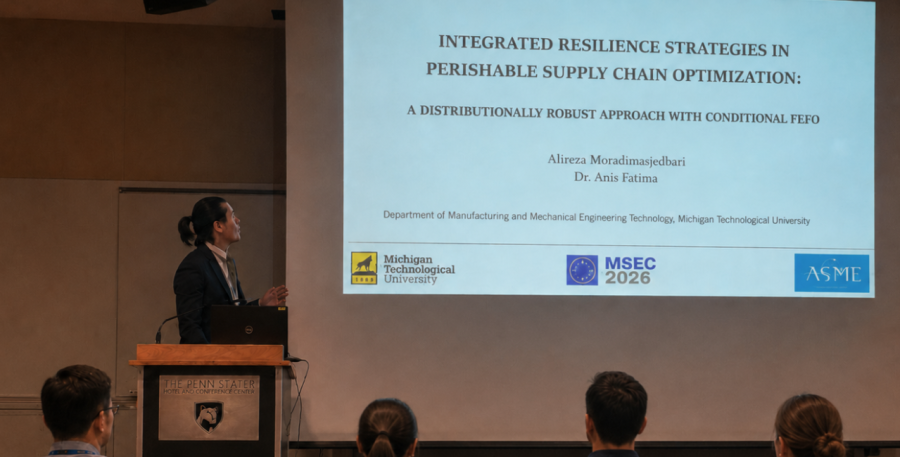
Alireza Moradimasjedbari presented “Integrated Resilience Strategies in Perishable Supply Chain Optimization: A Distributionally Robust Approach with Conditional FEFO,” coauthored with Fatima. His research focuses on improving the resilience and sustainability of perishable supply chains, where demand uncertainty, limited shelf life, and disruptions can lead to waste, lost sales, and increased costs.

The study develops an optimization model to support better decisions about inventory, distribution, and product freshness. The model considers cost, waste, customer freshness requirements, and uncertainty in demand while evaluating resilience strategies such as transferring inventory between distribution centers and offering discounts for near-expiry products. Results show that combining freshness-aware inventory management with flexible distribution and pricing strategies can reduce waste and improve overall supply chain performance.

Moradimasjedbari received an NSF Travel Award to support his attendance and presentation at ASME MSEC 2026. His paper was also identified as a strong fit for submission to a joint special issue organized by the ASME Journal of Mechanical Design and the ASME Journal of Manufacturing Science and Engineering. He noted that attending MSEC helped him expand his professional network through discussions with researchers working in manufacturing, supply chain resilience, sustainability, and optimization, including conversations about potential future inter-university collaborations.

MMET PhD student Alireza Moradimasjedbari presents his research on resilient and sustainable perishable supply chains at MSEC 2026.

Aditya Cheruvu presented “Quantifying the Environmental Impact of Unrecovered Feedstock during Powder-based Additive Manufacturing.” The paper was coauthored by his advisor, MMET Assistant Professor Dr. David M. Labyak, and Assistant Professor Dr. Sriram Vijayan, in the Department of Materials Science and Engineering.

Cheruvu’s research examined the environmental impact of unrecovered titanium and titanium-alloy powders used in powder-based additive manufacturing. These powders are widely used to produce lightweight, high-performance components for applications in space, aviation, and biomedical industries. Although powder-based additive manufacturing processes often lose only a small percentage of material during each build cycle, the cumulative losses across repeated reuse cycles can have a significant environmental impact.

The study quantified unavoidable powder losses across ten reuse cycles and estimated the associated carbon dioxide emissions. Using publicly available market research data, published powder recovery efficiencies, and emissions data from the ANSYS Granta database, the work highlights the environmental cost of current additive manufacturing powder handling practices. The findings emphasize the need for more sustainable material production, powder processing, and recycling technologies to reduce future emissions.

MMET PhD student Aditya Cheruvu presents his research on the environmental impact of unrecovered feedstock in powder-based additive manufacturing at MSEC 2026.

Dr. Vinh Nguyen, an Assistant Professor in Mechanical and Aerospace Engineering (MAE) and affiliated faculty member in MMET also had several presentations by his students from the MAE Department on topics including vision-language models for infrared industrial sensing in additive manufacturing, few-shot VLM-based G-code and HMI verification in CNC machining, in-process large language model-based querying of digital twins for additive manufacturing processes, computational fluid dynamics analysis of turbulent flow in engine nozzle systems, and experiential learning in assembly process development. These presentations included work by Nazanin Mahjourian, Yaasi Hashem Pour, Karuka Reiki Tanaya, Samantha Torres, and Gracie Brownlow, with Nguyen serving as a coauthor on each project.

The MMET Department’s presence at MSEC/NAMRC reflects the breadth of manufacturing research taking place at Michigan Tech, from improving manufacturing processes through digital twins to reducing energy demand in additive manufacturing, strengthening supply chain resilience, and evaluating the environmental impact of advanced materials. The work presented by Fatima, Shafi, Moradimasjedbari, and Cheruvu demonstrates how MMET researchers are addressing practical challenges in modern manufacturing while contributing to broader goals of efficiency, sustainability, and innovation.

Gene Haas Foundation Awards $18,000 to Support Michigan Tech Manufacturing Students

Estimated reading time: 2 minutes

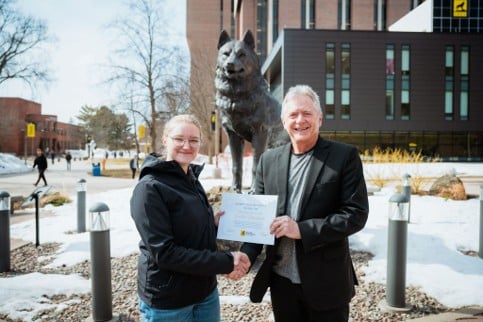
MMET Receives $18,000 Gene Haas Foundation Scholarship Grant Michigan Tech’s Department of Manufacturing and Mechanical Engineering Technology has received an $18,000 grant from the Gene Haas Foundation to support student scholarships in manufacturing and engineering programs with an emphasis on Computer Numerical Control (CNC) technology. Students enrolling in Fundamentals of Machining and/or Computer Aided Manufacturing courses will be eligible to apply for scholarships.

The funding will help students continue developing skills in areas such as CNC machining, CAD/CAM, geometric dimensioning and tolerancing, metrology, machining mathematics, and design for manufacturability. Scholarship recipients will be selected by MMET faculty in conjunction with a program advisory committee.

In addition to tuition support, eligible uses of the grant include student toolkits containing items such as calipers, micrometers, and safety equipment, as well as participation in approved CNC competitions and manufacturing-related training opportunities.

The Gene Haas Foundation supports programs that prepare students for careers in advanced manufacturing. This award will help MMET students gain the technical knowledge and hands-on experience needed to succeed in the manufacturing industry.

“The Gene Haas Foundation scholarship award for the MMET Department will help meet our vision to create a learning environment where students receive a world-class education, and the goal to prepare hands-on professionals who can apply Industry 4.0 methodology in advanced manufacturing,” said John Irwin, chair and professor in MMET.

“Thank you to the Gene Haas Foundation for their support,” said Irwin. “We look forward to building on this partnership to educate industry-ready graduates in MMET.”

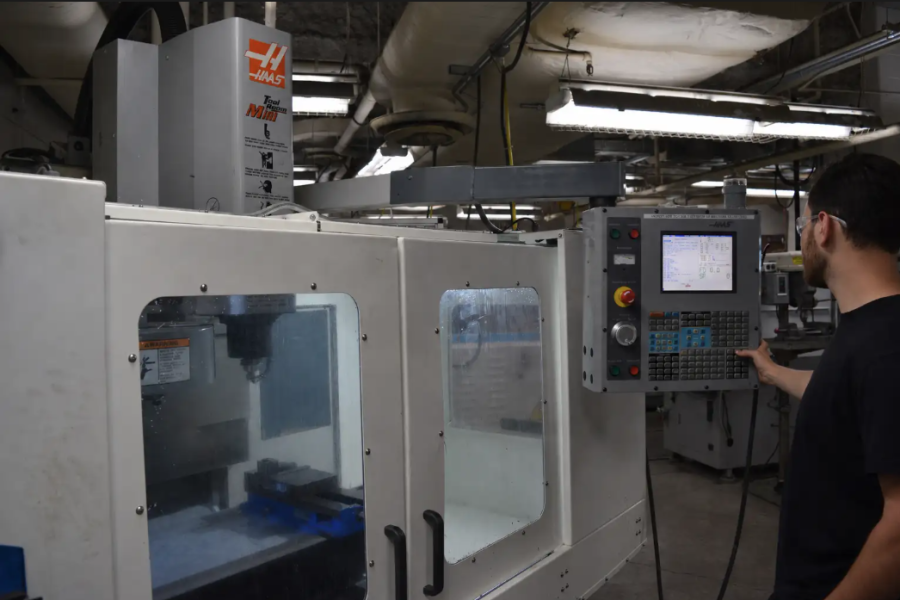
A Michigan Tech MMET student gains hands-on experience operating a Haas CNC machine in the department’s manufacturing laboratory.