From Digital Twins to Sustainable Manufacturing: MMET Research at MSEC/NAMRC 2026

Estimated reading time: 6 minutes

Michigan Technological University’s Department of Manufacturing and Mechanical Engineering Technology (MMET) was represented by faculty and graduate students at the 54th NAMRI/SME North American Manufacturing Research Conference (NAMRC) and the ASME International Manufacturing Science and Engineering Conference (MSEC) June 14-18, 2026, where researchers presented work spanning digital twins, additive manufacturing, energy efficiency, supply chain resilience, and sustainability. This premier international advanced manufacturing research conference was hosted by Penn State Department of Mechanical Engineering and the Harold and Inge Marcus Department of Industrial and Manufacturing Engineering.

The presentations included work by MMET Assistant Professor Dr. Anis Fatima, PhD candidate Shammas Shafi, and PhD students Alireza Moradimasjedbari and Aditya Sairam Cheruvu. Together, their research highlights the department’s growing contributions to advanced manufacturing, process optimization, and sustainable engineering systems.

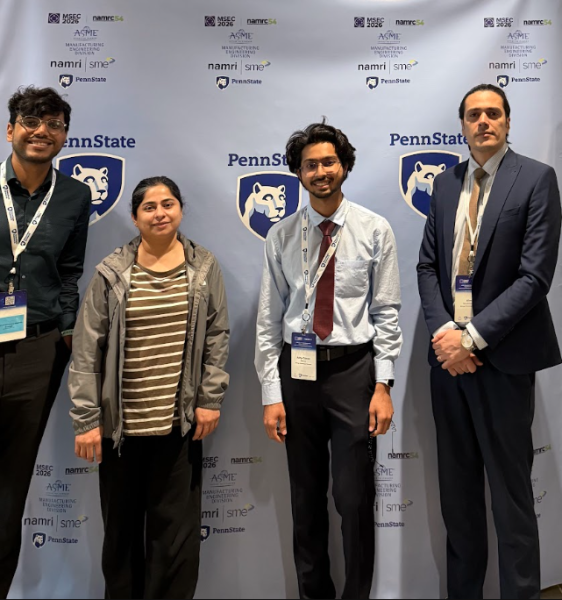
Pictured left to right: Shammas Shafi, Dr. Anis Fatima, Aditya Cheruvu, and Alireza Moradimasjedbari

Anis Fatima presented research titled “Process Improvement Using Digital Twins: A Lean Case Study in Sensor Manufacturing.” The paper was coauthored by Muhammad Shamikh Khan of Soluzione Solare in Vicenza, Italy, and Vinh Nguyen of Michigan Tech. This study investigated how digital twin technology can be used to optimize stamping processes for energy-sector components. By comparing traditional hammering, manual pressing, and automated stamping through CAD modeling and Siemens Tecnomatix, the researchers demonstrated the value of virtual experimentation in identifying more efficient manufacturing methods.

The digital twin-enabled automated process reduced cycle time by 31%, improved system efficiency from 10% to 99.95%, and achieved a Six Sigma yield with zero defects per million opportunities. The results show how digital twins can support lean manufacturing strategies by reducing waste, improving efficiency, and enabling continuous process improvement before changes are implemented on the shop floor.

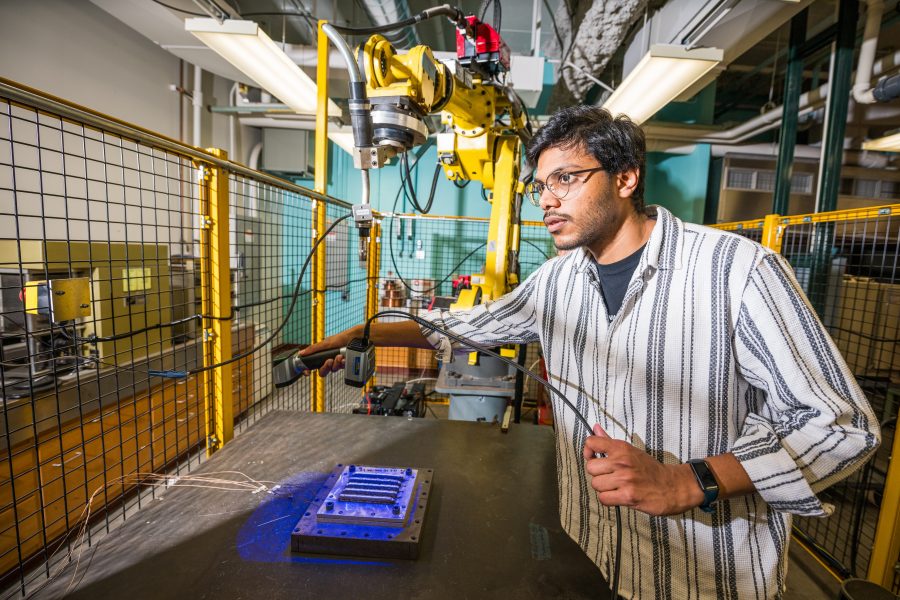
Shammas Shafi presented his NAMRC paper, “On Profiling Power Consumption and the Influence of Process Parameters on Electrical Demand in Wire Arc Additive Manufacturing.” The paper was coauthored by Fatima and Nicholas V. Hendrickson, both faculty from Michigan Tech’s MMET Department. The study focused on Wire Arc Additive Manufacturing, which is an emerging metal additive manufacturing process known for high deposition rates and material efficiency in producing large-scale components.

The research experimentally measured electrical power consumption from both the welding power source and robotic system during startup, idle operation, robot motion, active welding, and shutdown. The team also studied how voltage, wire feed speed, and travel speed affected electrical demand. Their findings showed that the welding system accounted for approximately 80% of total system power consumption, while the robotic system contributed about 20%. Voltage had the greatest influence on power demand, followed by wire feed speed, while travel speed primarily affected total energy input by changing welding time.

The study established a system efficiency of approximately 62% and a process-level specific energy consumption of 10.5 MJ/kg. These findings provide a clearer picture of where energy is consumed during Wire Arc Additive Manufacturing and create a foundation for future sustainability studies, including life cycle assessments and energy-efficient process optimization strategies. Shafi also co-chaired a conference session, marking a memorable milestone during his first time attending both NAMRC and MSEC.

Alireza Moradimasjedbari presented “Integrated Resilience Strategies in Perishable Supply Chain Optimization: A Distributionally Robust Approach with Conditional FEFO,” coauthored with Fatima. His research focuses on improving the resilience and sustainability of perishable supply chains, where demand uncertainty, limited shelf life, and disruptions can lead to waste, lost sales, and increased costs.

The study develops an optimization model to support better decisions about inventory, distribution, and product freshness. The model considers cost, waste, customer freshness requirements, and uncertainty in demand while evaluating resilience strategies such as transferring inventory between distribution centers and offering discounts for near-expiry products. Results show that combining freshness-aware inventory management with flexible distribution and pricing strategies can reduce waste and improve overall supply chain performance.

Moradimasjedbari received an NSF Travel Award to support his attendance and presentation at ASME MSEC 2026. His paper was also identified as a strong fit for submission to a joint special issue organized by the ASME Journal of Mechanical Design and the ASME Journal of Manufacturing Science and Engineering. He noted that attending MSEC helped him expand his professional network through discussions with researchers working in manufacturing, supply chain resilience, sustainability, and optimization, including conversations about potential future inter-university collaborations.

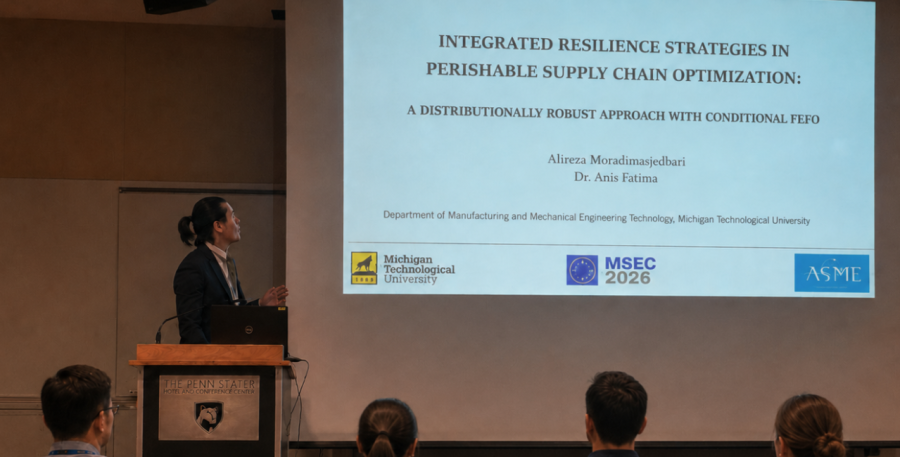
MMET PhD student Alireza Moradimasjedbari presents his research on resilient and sustainable perishable supply chains at MSEC 2026.

Aditya Cheruvu presented “Quantifying the Environmental Impact of Unrecovered Feedstock during Powder-based Additive Manufacturing.” The paper was coauthored by his advisor, MMET Assistant Professor Dr. David M. Labyak, and Assistant Professor Dr. Sriram Vijayan, in the Department of Materials Science and Engineering.

Cheruvu’s research examined the environmental impact of unrecovered titanium and titanium-alloy powders used in powder-based additive manufacturing. These powders are widely used to produce lightweight, high-performance components for applications in space, aviation, and biomedical industries. Although powder-based additive manufacturing processes often lose only a small percentage of material during each build cycle, the cumulative losses across repeated reuse cycles can have a significant environmental impact.

The study quantified unavoidable powder losses across ten reuse cycles and estimated the associated carbon dioxide emissions. Using publicly available market research data, published powder recovery efficiencies, and emissions data from the ANSYS Granta database, the work highlights the environmental cost of current additive manufacturing powder handling practices. The findings emphasize the need for more sustainable material production, powder processing, and recycling technologies to reduce future emissions.

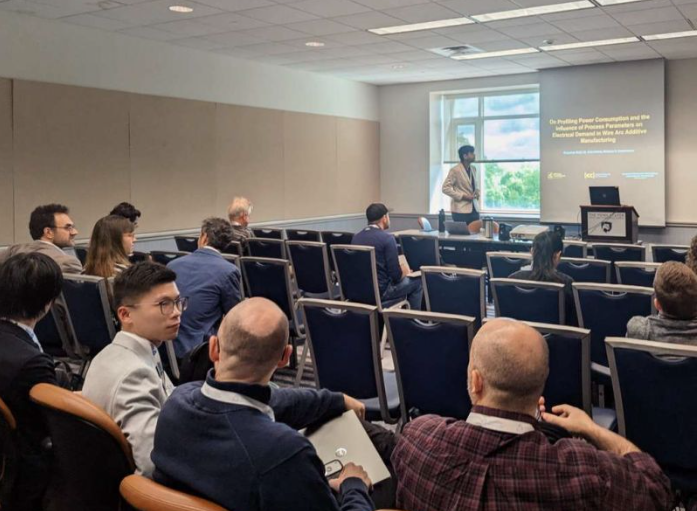
MMET PhD student Aditya Cheruvu presents his research on the environmental impact of unrecovered feedstock in powder-based additive manufacturing at MSEC 2026.

Dr. Vinh Nguyen, an Assistant Professor in Mechanical and Aerospace Engineering (MAE) and affiliated faculty member in MMET also had several presentations by his students from the MAE Department on topics including vision-language models for infrared industrial sensing in additive manufacturing, few-shot VLM-based G-code and HMI verification in CNC machining, in-process large language model-based querying of digital twins for additive manufacturing processes, computational fluid dynamics analysis of turbulent flow in engine nozzle systems, and experiential learning in assembly process development. These presentations included work by Nazanin Mahjourian, Yaasi Hashem Pour, Karuka Reiki Tanaya, Samantha Torres, and Gracie Brownlow, with Nguyen serving as a coauthor on each project.

The MMET Department’s presence at MSEC/NAMRC reflects the breadth of manufacturing research taking place at Michigan Tech, from improving manufacturing processes through digital twins to reducing energy demand in additive manufacturing, strengthening supply chain resilience, and evaluating the environmental impact of advanced materials. The work presented by Fatima, Shafi, Moradimasjedbari, and Cheruvu demonstrates how MMET researchers are addressing practical challenges in modern manufacturing while contributing to broader goals of efficiency, sustainability, and innovation.

Gene Haas Foundation Awards $18,000 to Support Michigan Tech Manufacturing Students

Estimated reading time: 2 minutes

MMET Receives $18,000 Gene Haas Foundation Scholarship Grant Michigan Tech’s Department of Manufacturing and Mechanical Engineering Technology has received an $18,000 grant from the Gene Haas Foundation to support student scholarships in manufacturing and engineering programs with an emphasis on Computer Numerical Control (CNC) technology. Students enrolling in Fundamentals of Machining and/or Computer Aided Manufacturing courses will be eligible to apply for scholarships.

The funding will help students continue developing skills in areas such as CNC machining, CAD/CAM, geometric dimensioning and tolerancing, metrology, machining mathematics, and design for manufacturability. Scholarship recipients will be selected by MMET faculty in conjunction with a program advisory committee.

In addition to tuition support, eligible uses of the grant include student toolkits containing items such as calipers, micrometers, and safety equipment, as well as participation in approved CNC competitions and manufacturing-related training opportunities.

The Gene Haas Foundation supports programs that prepare students for careers in advanced manufacturing. This award will help MMET students gain the technical knowledge and hands-on experience needed to succeed in the manufacturing industry.

“The Gene Haas Foundation scholarship award for the MMET Department will help meet our vision to create a learning environment where students receive a world-class education, and the goal to prepare hands-on professionals who can apply Industry 4.0 methodology in advanced manufacturing,” said John Irwin, chair and professor in MMET.

“Thank you to the Gene Haas Foundation for their support,” said Irwin. “We look forward to building on this partnership to educate industry-ready graduates in MMET.”

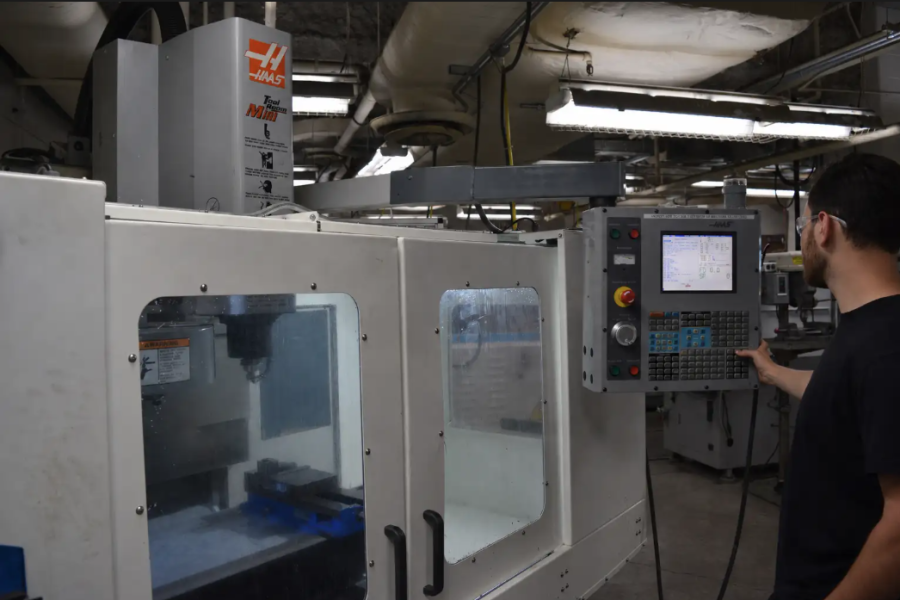
A Michigan Tech MMET student gains hands-on experience operating a Haas CNC machine in the department’s manufacturing laboratory.

Get the Details on Our New Manufacturing Engineering PhD Program

Learn more about the Manufacturing Engineering PhD curriculum.

Our department has established a new PhD program in Manufacturing Engineering. Applications are now being accepted for enrollment in spring semester 2025.

The Manufacturing Engineering PhD program will emphasize research focused on the most viable and efficient processes used during fabrication, shaping, machining, and assembly. The current MS in Manufacturing Engineering includes core manufacturing courses along with options for coursework that specialize in Industry 4.0 topics like additive manufacturing. The new Ph.D degree program is a good opportunity for our students with a master’s degree in Manufacturing Engineering to further their domain knowledge and expertise in the field. 

The curriculum was designed with industry, students, and the manufacturing community in mind. The department used the SME Four Pillars of Manufacturing Knowledge as a guide.

Four Pillars of Manufacturing Knowledge and MS/PhD Manufacturing Engineering Coursework

Foundation Skills

Mathematics and Science

MA 5701 – Statistical Methods (required MS/PhD core course)

Personal Effectiveness

MFGE 6010 – Engineering Research Communications (required MS/PhD core course)

Pillar #1—Materials and Manufacturing Processes

Engineering Sciences, Engineering Materials

MET 5377 – Applied Fluid Power (technical emphasis course)

MET 5378 – Advanced Hydraulics (technical emphasis course)

MSE 5400 – Statistical Quality Control in Materials Manufacturing (technical emphasis course)

Manufacturing Processes

EET 5144 – Real-Time Robotics Systems (technical emphasis course)

EET 5147 – Industrial Robotic Vision System and Advanced Teach Pendant Programming (technical emphasis course)

MET 4780 – Advanced Manufacturing (technical emphasis course)

Pillar #2—Product, Tooling and Assembly Engineering

Product Design

MFGE 5100 – Tolerance Analysis with Geometric Dimensioning and Tolerancing (required MS/PhD core course)

Equipment/Tool Design, Process Design

MEEM 5695 – Additive Manufacturing (technical emphasis course)

MFGE 5300 – Design for Additive Manufacturing (technical emphasis course)

MFGE 5400 – Additive Manufacturing Lab (technical emphasis course)

Pillar #3—Manufacturing Systems and Operations

Production System Design

BA 5610 – Operations Management (technical emphasis course)

MEEM 5656 – Advanced Production Planning (technical emphasis course)

MET 4510 – Lean Manufacturing and Production Planning (technical emphasis course)

MET 4585 – Facilities Layout and Safety Design (technical emphasis course)

Industry 4.0 and Automated Systems and Controls

EET 5373 – Advanced Programmable Controllers (technical emphasis course)

MET 4355 – Industrial Systems Simulation (technical emphasis course)

MFGE 5200 – Industry 4.0 Concepts (required MS/PhD core course)

SAT 4343 – Network Engineering (technical emphasis course)

Pillar #4—Manufacturing Competitiveness

Quality and Continuous Improvement

MEEM 5650 – Advanced Quality Engineering (technical emphasis course)

MEEM 5655 – Introduction to Lean Manufacturing (technical emphasis course)

MEEM 5670 – Experimental Design in Engineering (technical emphasis course)

Manufacturing Management

MFGE 5000 – Organizational Leadership (required MS/PhD core course)

MFGE 5500 – Industrial Safety (required MS/PhD core course)

The number of credits required to fulfill degree requirements for those with a bachelor of science degree is 60 and 30 credits for those with a master’s degree. 

PhD students following the MS pathway can take the 16 credits of core courses as electives. A minimum of 12 credits is required in dissertation research or practicum. The dissertation research can be done at the workplace as a supervised practicum offering engineers the flexibility to complete this degree while working full-time.

For more information about how you can be part of the program, contact MMET graduate program director David Wanless.

Patrick Moeller Named 2024 MMET Department Scholar

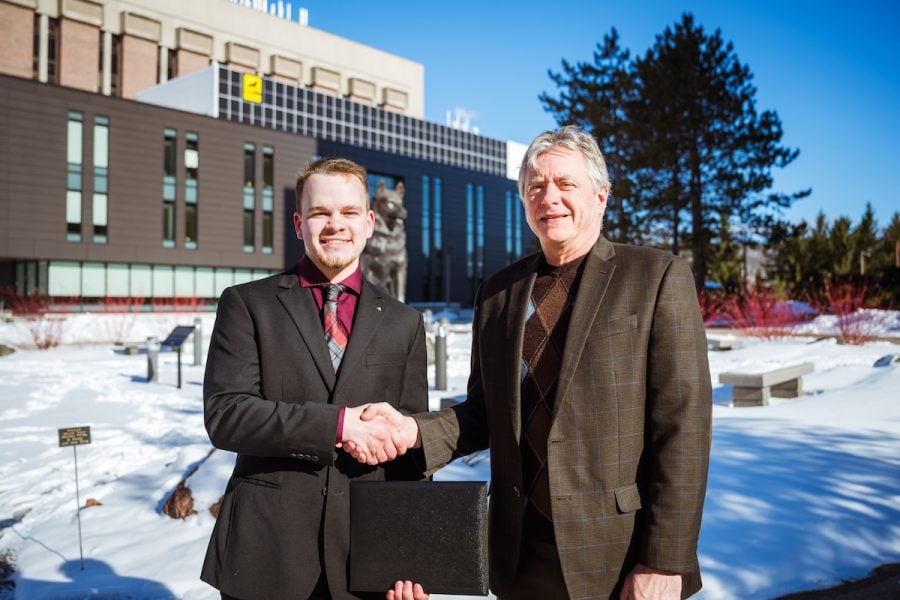
Patrick Moeller and Dr. John Irwin

The Department of Manufacturing and Mechanical Engineering Technology (MMET) is pleased to announce that Patrick Moeller has been selected as the 2024 MMET Department Scholar.

Patrick is currently a senior in mechanical engineering technology where he continues to excel in all areas of learning, intellectual creativity, and curiosity. His journey started in 2020 after applying and receiving the NSF sponsored ETS-IMPRESS scholarship. Patrick participates in the Pavlis Honors College that has an academic enhancement component requiring six credits outside of his field of study. Moeller’s interest in Engineering Management lead to his adding a second degree, combining his engineering skills and leadership abilities.

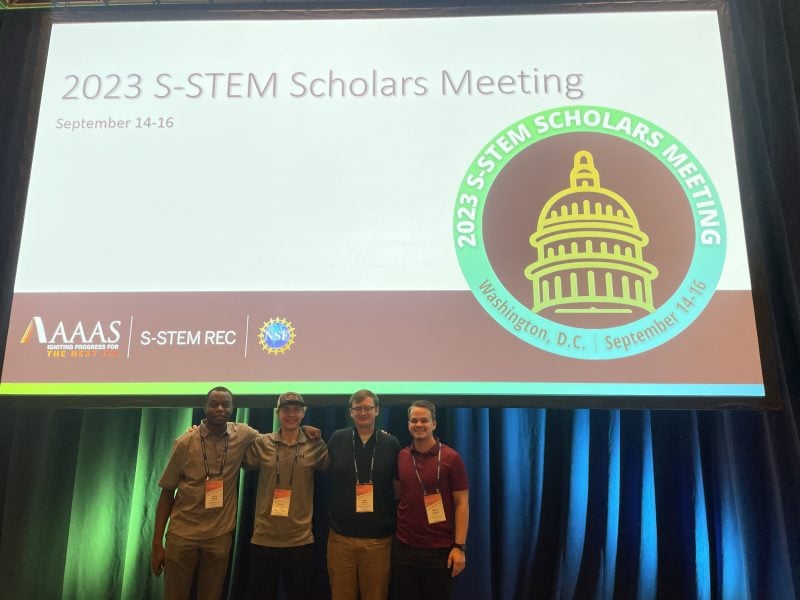
In 2023, Moeller was selected for the first annual American Association for the Advancement of Science (AAAS) S-STEM REC Scholars Conference in Washington, D.C. This inspirational opportunity provided Patrick with great insights on his academic and professional career, while networking with over 1,000 NSF S-STEM scholars from around the nation.

Patrick also participated in the 2022 Zachary R. Podkul MMET student scholarship competition. Through this process, he created a 3D model of a cookie cutter design in the shape of the Portage Lake lift bridge to represent Michigan Tech earning second place.

Mr. Moeller has pursued numerous leadership opportunities while attending Michigan Tech, including serving as an Orientation Team Leader, Campus Tour Guide, Teaching Assistant and Learning Center Coach, and President for the Delta Zeta Chapter of Epsilon Pi Tau International Honor Society. Patrick has also participated in various clubs and engaged in Greek life. He plans to graduate in the spring of 2025.

The MMET Department is proud of Patrick and all that he has accomplished as a Michigan Tech student. Mr. Moeller will emerge as a strong leader in his field. “Patrick has made a positive impact on the MMET Department as a grading assistant, lab assistant, tutor, and leader of the honor society students,” said MMET Department Chair, Dr. Irwin.

“Patrick is dependable, honest and relates well with students, faculty, and the Michigan Tech community. He is very deserving of this award as were the other two department scholar finalists, Bobby Coene and Imelia Meiser.” 

Read more:

My Story: Patrick Moeller, MTUengineer

My Story: Patrick Moeller, MTUengineer

L to R: Henry Inyang, Logan Schultz, Andrew Brodowski and Patrick Moeller

Michigan Tech MET student Patrick Moeller had a co-op at Georgia Pacific last fall, and an internship this past summer at Milwaukee Tool. Both helped him to prepare and decide on his career.

Recently Patrick traveled to Washington DC with three fellow students for the American Association for the Advancement of Science (AAAS) S-STEM REC Scholars Conference. Their travel and expenses were fully funded by AAAS. The annual event is co-hosted by the National Science Foundation.

“If you’re unsure about applying for college, I challenge you to submit your applications. After all, you may have doors open that you never even knew existed.”

Advice for prospective students, from Patrick Moeller
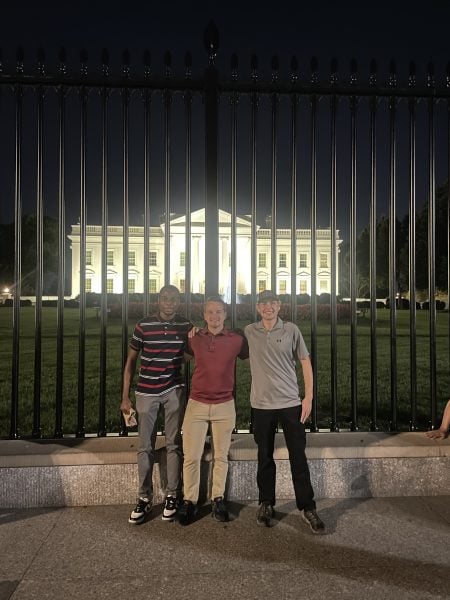
Henry, Patrick, and Logan, outside the White House in Washington DC.

At Michigan Tech, Patrick is part of the Engineering Technology Scholars-IMPRESS Program. “The ETS-IMPRESS scholarship has opened more doors than I possibly could have imagined. This trip is a great example of one of those doors,” he says.

“The thing that stuck with me the most from the conference was when a panelist asked the audience to raise their hand if they had ever felt ‘impostor syndrome’ at some point in their educational career. I was surprised to see almost every scholar in the room raise their hand. This made me realize the feeling of ‘I don’t belong here’ is something that most people will experience in their careers and I was not alone. However, this is actually a good thing because a majority of the time it means you are on the road to success. Feeling the impostor syndrome means that you have challenged yourself enough to be outside of your comfort zone which is the first step in personal and professional development. I felt this way when applying to college. I did not believe that I could be successful and wasn’t sure if college was for me.”

“In high school, I had a few teachers who believed in me and pushed me to go to college. Having this support inspired me to do so. Applying to college can be stressful and intimidating, but it is also one of the most rewarding decisions you can make. The MMET Department is a community of faculty, staff, and scholars who inspire each other to achieve their goals and overcome challenges along the way.”

John Irwin, professor and chair of the MMET Department serves as Patrick’s ETS-IMPRESS faculty mentor. “I would like to give Dr. John Irwin a special thank you for nominating Henry, Logan, Andrew, and me to attend this fantastic networking and professional development event!”

Not a transfer student, but still want info on MMET scholarships and opportunities?

Contact MMET Department Chair John Irwin for more details

More about ETS IMPRESS

Incoming community college transfer students who plan to major in electrical engineering technology, mechanical engineering technology, computer network and system administration, cybersecurity, or mechatronics are invited to apply for the Engineering Technology Scholars-IMPRESS program. In addition to an annual scholarship, students admitted to the program engage in high-impact curricular and co-curricular activities designed to increase their success.

Students receiving an ETS-IMPRESS scholarship are admitted to the Pavlis Honors College at Michigan Tech, an innovative and inclusive honors program designed around high-impact educational opportunities.

Students selected for the program can receive up to $10,000 per year. Additionally, transfer students who engage in the bridge program will receive a $2,500 stipend for a 7-week research program the summer before their first semester.

New Faculty Spotlight: Rachel Store

Rachel Store

Rachel Store recently joined the Department of Manufacturing and Mechanical Engineering Technology (MMET) as an assistant teaching professor. She earned her BS and MS at Michigan Tech, both in Mechanical Engineering.

What first drew you to Michigan Tech?

It all started when I was in high school. My parents moved back to Michigan’s Upper Peninsula after a 25-year military career. They were living in Escanaba. I knew I wanted to study engineering; I wanted to play varsity soccer; and I wanted to be close enough to my family that I could see them within a day. Michigan Tech was honestly the only school that fit that bill—so it was an easy decision. It was also the only campus I visited. But I fell in love with Tech. So much so, that after I finished my undergrad, I went for a victory lap masters degree—Tech has a fantastic accelerated masters program! And I loved the campus, the community, and the Keweenaw. Houghton truly is a special place.

After graduating with my Master’s degree, I got a job in Milwaukee. I still found myself coming back to Houghton several times a month to see my boyfriend. He’s really what brought me back to Houghton. As soon as I could, I started looking for jobs back in the Houghton area (spoiler, we’ve been married for four years and are blessed with two wonderful children).  

I was delighted when I found work back at Michigan Tech, in the Department of Mechanical Engineering-Engineering Mechanics. I actually had several offers from local companies that I passed on because I wanted to be part of the Tech community again. I was in the ME-EM Department for 5 years. Now, I am super excited to move into a more student-focused position in the MMET Department.

“Get out and talk to people. Talk to your classmates, talk to your professors, talk to the locals.  The best thing about Houghton and MTU are the people.”

Advice to incoming students, from Rachel Store.

What do you consider an important long-term goal for your teaching, research, and outreach?

My background in industry was manufacturing and quality. I really enjoy teaching the topics where you go from a design or theory into making something physical, for example, a product or a lab sample. I enjoy additive manufacturing and especially forming processes. My research right now is focused on materials manufacturing with friction stir processing. I am working with Dr. Scott Wagner (MMET) and Dr. Vinh Nguyen (ME-EM) on a project right now. I am hoping to earn a PhD in a few years. In the meantime, I want to continue to develop as a teacher.

What do you hope to accomplish, as an educator and as a researcher, over the next few years?

I’ve been spending a lot of time lately thinking about teaching—how to teach, why it matters, and how I can help make my students the best future employees that they can be.  A lot of students see the class, the grade, the degree as an end goal. But really those are just the starting points for the rest of their lives. This is my first year in a full-time instructor role, so I know I still have a lot to learn myself.

Aerial view of the Black Creek Nature Sanctuary. Credit: visitkeweenaw.com

What do you like to do in your spare time?

Fun question!  I have two and a half year old twins, so spare time at my house is more like ‘how do I multi-task!’ We live just south of Chassell on a little hobby farm (I’m a bit of a crazy chicken lady). And now my kids are starting to pick that up too. They love collecting the eggs with me, or going to the garden and looking for vegetables. We do a lot of stuff on our property—apple cider, maple syrup, gardening, foraging.

I also really enjoy being creative. I quilt and make soap, or sometimes I like to bring that creativity to the kitchen and cook fun meals. I am always excited for a welding, construction, or repair project. And I love the outdoors. That includes hunting, camping, kayaking, snow sports, and hiking (or snowshoeing!) especially.  

“I need a quota of ‘tree time’ as I call it every week, and the Keweenaw is such a great place to soak it in!”

Rachel Store

What’s your favorite book, movie, or piece of art?

The Princess Bride and Finding Nemo are two movies that come to mind. I like the stories about doing whatever it takes for someone that you love.    

Any favorite spots on campus, in Houghton, or in the UP?

Anywhere on Lake Superior, but I am partial to the Black Creek Trail. It’s where my husband and I met. I also really love the Gratiot River Park. I think is so cool how the mouth of the Gratiot River changes every year depending on how the ice and snow was that winter.  

Any advice for incoming students?

Get out and talk to people. Talk to your classmates, talk to your professors, talk to the locals.  The best thing about Houghton and MTU are the people. It is such a rich community. Also, get out and play in the snow. I always tell people new to the area and snow that you have to find ways to play in the snow. 

“The winters are long. And they can be hard. But if you don’t find ways to seek joy in the snow, you have the same amount of snow and much less joy!”

Rachel Store

Teresa Hoving Named MMET Department Scholar

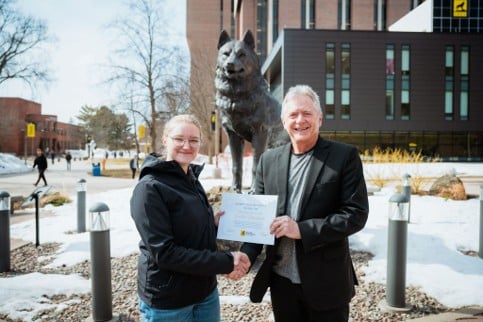
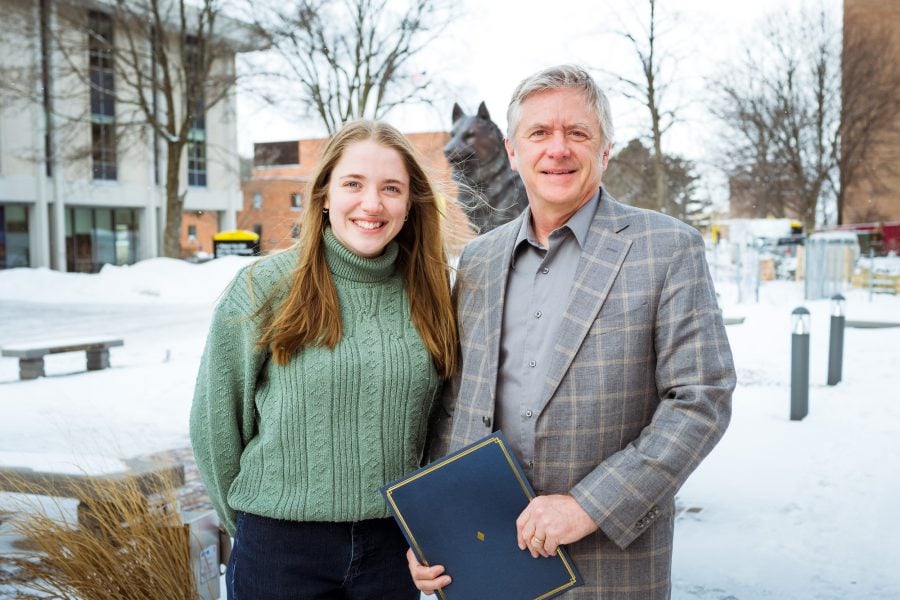
Student and faculty member standing outside in the snow with an award.
Teresa Hoving (left) accepts the MMET Department Scholar Award from MMET Chair John Irwin.

The Department of Manufacturing and Mechanical Engineering Technology (MMET) is pleased to announce that Teresa Hoving has been selected as the 2023 MMET Department Scholar.

Teresa is a third-year mechanical engineering technology student who always seeks to aim high in her coursework. She has been on the 4.00 Dean’s List every semester. Teresa continues to learn new information, grow in curiosity, and take advantage of opportunities to be creative. When given a task, Teresa strives to do it perfectly. Whether it is academic or personal, she frequently sets goals to the highest standard possible. Academically, she has shown this through her attention to detail in each assignment. Furthermore, Teresa has a persistent curiosity, especially pertaining to the subjects of manufacturing and machining.

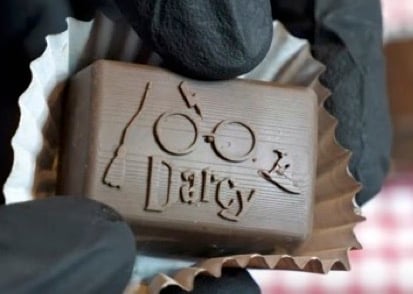
As a great opportunity to make use of her creativity, Teresa designed a candy mold for the 3rd Annual ZRP MMET student scholarship competition. Her problem-solving approach involves “When working on homework or projects, I inevitably run into roadblocks. If I have an issue solving a problem one way, I commonly brainstorm different approaches and research possible solutions” as described by Teresa.

Teresa has demonstrated communication skills through forming a study group with her classmates, actively participating in classroom discussions, and as a contestant in the Winter Carnival Royalty competition. Teresa explains, “I enjoy building relationships with my professors and classmates. I am thankful for all the opportunities that I have received to practice teamwork in projects and labs.”

Patricia Stein, Four Students Inducted Into MTU’s Epsilon Pi Tau Honor Society

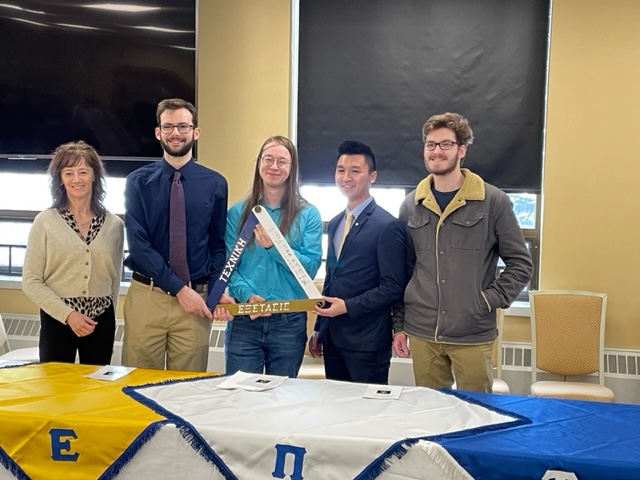
Group of five people holding the EPT triangle.

The Department of Manufacturing and Mechanical Engineering Technology (MMET) and the College of Computing (CC) inducted four Michigan Tech students and MMET’s academic advisor into Michigan Tech’s Delta Zeta Chapter of the Epsilon Pi Tau Honor Society on April 6, 2023.

Epsilon Pi Tau is the international honor society for professions in technology, recognizing students and technology professionals for academic excellence.

Congratulations to the Delta Zeta Chapter Spring 2023 Epsilon Pi Tau initiates: Donovan Choa and Robert Coene (mechanical engineering technology), Noah Harvey and Ryan Kern (computer network and system administration), and Academic Advisor Patricia Stein (MMET).

For more information, contact Delta Zeta Chapter Trustee John Irwin (MMET) at jlirwin@mtu.edu, co-trustee Todd Arney (CC) at toarney@mtu.edu, or visit Epsilon Pi Tau’s website.

By Manufacturing and Mechanical Engineering Technology | College of Computing.

Chocolate Anyone? Announcing the 3rd Annual Zachary Richard Podkul ’18 MET Design Challenge

Who doesn’t like chocolate around the holidays? For the third annual Zachary R. Podkul Design Challenge, MET students are tasked with developing a mold to make their own chocolates. The process involves first designing a 3D CAD model of the finished chocolate—Michigan Tech related, of course!

Zach and his mom together on Mt. Ripley. Read more about Zachary R. Podkul Design Challenge here.

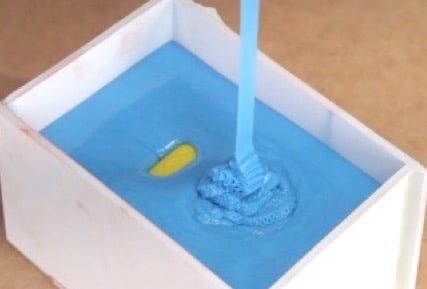
The MMET AM facility will 3D print patterns of all entries on the Stratasys Fortus 400 MC which uses Fused Deposition Modeling (FDM) process of extruding plastic filament. The students will create a flask made of poster board strips to hold the food safe silicone mold material and 3D printed patterns of the chocolates.

The students will remove their silicone mold from the flask. Fill the mold with melted chocolate, then freeze to perfection.

MMET Faculty judges will rate the student’s work on the following criteria:

  • 3D CAD Model – Utilizes sketches fully constrained with parametric features
  • Originality – Unique and innovative design representative of Michigan Tech
  • Quality – Uniformity, strength and surface finish
  • Manufacturability – Ability for chocolate to be easily formed in mold
  • Detail – The chocolate conforms to the mold intended design
Finally, the finished product will be ready for judging and eating (it’s a tough job, but someone’s gotta do it!)

Three winners will be announced on April 19, 2023 with the prize going towards Fall 2023 tuition.
First Place: $1,000
Second Place: $500
Third Place: $250

MMET Graduate Program Adds New Options

Students and faculty hard at work on the Parker fluid power equipment

There are now two options in the MMET Department for students who want to pursue graduate studies after receiving their undergraduate degrees: Graduate Certificates and Master’s degrees. 

“Our graduate students now represent 20 percent of our overall enrollment in the MMET Department,” says chair John Irwin. “This growth impacts our course offerings, lab needs, and research space. This is positive in most respects, although it presents certain challenges. We welcome the continued support from the friends of  the department.” 

MMET has been offering a multidisciplinary MS in Mechatronics for some time now, but new this fall is the department’s own MS in Manufacturing Engineering

Each of the MMET Department’s Manufacturing Engineering graduate courses are also offered online for any remote learners pursuing an advanced degree while employed. 

The Graduate Certificate in Fluid Power Mechatronics is composed of four courses totaling 10 credits. “Fluid power engineering is growing nationwide and globally. It has a major downstream economic impact because thousands of companies in the US depend on fluid power,” Irwin explains. “According to a 2021 National Fluid Power Association Industry Brief, these companies are estimated to employ more than 845,000 people representing more than $60 billion in annual payroll.”

Michigan Tech’s MMET Fluid Power Lab

Key Factors in Holistic Safety Systems is one of the courses required to earn the Mechatronics Graduate Certificate. It is also required to earn an MS in Mechatronics. “This course has tremendous support from industry, in particular from Donald Engineering and Ross Controls,” notes Irwin.  

Ross Controls Safety Working Demo

Ross Controls and Donald Engineering supplied working demonstration stands, to hold state-of-the-art safety equipment used in the safety industry. The equipment is used in the Safety course along with curriculum developed in partnership with Ross Controls. 

Associate Professor Scott Wagner attended safety training offered by Ross Controls at their Ferndale, Michigan facility. The training included a high-level introduction to fluid power and safety basics including LOTO standards followed by an in-depth and hands-on valve configuration review.