
Human Factors was proudly represented at Michigan Technological University’s annual Railroad Night! Hosted by MTU’s Rail Transportation Program (RTP) and led by Professor Pasi Lautala, Railroad Night is one of the program’s most cherished traditions. The annual event brings together Michigan Tech students, faculty, and rail-industry leaders to showcase and explore cutting-edge research emerging from the university.
For the past several years, Psychology and Human Factors faculty and students have joined the lineup to share research aimed at improving road and rail safety. At this year’s event, four researchers from Professor Elizabeth Veinott’s lab presented driving and rail safety studies utilizing Michigan Tech’s high-fidelity NADS MiniSIM driving simulator.
Exploring Interface Modality and Driver Performance
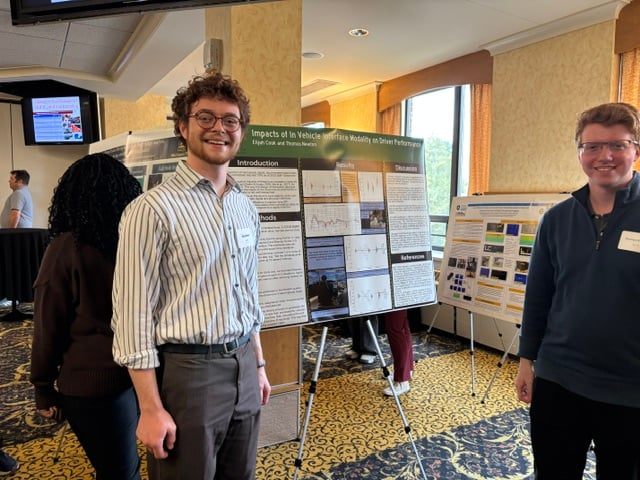
Undergraduate researchers Eli Cook (HF) and Thomas Newton (HF) presented a poster titled “Impacts of Interface Modality on Driver Performance.” Developed under the mentorship of Dr. Jeffery Pettibone during the Research Methods course last spring, their study examined how different user interface designs affect operator performance and focus. Utilizing a tablet to display their custom-designed user interface, Eli and Thomas have since expanded their work to explore early warning systems for oncoming rail crossings.
When asked how it felt to present their research on a large scale, Thomas shared, “There’s always going to be nerves, at least in my experience. I’ve been working on this poster for the better part of a year now and I still stumble over words occasionally. At the same time, we’re all there to connect over cool research, so I’m truly just having fun.”
This highlights the broader value of events like Railroad Night: students gain an opportunity to share their research while drawing inspiration from others. Thomas noted, “I had the wonderful opportunity to chat with someone from the civil engineering side of rail design. It turns out there’s a blue plaque posted at every rail crossing with a direct line to the railroad’s emergency response team. Very few people outside of rail studies know it exists because there’s little public education and the signs are easy to miss. Learning that immediately made me think, ‘This is a classic human factors problem!’”
A Systems Approach to Road and Rail Safety
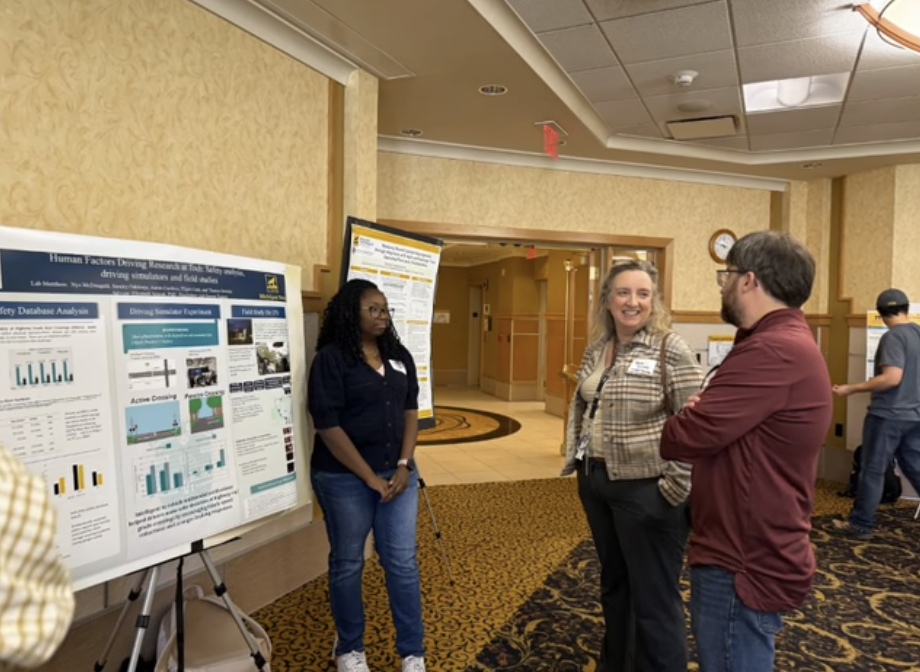
Undergraduate Aaron Cordova (HF) and PhD student Nya McDougald (ACSHF) presented a poster titled “Human Factors Driving Research at Tech: Safety Analysis, Driving Simulators and Field Studies.”
Their presentation highlighted how the lab takes a systems approach to improving road safety by bridging theory, real-world applications, and multi-method research. Their process includes analyzing naturalistic data from the Federal Railroad Administration (FRA) safety portal to identify critical patterns in real-world driving behavior. These patterns then inform controlled experiments in the NADS MiniSIM driving simulator to test operator responses to hazards and evaluate in-vehicle interventions. Finally, the team conducts on-road field studies to test these interventions in real-world environments. This interdisciplinary human factors research involves ongoing collaborations with Civil Engineering Professors Pasi Lautala and Kuilin Zhang.
Reflecting on the Event
We spoke with Nya after the presentation to ask about her experiences. “I usually go into presentations with nerves, a bad habit I know!” she said. “It can be tricky at events at Rail Night because it can feel like Human Factors is the odd one out at times, even though safety research is a big part of the railroad industry.”
That boundary-spanning perspective is precisely what makes Dr. Veinott’s lab so impactful. By bringing Human Factors into practical domains, the team offers fresh solutions to longstanding safety, design, and human-interaction challenges.
Reflecting on lab work more broadly, Thomas added, “It’s a fantastic experience! We get to do exciting, novel research on topics that directly impact daily life. It’s not without its challenges, but any lab doing innovative work is bound to hit roadblocks. It’s never anything we can’t tackle together as a team.”
Looking Ahead
Events like Railroad Night highlight the vital role interdisciplinary collaboration plays in tackling complex engineering and safety challenges. By combining human-centered research with advanced simulation and field data, Michigan Tech’s Human Factors researchers are helping shape a safer future for both road and rail transportation.
Interested in exploring Human Factors degree pathways at Michigan Tech? Check out our Human Factor’s Bachelor’s degree program here!