
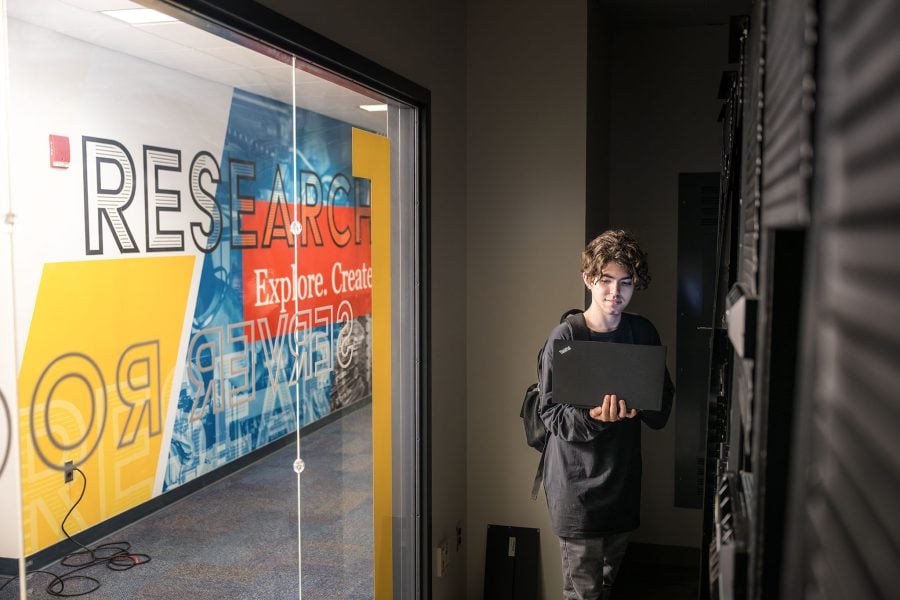
Noah Holland didn’t know there was another Husky in his family tree until he applied to Michigan Tech. What he did know, well before he came to the University as a first-year cybersecurity student, was that he wanted to join MTU RedTeam.
Holland discovered RedTeam months before setting foot in Houghton. He’d scrolled through Tech’s list of student organizations during his senior year of high school, hung out in the team’s Discord, and even met a few members at DEF CON, one of the oldest and largest annual hacker conventions in the world.
While talking with a relative who was tracing the family genealogy, Holland mentioned where he’d applied to school. That’s when he found out that his great-great-grandpa, Solomon Fechhimer, had graduated from what was then known as the Michigan College of Mines, earning a mining engineering degree.
Holland’s own choice of degree was set before he decided on a school. “I knew I was going to do cybersecurity before I decided to enroll at Tech. I chose Tech over other schools because of the RedTeam. I thought it was really cool that Tech had an active student group participating in national competitions and attending industry conferences. Not many of the other schools I was looking at had organized groups doing similar things, so it made Tech stand out to me,” he said.
“I was drawn to cybersecurity because I’ve always wanted to understand how things work,” Holland said. “RedTeam is built around that mindset. You take things apart, examine the vulnerabilities, and learn how to fix them.”
– Noah Holland ’26, cybersecurity major and RedTeam president
Today, Holland is the president of MTU RedTeam, helping prepare students to enter the cybersecurity world armed with a solid working knowledge of current tools, along with the capacity to adapt to evolving challenges.
What Does RedTeam Do?
Ask Holland to explain RedTeam to someone with zero cybersecurity background, and he makes it simple:
“We help students understand how systems actually break—and how to secure them,” he said. “That’s the core of RedTeam.”
Holland is also quick to challenge stereotypes about hackers.“The biggest misconception is that teaching security puts people at risk,” he said. “That’s called security through obscurity, and it doesn’t work.”
He points to centuries-old physical vulnerabilities, such as improperly installed door latches, that persist because people never learned how attackers think. “Open discourse in cybersecurity makes systems safer,” he said. “The more people understand, the better we all are.”
RedTeam’s weekly meetings cover web exploitation, hardware hacking like “modding” (modifying) a Nintendo Switch, and physical access control. Students learn to analyze network logs, conduct forensics, exploit vulnerabilities, and understand the security principles underlying everyday systems. One evening meeting might cover SQL (structured query language) injection and patient-record recovery; the next, reverse engineering digital locks.
“We teach things the curriculum doesn’t have room for,” said Holland. “Classes provide fundamentals—network basics, system security, and higher-level concepts. But labs are short, and the field moves fast. RedTeam gives students the depth, recency, and hands-on time they need to become job-ready.”
During the fall semester, Holland also ran a workshop on master key systems, demonstrating how flawed designs can create real-world security risks. Students attacked demo lock sets, learning firsthand why physical security matters as much as digital security.
RedTeam Competitors Continue National Cyber League Successes
RedTeam was formed in 2017. Throughout its existence, the organization has excelled in national competitions, typically ranking in the top 100 among nearly 600 teams in the National Cyber League (NCL).
One of RedTeam’s biggest strengths is its competitive training. The College of Computing supports participation by covering entry fees, ensuring students can compete without financial barriers.
“NCL gives students real scenarios, network breaches, forensic puzzles, cryptography challenges, and asks them to solve problems using the same tools professionals use,” Holland said. “It builds skills you just can’t get from lectures alone.” Top individual performers form MTU’s competition teams, with leadership coordinating practice sessions, roles, and important skills like how to formulate strategy under pressure.
The group is advised by College of Computing professors Yu Cai and Bo Chen. Both bring knowledge and resources to the table through both their roles in the College and their dedication to outreach. Cai is a professor of applied computing serving as associate dean of the College of Computing. Chen, an associate professor of computer science, serves as director of the Institute of Computing and Cybersecurity’s (ICC) Center for Cybersecurity.
Cyber Scholarship Opportunities Await
Chen administers the Cyber Service Academy Recruitment Program through the U.S. Department of Defense (DoD). The program provides full-tuition scholarships to college students in their junior or senior year and graduate-level students to study in cyber-related majors at select National Centers of Academic Excellence in Cybersecurity (NCAE-C). Michigan Tech has been designated as the NCAE-C institute of NSA since 2023. Recipients are required to work for a federal government agency, such as DoD, for one year per year of scholarship support they receive. For more information on scholarships, which also include a stipend for room and board, contact Chen. The latest application round deadline is Feb. 17, 2026. Get details on the application process here.
In the fall 2025 NCL Competition, MTU fielded 41 individual competitors. Among them was a first-year computer science major who placed 11th out of 620 participants nationwide in the experienced students bracket.
Holland knows what that’s like. He placed fifth out of 8,483 individual players in fall 2024.
In fall 2025, Holland ranked 132 out of 7,876 participants in the standard bracket. In team play, the Redteam@mtu group, consisting of Holland, Frank, Mitchell Kelly ’26, Trent Verboncouer ’26, Max Oftedahl ’28, Tyler Ormstad ’27, and Brandon Hoang ’28, ranked 15th out of 454 teams in the experienced students bracket.
Leadership, Culture, and a Community of Mentorship
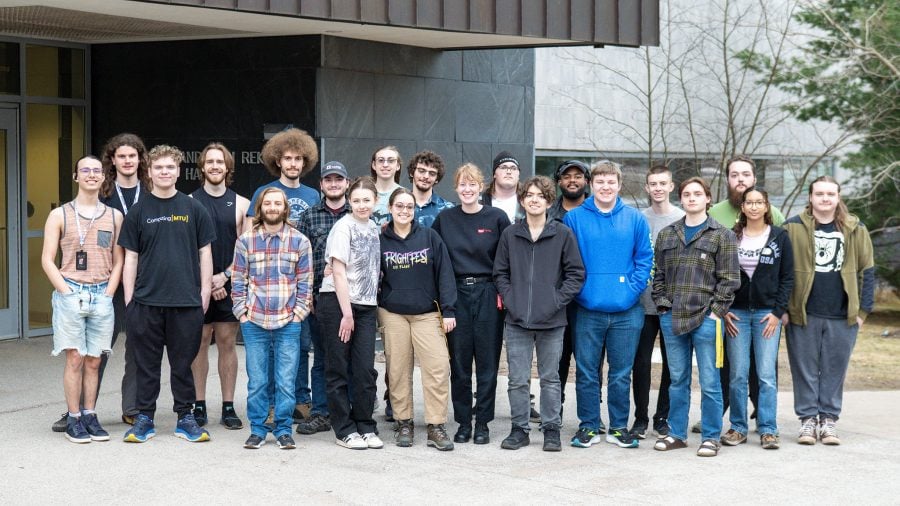
RedTeam is student-run. The current executive board includes Holland; Vice President Ethan Norush ’27; Treasurer Dane Cucinelli ’27; Secretary Anika Ahren ’28; and Capture-the-Flag Chair Tyler Ormstad. All are cybersecurity majors with the exception of Cucinelli, who is a mechanical engineering technology major.
The group’s mentorship culture is strong. Holland credits older students—including past presidents—for shaping his development early on. Now, he sees it as his responsibility to continue that cycle. “We advertise every meeting as beginner-friendly,” he said. “There’s no skill floor. You can walk in knowing nothing. The point of our org is to teach you.”
Some attendees aren’t MTU students at all—community members have been known to show up, eager to learn. “Cybersecurity is a space where everyone starts somewhere,” he said. “We want this to be accessible.”
Beyond Campus: Conferences and Industry Connections
Participation in major industry conferences is a RedTeam hallmark: SecretCon in Minnesota, CypherCon in Milwaukee, and GrrCON in Grand Rapids. For a lucky few: DEF CON.
DEF CON, which now costs around $500 per ticket, is notoriously hard for students to attend. But Holland worked his way into the Physical Security Village, a not-for-profit initiative to more widely promote understanding of preventable security issues. Volunteering with the group gives him access to several free badges each year.
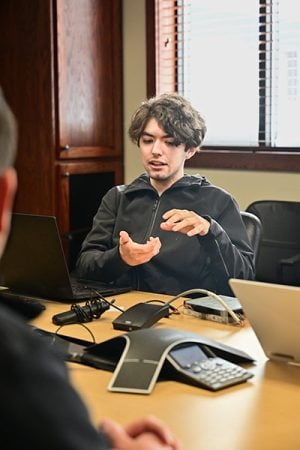
“We created a point-based system, kind of jokingly called ‘RedTeam social credit’ to decide who gets the free tickets,” he explained. “Show up, work hard, contribute consistently, and you’re rewarded.”
Conferences give students direct exposure to industry professionals, advanced workshops, and live demonstrations from car hacking to new exploit techniques. “It’s the good kind of imposter syndrome,” said Holland. “You realize how much there is to learn, and that motivates you.”
One of RedTeam’s most ambitious future projects involves a partnership with Chen’s Security and Privacy Lab: bringing a car onto Walker Lawn for a live CAN-bus (controller area network) hacking demonstration.
The plan: Students walking to class can stop, connect to the vehicle’s network, and experiment with safe, controlled exploitation techniques, turning headlights on and off, sending signals, and observing how modern cars communicate.
“It’s a big lift, but we want students to have those memorable, hands-on moments,” Holland said. “Workshops are easy. Large events take time. But this one is in the pipeline.” He and the RedTeam also look forward to continued work with Professor of Practice Victoria Walters, a cybersecurity professional who brings additional hands-on experiences to students in her courses.
If you’re thinking about joining RedTeam, you’re welcome. “Don’t be intimidated,” said Holland. “No one expects you to know anything when you walk in.”
RedTeam meetings are designed to start at the ground level, with step-by-step explanations, hints, and collaborative problem-solving. “You show up, you try, and you learn. That’s it,” Holland said. “If you’re curious, you belong here.”
Editor’s note: Mary Ahkin, a former College of Computing marketing and communications manager, contributed to this blog.
About the College of Computing
The Michigan Tech College of Computing, established in 2019, is the first academic unit in Michigan dedicated solely to computing, and one of only a handful such academic units in the United States. The college is composed of two academic departments. The Computer Science department offers four bachelor of science programs in computer science, cybersecurity, data science, and software engineering; four master of science programs in applied computer science, computer science, cybersecurity, and data science; and a doctoral program in computer science. The Applied Computing department offers four bachelor of science programs in cybersecurity, electrical engineering technology, information technology, and mechatronics; two master of science programs in health informatics and mechatronics; and a doctoral program is in computational science and engineering.
Questions? Contact us at computing@mtu.edu. Follow the College of Computing on Facebook, Instagram, LinkedIn and Twitter.