

It was just another ordinary day at his desk for computer science PhD student Josh Dafoe. But everything changed when he heard that the National Science Foundation Graduate Research Fellowship (NSF GRFP) results had been released. Dafoe, a researcher in cybersecurity expert Bo Chen’s Security and Privacy Lab at Michigan Tech, logged into the portal to find he had won the prestigious award, leaving him “surprised, grateful, and incredibly honored.”
Rightly so. The NSF GRFP is one of the most prestigious awards given in recognition of outstanding graduate students pursuing full-time research in the STEM fields.
“GRFP was one of the first NSF programs, indicating the importance of supporting early-career researchers. Being selected for this fellowship feels like a vote of confidence that my current and future research aims are worth supporting,” Dafoe said. “It both motivates and enables me to pursue more impactful research throughout my career.”
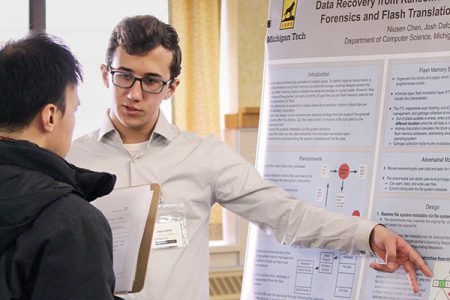
In Chen’s lab, the overall goal of the research is to safeguard people and their digital assets against malicious cyberthreats. Security and privacy issues in embedded systems (think airbag deployment in cars or smart TVs), cyber-physical systems (like autonomous vehicles or heart pacemakers), and cloud computing (examples of services accessed through the internet instead of hardware include Google Drive and Netflix) are central research areas in the lab. Chen’s research has earned funding from both NSF and the National Security Agency, along with numerous recognitions from industry and academia.
In addition to the excellence of his work in the field, Chen, an associate professor of Computer Science, is also developing a track record for mentoring award-winning graduate students. In 2024, he and his PhD student Niusen Chen won the Bhakta Rath Research Award, which is presented annually to a Michigan Tech PhD student and faculty advisor who have conducted research that meets the needs of the nation and the challenges of emerging technology.
“I’m pleased to see the students in my lab recognized through various honors,” said Chen. “They are very self-motivated and hard-working. In addition, they have benefited from the encouraging, supportive, and collaborative environment in my lab. Supervising students and helping them succeed is one of my missions as a faculty member at Tech. I enjoy working with students and am truly excited by their research accomplishments.”
Dafoe’s broad interest centers on solving cybersecurity challenges in ways that enable more practical and capable computing systems. “In practice, my work has explored how systems can recover from malware in the context of ransomware attacks, decentralized cloud storage, and vehicle security. Much of this work uses hardware that is protected from an untrusted operating system for security-critical operations. My current work extends this idea by exploring how storage devices can support new secure functionality to enable more flexible systems,” he said.
Both Chen and Dafoe have found mentorship and support at the University.
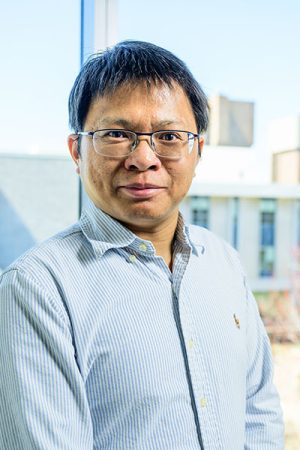
“Since I joined Tech in 2017, I have felt that the university is committed to fostering a supportive and collaborative environment,” said Chen. “In the past nine years, I’ve been fortunate to receive tremendous guidance and support from the senior faculty members.”
He also appreciates the support his research has received through numerous internal grants and initiatives, including those from the Vice President for Research Office, the Institute of Computing and Cybersystems (ICC), the Great Lakes Research Center, the College of Computing, and the College of Business.
Dafoe, who earned his bachelor’s degree in computer science and mathematics at Michigan Tech in 2025, said he chose Tech because he appreciated its reputation as a STEM-focused school and had heard good things about the computer science program. “Houghton also attracted me as a place of great natural beauty,” he said. “I have stayed here because of the opportunities I’ve been given to develop and pursue my research interests.”
Dafoe connected with Chen in 2022 while still an undergrad. “I remember that he gave a presentation at my CS 1000 class and I was interested in his research. I talked with Dr. Chen over email, and by the summer he had a position for me in his lab,” he said. Dafoe’s work with Chen includes a 2023 Summer Undergraduate Research Fellowship related to Chen’s NSF-funded project “Hardware-assisted Self-repairing in Decentralized Cloud Storage against Malicious Attacks.”
“One of the things I appreciate is Dr. Chen’s openness to new ideas, while also having the expertise to help guide the ideas into concrete projects,” he said.
Besides scientific research on security and privacy, Chen’s lab has been actively conducting education and outreach activities on cybersecurity. The lab has been organizing cybersecurity workshops for high school students since 2021 through Michigan Tech’s popular and long-running Summer Youth Programs. Chen and his lab have also collaborated with the Michigan College and University (MiCUP) and McNair Scholars programs. MiCUP involves students from community colleges in research while giving them the tools to understand and navigate the opportunities at a four-year public research university. The McNair Scholars program strives to prepare first-generation and low-income college students for success in attaining their college degrees and ultimately going on to pursue PhDs.
Chen’s lab is also actively organizing cybersecurity hackathons for Huskies across campus. They ran a robotic vehicle cybersecurity hackathon in conjunction with the 2025 Computing [MTU] Showcase 2025 and are offering an AI cybersecurity Hackathon for high school students from 9 a.m. to 4 p.m. Tuesday, June 30, 2026 utilizing the lab’s robotic platforms. No experience is required; there’s a training session prior to the start of the event, which is sponsored by ICC and the College of Computing.
“Josh has played a key role in those outreach efforts,” said Chen. “He’s a talented student with whom I really enjoy working.”
Dafoe is one of three Michigan Tech students selected for an NSF Graduate Research Fellowship beginning in fall 2026. The other two students are studying in the College of Forest Resources and Environmental Science. Molly Vander Werp, is pursuing a PhD in forest science and advised by Associate Professor Kristin Brzeski and Assistant Professor Sarah Hoy. Lenka Doskocil, pursuing a PhD in Applied Ecology, is advised by Professor Rodney Chimner.
The fellowship provides three years of support, including a $37,000 stipend and $16,000 Cost of Education allowance payment to cover all tuition and mandatory fees, providing students with the resources required to dive deeper into their research.
About the College of Computing
The Michigan Tech College of Computing, established in 2019, is the first academic unit in Michigan dedicated solely to computing, and one of only a handful such academic units in the United States. The college is composed of two academic departments. The Computer Science department offers four bachelor of science programs in computer science, cybersecurity, data science, and software engineering; four master of science programs in applied computer science, computer science, cybersecurity, and data science; and a doctoral program in computer science. The Applied Computing department offers four bachelor of science programs in cybersecurity, electrical engineering technology, information technology, and mechatronics; two master of science programs in health informatics and mechatronics; and a doctoral program is in computational science and engineering.
Questions? Contact us at computing@mtu.edu. Follow the College of Computing on Facebook, Instagram, LinkedIn and Twitter.