
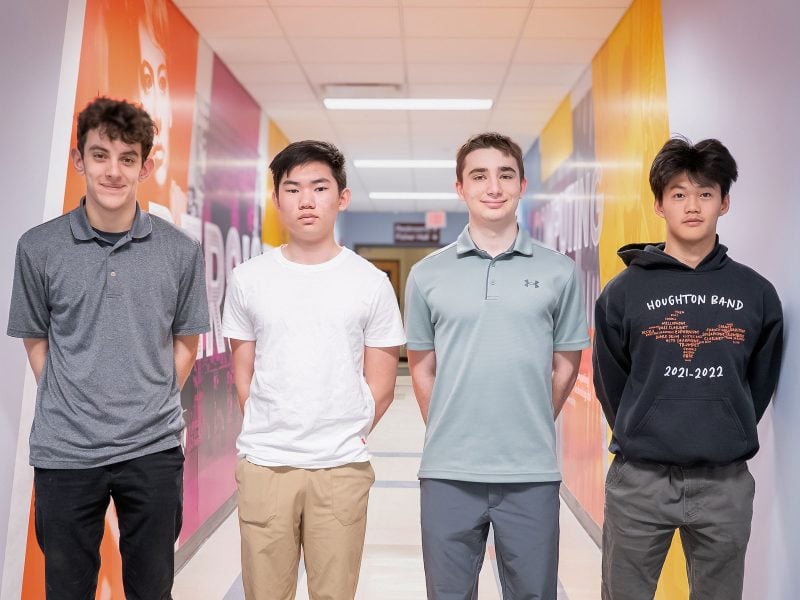
Four Houghton High School students from the Michigan Tech-led CyberHusky Team are among the winners of the 2026 Presidential AI Challenge state championship.
The nationwide competition is designed to engage students in applying artificial intelligence tools to help their local community and solve real-world problems.
The winning team, which includes Samuel Cai, Gabe Hjerstedt, Lewis Vendlinski, and Daniel Xie, demonstrated outstanding technical ability, creativity, and teamwork in designing and implementing AI-driven solutions, said advisor Yu Cai, a professor in the Department of Applied Computing and associate dean of Michigan Tech’s College of Computing.
Organized by multiple U.S. government agencies, the AI challenge gives students opportunities to explore the latest AI concepts capable of addressing meaningful societal challenges. The competition emphasizes innovation, problem-solving, and the responsible use of AI technologies. Projects that teams across the nation took on included an AI-powered drone system for gutter inspection, early detection of crop stress using vegetation and environmental data, minimizing cafeteria food waste using AI analysis, and using AI to preserve the Cherokee language.
The CyberHusky Team’s winning project, titled AmeriQuest, is an AI-assisted mobile app designed to encourage children to spend more time outdoors by turning nature exploration into an interactive quest. The app uses nature-finding challenges, map-based checkpoints, progress tracking, and AI image recognition to verify uploaded photos of outdoor objects. By combining technology with outdoor activity, the project aims to improve kids’ physical activity, confidence, social skills, and healthy habits while supporting AI education and future readiness.
“The CyberHusky team’s achievement reflects both the students’ dedication and the strength of Houghton High School in STEM education,” said Cai. “Their success highlights the growing impact of K–12 AI education initiatives and the importance of preparing the next generation of technology leaders.”
The CyberHusky program, guided by Michigan Tech professors and students, is open to students in grade eight and above who have previously taken at least one coding course. It’s free to participate.
About the College of Computing
The Michigan Tech College of Computing, established in 2019, is the first academic unit in Michigan dedicated solely to computing, and one of only a handful such academic units in the United States. The college is composed of two academic departments. The Computer Science department offers four bachelor of science programs in computer science, cybersecurity, data science, and software engineering; four master of science programs in applied computer science, computer science, cybersecurity, and data science; and a doctoral program in computer science. The Applied Computing department offers four bachelor of science programs in cybersecurity, electrical engineering technology, information technology, and mechatronics; two master of science programs in health informatics and mechatronics; and a doctoral program is in computational science and engineering.
Questions? Contact us at computing@mtu.edu. Follow the College of Computing on Facebook, Instagram, LinkedIn and Twitter.