John “Jack” Seaman, grandson of the namesake of the A. E. Seaman Mineral Museum at Michigan Tech, and his wife, Phyllis, have given a gift to support the museum’s endowment to further the work of Jack’s grandfather and enhance the museum experience for visitors long into the future. In recognition of their generosity, the Phyllis and John Seaman Garden will be dedicated this Thursday, Sept. 11, at 1 p.m. at the Mineral Museum on Sharon Ave.
Congratulations to the geo/mining department’s softball team! They took home the traveling trophy by defeating the forestry department in the graduate student government’s (GSG) summer 2014 softball league. This is the first time since 1991 the team has captured the title.

Michigan Tech research professor Bill Rose is leading the group and said without the Keweenaw Fault, we wouldn’t have so many waterfalls, rock formations, or the once-booming copper mining industry.
Read more at Upper Michigan Source
Dr. Ted Bornhorst has taught Summer Field Geology at Michigan Tech for 31 years. This will be his last year and so we provide a photo gallery of the last field geology exam which was followed by a nice late day snack brought by Dr. John Gierke into the field for all to enjoy after a hard day’s work. Dr. Bornhorst surely has taught several hundred students in this essential field course over the years.
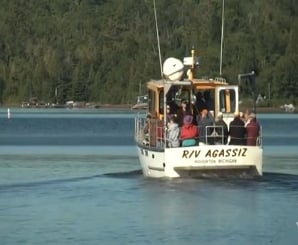
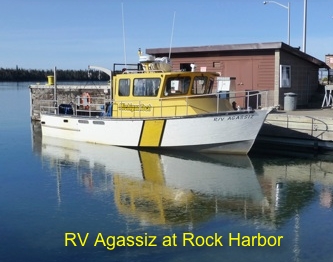
Michigan’s Keweenaw Peninsula is known as a place of natural beauty with a fascinating mining history. Join local expert Bill Rose to learn how to read this landscape and how it came to be the way it is today. The Copper Country has a strong geoheritage comprised of five major events in Earth’s history. Rose has designed several two-day field trips that address each of these specific themes. Participants can look forward to covering lots of ground and being outside all the time with travel by boat, van and short walks.
Alexandria, VA – The American Geosciences Institute (AGI) and Schlumberger welcome former Peace Corps volunteer and geoscientist, Stephanie Tubman as the AGI/Schlumberger Geoscience Communication Fellow. Through a generous donation from Schlumberger, a global service provider to the oil and gas industry, Tubman will be working with AGI’s Critical Issues Program to disseminate geoscience information to help support decision making at the federal, state and municipal levels.
Many Michigan Technological University students at this moment are trying to decide what to do after graduation, and a common question is: graduate school or a job? But, Nathan Sankary, who graduated from Michigan Tech last spring, added another layer of complexity to the question: Could he complete more schooling in a country where he did not know the language, one that is riddled with turmoil over the Western perspective of their international political problems?
The National Mining Competition announced the three winners from the 2013 event. First place Michigan Tech, second place University of British Columbia, and third place Edwards School of Business.
The winning Michigan Tech Mining team, “the fabulous four,” was Cora Hemmila, Matthew Younger, Matthew Schuman and Matthew Schwalen. The team advisor is James Murray Gillis, Instructor, Geological and Mining Engineering and Sciences, Director, Mine Safety and Health Training Program.
Nathan Sankary, who graduated in geology from Michigan Tech earlier this year, is doing Master’s degree work in Israel this year at the Israel Institute of Technology studying Environmental Engineering. He was raised in Minneapolis and earned a Michigan Tech geology degree. He is posting a blog on his adventures. It’s at
The Midwest to The Mideast
.
To the people of Peña Blanca, Panama, Chet Hopp must seem like a godsend. He’s helping them get cleaner water, improve sanitation and understand their local volcanic hazards.
“I’m an environmental health extensionist, which means that my main responsibilities to my community of Peña Blanca deal with sanitation,” says Hopp, a Peace Corps Master’s International student in geology at Michigan Technological University. “Specifically, we work to improve access to potable water through development and construction of gravity-fed aqueducts, as well as improving sanitation practices through education and access to various types of latrines.”
MORE