Search Results for "thesis and dissertations MS Office tips"

Submission and Formatting 101 for Summer 2021

Students who are completing a dissertation, thesis, or report are invited to join the Graduate School to learn about the resources available to them to assist in scheduling their defense, formatting their documents, and submitting their documents.  In one afternoon, you can learn everything you need to be successful and complete your degree in a timely fashion!  Faculty and staff who assist students with submissions are also welcome to attend.  Attend the entire event, or stop in for the seminar that interests you.

  • When: Wednesday, May 19, 2021, 2 – 4pm (see detailed schedule below)
  • Who: Students completing a dissertation, thesis or report; faculty and staff who assist students with submission
  • Where: Zoom webinar; (register to attend online and receive participation instructions)

If you are unable to join us, the event will be taped and available online after the event. The previous semester’s seminars are always available online.

Information on submitting, formatting, and more can be found online for dissertations and theses or reports.

Detailed schedule

  • 2 – 3pm – Submission 101 Learn what is required to submit your document to the Graduate School and the deadlines for the upcoming semester.  Best for students who are completing their degree this semester or next semester.
  • 3 – 4pm – Formatting 101-103: Word, Acrobat and Copyright
    • Learn how to find what you need in the Guide and use a Word template to create a perfectly formatted document the first time. 
    • Learn how to use Adobe Acrobat to check your document to ensure it meets our formatting requirements and correct it without recreating the PDF.
    • Learn how to use copyrighted materials in your document, including papers you have published as well as materials created by someone else.
  • 4pm – ?: Final questions Have a question that hasn’t been answered yet? We’ll be available to answer any additional questions you have.

Copyright for Graduate Students

Who owns the copyright to my dissertation? When using an image from another work, do I need copyright permission? If I do, how much does it cost? What are the benefits of making my thesis open access? Get the answers to these and other questions at the library workshop, “Copyright and Your Dissertation, Thesis or Master’s Report.”

This workshop will examine the role U.S. Copyright law plays in the thesis or dissertation writing and publishing processes. The use of copyrighted material, publishing agreements and the role of the Digital Commons at Michigan Tech repository will be explored.

Join us at 12:05 p.m. tomorrow (Sept. 26) in Library 242. Registration is required.

(Note: for students of UN0500, this will be the same workshop presented to your class on Sept 11.)

How to access a document in Perceptive Content

Graduate School forms submitted by students are electronically stored in Perceptive Content (formerly known as ImageNow).  All member of the graduate faculty and authorized staff may access these forms by opening the Perceptive Content program, and logging in with their Michigan Tech ISO ID and password.  Students do not have access to Perceptive Content.  Dissertation, thesis, or report reviews are available to students through Canvas (for pre-defense documents) or Digital Commons (for post-defense documents).

Faculty can also choose not to utilize Perceptive Content to access the student’s review.  These faculty may ask their student to share the review file with them, or contact the Graduate Program Assistant for access to the file. The email notification lets the faculty member know that the review is available.

Perceptive Content may be installed on any University computer running the Windows operating system; contact IT for assistance. There is no longer a web client for Perceptive Content.

If your computer is unable to have Perceptive Content installed, the software can also be accessed on the University’s remote server, remote.mtu.edu. See information from IT on how to connect using a Windows or Mac computer and note that a VPN will be needed to access from off campus.

Once logged in, click on the “Documents” icon.  If you have access to more than one set of documents, click on the arrow next to the “Documents” icon and select “Graduate School.”  Note that the name of the software is now Perceptive Content, some windows in the program may still list ImageNow in the title bar of the window.

Notifying the Graduate School of a final oral examination

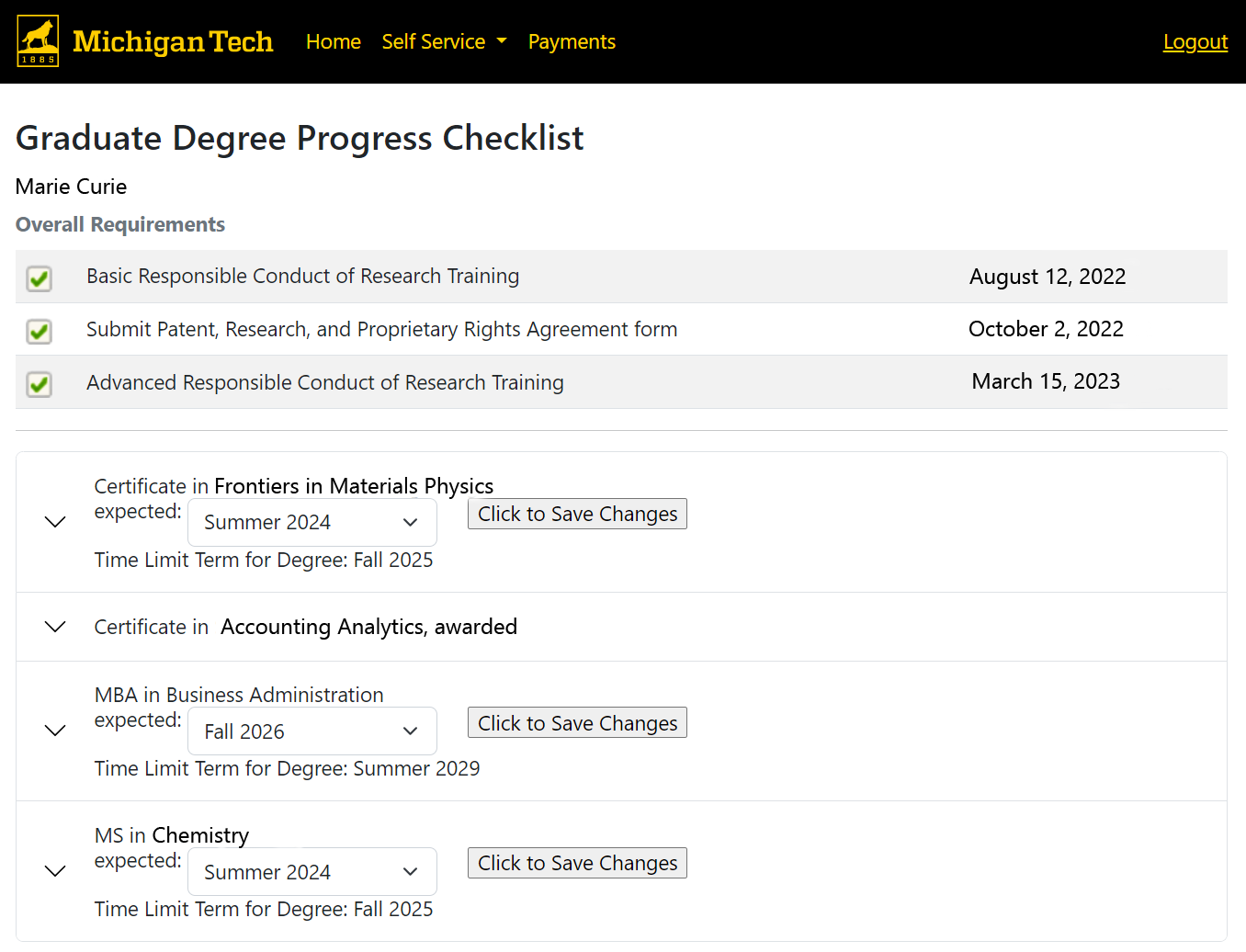
A final oral examination (“defense”) is a milestone for students completing a dissertation, thesis, or report. To schedule a defense, students arrange a date, time and location for their committee to meet following the procedures in their graduate program. Once this has been determined, students must notify the Graduate School of their defense information on our Michigan Tech app, the Graduate Degree Progress Checklist.

Log into the Graduate Degree Progress Checklist.

Select the degree of interest by clicking on the arrow next to the degree in the list. If a degree is missing, please contact the Graduate School.

A screenshot of the degree progress checklist showing the list of degrees available for this student.

Student Veterans Honored at Midyear Commencement

For the first time at Michigan Tech, graduating student veterans will be honored at commencement with red, white and blue cords in recognition of their service to the country.

Three graduates will wear the cords this fall and be recognized by President Glenn Mroz during commencement on Saturday, Dec. 10, in the SDC Wood Gym. The students are:

  • Mike Geiersbach of Wheeler (Marine Corps/Military Police), who served more than four years and is graduating with a BS in Mechanical Engineering.
  • Sue Larson of Waupaca, Wisc. (Air Force), who served six years and is receiving an MS in Environmental Engineering Science.
  • Matt Smith of Hancock (Air Force/Security Forces), who served two years and is receiving a BS in Electrical Engineering Technology.

Larson, a graduate student, said: “I think it’s great that Michigan Tech is so supportive of the student veteran population and has chosen to distinguish us in this way. It will be an honor to be among the first veterans to wear the new red, white and blue cords.”

The presentation of the cords reflects the growing number of activities and services on campus that focus on students who are veterans or children of veterans. This initiative is being coordinated by Veterans’ Services/Registrar’s Office and the Vice President for Student Affairs Office.

Submitted by Kathy Pintar, veteran school certifying official, registrar’s office
Published in Tech Today

Research Award Nominations Due Today

The Bhakta Rath Research Award offers an opportunity to promote and reward excellence in scientific and engineering research in the fields of physical and natural sciences and engineering. For complete submission guidelines, see Rath Research Award.

The Vice President for Research Office is also accepting nominations for the Michigan Tech Research Award, which offers an opportunity for an individual to be recognized for outstanding achievements in research.

For complete submission guidelines, see Michigan Tech Research Award.

Nominations should be submitted electronically in PDF format per the guidelines on the web pages no later than 4 p.m. today (March 10).

All nominations should be sent to Cathy Jenich.

by Vice President for Research Office

National Defense Science and Engineering Graduate (NDSEG) Fellowship

The National Defense Science and Engineering Graduate (NDSEG) Fellowship is a highly competitive, portable fellowship that is awarded to U.S. citizens and nationals who intend to pursue a doctoral degree in one of fifteen supported disciplines. NDSEG confers high honors upon its recipients, and allows them to attend whichever U.S. institution they choose.

NDSEG Fellowships last for three years and pay for full tuition and all mandatory fees, a monthly stipend, and up to $1,000 a year in medical insurance.

The Department of Defense (DoD) is committed to increasing the number and quality of our nation’s scientists and engineers, and towards this end, has awarded approximately 3,200 NDSEG fellowships since the program’s inception 22 years ago.

The NDSEG Fellowship is sponsored by the Air Force Office of Scientific Research(AFOSR), the Army Research Office (ARO), the High Performance Computing Modernization Program (HPCM), and the Office of Naval Research (ONR), under the direction of the Director of Defense Research and Engineering (DDR&E).

Application deadline: December 14, 2012

For more information and to apply online, go to http://ndseg.asee.org/

THE NASA GRADUATE FELLOWSHIP APPLICATIONS IS APPROACHING

THE DEADLINE OF FEBRUARY 23, 2011 FOR THE NASA GRADUATE FELLOWSHIP APPLICATIONS IS APPROACHING.

Only two weeks remain to submit graduate student applications for NASA’s new Space Technology Research Fellowships. Applications are due by February 23 for the new NASA grants.

Applications are being accepted from accredited U.S. universities on behalf of graduate students interested in performing space technology research beginning this fall.

The fellowships will sponsor U.S. graduate student researchers who show significant potential to contribute to NASA’s strategic space technology objectives through their studies. Sponsored by NASA’s Office of the Chief Technologist, the fellowships’ goal is to provide the nation with a pipeline of highly skilled engineers and technologists to improve America’s technological competitiveness.

NASA Space Technology Fellows will perform innovative space technology research while building the skills necessary to become future technological leaders. Information about the fellowships, including how to submit applications, is available at:

http://www.nasa.gov/offices/oct/early_stage_innovation/grants/NSTRF.html

To learn more about NASA’s Office of the Chief Technologist and the crosscutting space technology areas of interest to NASA, visit:

http://www.nasa.gov/oct

If you plan to submit an application please contact Jodi Lehman (jglehman@mtu.edu) in the Sponsored Programs Enhancement Office.

Workshops on Using an Individual Development Plan (IDP)

The Graduate School is pleased to have Dr. Joerg Schlatterer and Dr. Corrie Kuniyoski visit our campus on November 7, 2018 to conduct two workshops on using Individual Development Plans (IDPs) to assist in career development for graduate students and postdoctoral scholars.

Please register online so that we can plan for your attendance.

Workshop for Graduate Students and Postdoctoral Scholars

Planning for Your Career using an IDP
10-11:30am, MUB Alumni Lounge

Join the Michigan Tech Graduate School and the American Chemical Society (ACS) for a 1.5h interactive career planning workshop geared towards graduate students and postdocs. Workshop participants will learn about the four critical components of career development and planning, how they can relate to their individual situation, and finding their career “sweet spot”. Participants will be introduced to the Individual Development Plan (IDP) concept and how IDPs can help set clear goals toward a desired career path. As an example for online IDPs, the ACS tool ChemIDPTM(ChemIDP.org) will be introduced.

Workshop for Advisors

Individual Development Plan Assisted Mentoring
3-4pm, MUB Alumni Lounge

Adequate preparation of the future workforce is essential for the survival of the U.S. as an economic and innovative powerhouse in the world. Numerous reports from organizations such as the National Academy of Sciences, the American Chemical Society (ACS), and the Council of Graduate Schools (CGS) have highlighted the importance of mentoring for the successful navigation through college, graduate school, or postdoctoral training and towards securing satisfying jobs. Federal funding agencies such as the National Institutes of Health and the National Science Foundation strongly recommend the use of Individual Development Plans (IDPs) and postdoctoral mentoring plans for trainees, respectively.

This 1 hour interactive workshop will introduce the IDP process as a mentoring tool and share related resources available to advisors. The IDP process consists of four components: 1) self-assessment, 2) career exploration, 3) skill strengthening, and 4) goal setting. ChemIDPTM, the IDP tool and workshop developed by the ACS for trainees in the chemical sciences, will serve as an example of how use of IDPs has the potential to prepare faculty and trainees for efficient mentor-mentee discussions.

Speaker Biographies

Joerg Schlatterer, PhD

Joerg Schlatterer leads the ACS Graduate and Postdoctoral Scholars Office. Dr. Schlatterer studied chemistry in Berlin and received his PhD in Heidelberg (Germany) in 2004. He worked as a postdoctoral fellow at the National High Magnetic Field Laboratory in Florida before moving on to become a research associate and subsequently a faculty member in biochemistry at the Albert Einstein College of Medicine in New York City. Dr. Schlatterer published more than 16 peer-reviewed articles and filed 4 patents and patent applications. At Einstein Dr. Schlatterer also co-created and directed the Career & Professional Development Program for Graduate Students & Postdoctoral Researchers. Dr. Schlatterer worked as Assistant Dean of Faculty Professional Development at Columbia University Medical Center before joining the National Science Foundation in summer 2014 as a National Science Foundation Program Director for the Graduate Research Fellowship Program. Joerg joined the American Chemical Society to lead the Graduate and Postdoctoral Scholars Office in March 2017.

Corrie Kuniyoshi, PhD

Corrie Kuniyoshi is a Senior Program Manager in the ACS Graduate & Postdoctoral Scholars Office in the Learning and Career Development Department of the ACS. She received her Ph.D. in Physical Organic Chemistry from the University of California, Los Angeles, examining oxidation pathways of guanine and cycloaddition reactions of fullerenes. Dr. Kuniyoshi’s work and interests focus on the intersection of STEM graduate career development with innovative technology. Dr. Kuniyoshi has gained over 10 years of work experience, organizing career workshops, symposia, and events for graduates and postdocs searching for academic jobs and acting as managing editor for a newsletter and executive editor of a magazine focused on graduate education. For the last 4 years her work has focused exclusively on strategic development and delivery of career planning resources in the creation of technology tools, programs, and articles focused on the myriad career options available to scientists with M.S. and Ph.D. degrees. Two of the projects she is most proud of include co-leading the development and implementation of ACS’s ChemIDPTM (ChemIDP.org), a comprehensive interactive individual development plan platform available (free) online, and developing the Graduate Postdoctoral Chemist Magazine (www.acs.org/gradchemist). As a Myers-Briggs certified facilitator (and INTJ) she greatly enjoys facilitating personality assessment workshops and discovering more about how personality plays a role in career choices and the workplace environment.

Microsoft Research PhD Fellowship and Women’s Scholarship Program

Microsoft Research PhD Fellowship
<http://research.microsoft.com/en-us/collaboration/awards/apply-us.aspx>

* *Posted: August 24, 2010*
* *Internal deadline: September 9, 2010*
* Limit on number of proposals preliminary announcement
* *PI limit:* Students must be starting their second or third year
in an eligible PhD program in the fall (August/September) semester
or quarter of 2010.
* *Number per organization:* Computer Science, Electrical
Engineering, or Mathematics departments at eligible universities
may each nominate up to three (3) students.
* *Full proposal deadline: October 8, 2010*

Microsoft Research Graduate Women’s Scholarship Program
<http://research.microsoft.com/en-us/collaboration/awards/fellows-women.aspx#Schedule>

* *Posted: August 24, 2010*
* *Internal deadline: September 9, 2010*
* Limit on number of proposals preliminary announcement
* *PI limit:* Student must attend a U.S. or Canadian university and
be enrolled as a full-time graduate student in the Computer
Science, Electrical Engineering, or Mathematics departments
* *Number per organization:* A maximum of three (3) applicants per
department, per university will be accepted.
* *Full proposal deadline: October 8, 2010*

<http://www.nsf.gov/pubs/2010/nsf10603/nsf10603.htm?WT.mc_id=USNSF_25&WT.mc_ev=click>

Please keep in mind that your limited submission proposal must adhere to
the Sponsored Programs Office proposal submission policy which specifies
that all proposals must be submitted to the Sponsored Programs Office in
accordance with their internal deadlines chart
<http://www.mtu.edu/research/administration/sponsored-programs/office/proposal-preparation/spo-internal-deadlines.html>.

You can view the current information about Limited Submission
Opportunities here
<http://www.mtu.edu/research/administration/sponsored-programs/enhancement/identification-funding/limited-submission/opportunities.html>.

If interested in applying contact Jodi Lehman (jglehman@mtu.edu).