

Dr. Jingfeng Jiang
When it was founded in 2021, the ICC/HRI Joint Center of Biocomputing and Digital Health’s mission was to increase collaboration in digital health research and education across campus, developing innovative ways to push the boundaries of healthcare technology and delivery.
The impact of the BDH center and its members has been phenomenal, led by the co-founder of the center, Dr. Jingfeng Jiang, since its inception. During this time, over 130 proposals were submitted by members of the center, securing ~$4.5 million in research funding from sponsors like the National Institutes of Health, American Heart Association, Blue Cross Blue Shield Michigan, and the National Science Foundation.
Since its inception, the Center for Biocomputing and Digital Health is the first joint center between two institutes: Institutes of Computing and Cybersystems and Health Research Institutes on campus, which has grown from a small group of researchers with shared interests in computation and healthcare into a vibrant, interdisciplinary community that brings together faculty, students, and external partners across engineering, computer science, data science, mathematics among other disciplines. Its greatest successes have been building a collaborative research ecosystem, attracting competitive external funding, and fostering innovations in areas such as artificial intelligence, medical informatics, digital health, and precision medicine technologies.
Perhaps most importantly, the Center has helped establish Michigan Tech as a recognized contributor to the rapidly evolving field of healthcare technology, creating opportunities for students and researchers to address real-world health challenges while strengthening the university’s national and international research reputation. This is particularly important for Michigan Tech, which is recognized as an R1 institution.
Heading into this summer, Dr. Jiang is passing the torch to Dr. Weihua Zhou, Associate Professor of Health Informatics. Dr. Zhou joined Michigan Tech in 2019, bringing expertise in medical imaging, biomedical informatics, and clinical artificial intelligence, with an increasing focus on cardiovascular applications. His research centers on integrating multimodal clinical data—including imaging, electronic health records, and genomics—to develop AI-driven systems that support clinical decision-making and improve patient outcomes in complex diseases.
Perhaps most importantly, the Center has helped establish Michigan Tech as a recognized contributor to the rapidly evolving field of healthcare technology, creating opportunities for students and researchers to address real-world health challenges while strengthening the university’s national and international research reputation. This is particularly important for Michigan Tech, which is recognized as an R1 institution.
Since arriving at MTU, Dr. Zhou has established a highly productive, externally funded research program, serving as PI on multiple NIH-supported projects and contributing to more than 100 peer-reviewed journal publications. His work spans both methodological innovation and real-world clinical translation, including decision-support tools, simulation platforms for medical training, and AI systems embedded within clinical workflows.
In addition to his research accomplishments, Dr. Zhou has played a key leadership role within the Center, helping to organize multi-investigator proposals, expand interdisciplinary collaborations, and advance initiatives in healthcare data sharing and research infrastructure. He is also deeply committed to mentoring graduate and undergraduate students, contributing to workforce development in digital health and precision medicine.
Building on the Center’s strong foundation, Dr. Zhou aims to further expand BDH’s impact by strengthening collaborative research, advancing clinically deployable AI technologies, and fostering partnerships with healthcare systems and industry to accelerate innovation in digital health.
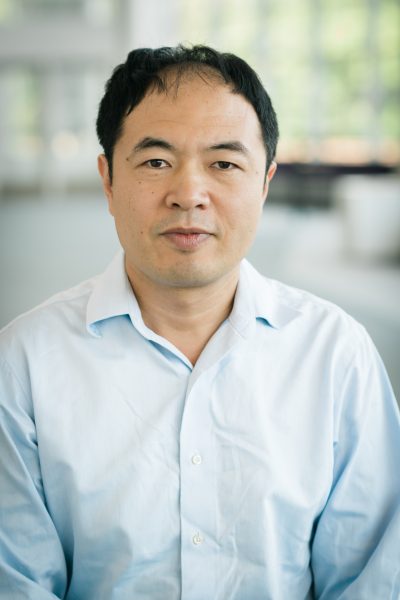
Dr. Weihua Zhou