Search Results for "senior design/page/6/813-882-3271"

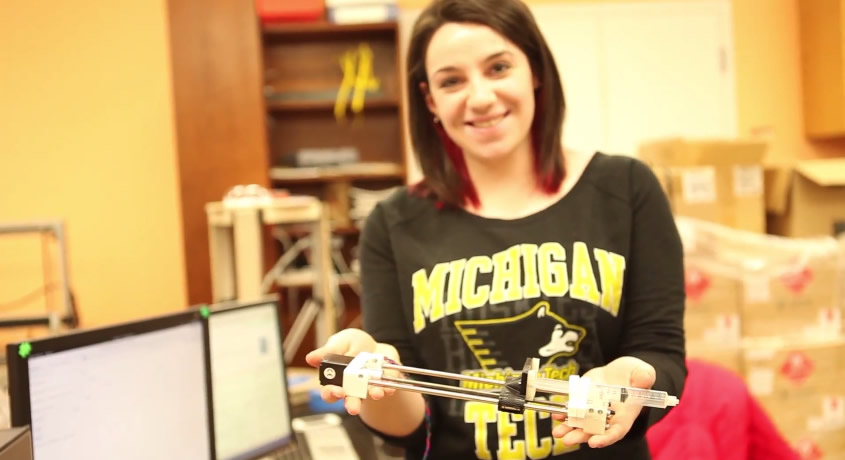
Science Just Got Cheaper (and Faster): Design Library Lets Researchers Print their Own Syringe Pumps
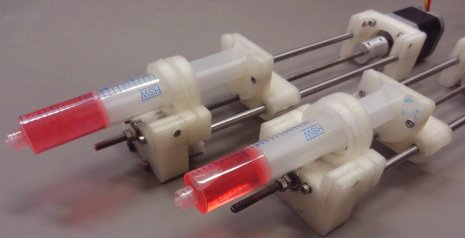
image113176-horizFurnishing a research lab can be pretty expensive. Now a team led by an engineer at Michigan Technological University has published an open-source library of designs that will let scientists slash the cost of one commonly used piece of equipment: the syringe pump. Syringe pumps are used to dispatch precise amounts of liquid, as for drug delivery or mixing chemicals in a reaction. They can also cost hundreds or even thousands of dollars.
MORE


Research Associate I – Advanced Microscopy and Microanalysis

> Email: cni@udel.edu
> Name: Chaoying Ni
>
> Organization: University of Delaware
>
> Title-Subject: [Filtered] Job – Research Associate I @ University of Delaware
>
> Message: Research Associate I – Advanced Microscopy and Microanalysis
>
> DEADLINE:  March 15, 2013
>
> QUALIFICATIONS:Bachelor’s degree in physical, chemical, biological, or a related field and one year
> of experience or Associate’s degree and two years of experience.
>
> MAJOR RESPONSIBILITIES:
>
> Trains and supervises students and post-docs in utilizing SEM/FIB, TEM, LM, SPM and auxiliary
> equipment for research or for course work.
>
> Maintains a high proficiency in SEM and TEM sample preparation techniques especially by using
> ultra-microtome in ambient or in cryogenic conditions and TEM vitrification equipment.
>
> Identifies, modifies and develops adequate experimental procedures and methods.
>
> Exercises initiative in conducting SEM, TEM, LM, and SPM with industrial clients.
>
> Calibrates and maintains instruments; troubleshoots equipment problems.
>
> Prepares and analyzes usage data including generation of various reports of results.
>
> Assists in setting and maintaining proper laboratory safety standards, including providing guidance
> on the proper placement, cleaning, and discarding of equipment and materials.
>
> Procures and maintains material stock.
>
> Performs other job-related duties as assigned.
>
>
> How To Apply
>
> When applying please submit a one-page cover letter and your resume as one document.  Also, please
> remember to provide names, addresses and telephone number of at least three references in the online
> application.
>
> Online application only:
https://wahrprd.nss.udel.edu:4450/psp/RESUME/EMPLOYEE/HRMS/c/HRS_HRAM.HRS_CE.GBL?Page=HRS_CE_HM_PRE&Action=A&SiteId=888
>
> or for more information:
http://www.udel.edu/udjobs/
>
>
> Equal Employment Opportunity

Josh Jay is a University Innovation Fellow

UIFTwo Michigan Tech undergraduates are among 229 students from 62 universities in 10 countries who have been named University Innovation Fellows (UIF). They are Robert Lambert and Josh Jay.

Run by Stanford University’s Hasso Plattner Institute of Design, the University Innovation Fellows program empowers students to become agents of change at their schools. Fellows work to ensure their peers gain the knowledge, skills and attitudes required to compete in the economy of the future and make a positive impact on the world.

Lambert is a second year management major. “I wanted to join UIF to have a more active part in the community, as well as to become an agent of change on Michigan Tech’s campus,” he said.

Jay is a second year student majoring in materials science and engineering. He is currently doing a co-op in Minneapolis. “I want to be a part of UIF because they aren’t just talking and thinking about creating change, but they are actually making it happen,” he said. “It is also a great community of people to help you figure out how to turn your ideas into reality.”

University Innovation Fellows advocate for lasting institutional change and create opportunities for students to engage with innovation, entrepreneurship, design thinking and creativity at their schools. Fellows design innovation spaces, start entrepreneurship organizations, host experiential learning events and work with faculty to develop new courses.

Since it began under the auspices of the National Science Foundation, the UIF program has trained more than 1,200 students.

Michigan Tech has had 14 University Innovation Fellows since the program started in 2014. They work as part of the Pavlis Honors College to promote entrepreneurship, innovation, design thinking and creativity. Among other projects, they developed the makerspace called The Alley in the former bowling alley in the basement of the Memorial Union Building.

“Stanford’s University Innovation Fellows program helps students develop the skills needed to be agents for positive change on their campus,” said Mary Raber, co-director of the Pavlis Honors College Innovation Center for Entrepreneurship. “After participating in an intensive six week online training program, our UIFs have been a force for helping to create a culture of innovation and entrepreneurship at Michigan Tech and have been instrumental in bringing many initiatives to life, like the orientation week’s #uifresh activity, the student-hosted Innovation Fest and the Alley Makerspace.”

By Jenn Donovan.

2012 Undergraduate Expo Winners

ExpoUndergraduate Expo 2012

Expo Awards

Senior Design Awards to MSE Projects

Taking first place was Bioabsorbable Polymer-Coated Metal Stent Degradation Simulation Design. The students devised a better way to check for the degrading of stents, which are inserted into arteries, both in vitro (in the lab) and in vivo (in the living subject). Team members were Kristina Price, Brendan Daun, Thomas Faulkner, Erin Larson, Derek Yesmunt and David Strobel (Biomedical Engineering); and Kelsey Waugh and Matt Gardeski (MSE). The team was sponsored by Boston Scientific and advised by Associate Professor Jeremy Goldman (Biomedical Engineering) and Associate Professor Jaroslaw Drelich (MSE).

Second place went to the Economic Recovery of Alloying Elements from Grinding Swarf. The students speculated that they could help metal-grinding operations reclaim cobalt and nickel, in addition to other metals, from the waste or “swarf.” It could produce as much as $1.75 million in a year. The team consisted of Alicia Steele (MSE/ME); and Daniel Hein, Michael Wyzlic and Nicholas Kraft (MSE). They worked with the Casting Services Group of ThyssenKrupp. Jaroslaw Drelich was their advisor, too.

3D Printers in March News

Open-source 3D printed parts often stronger than proprietary versions

A common criticism of home 3D printers is that whilst they can easily replicate any number of shapes and objects, and print parts that look identical to plastic prints from professional 3D printers, they can only print flimsy plastic trinkets. Are RepRap prints as strong as professional 3D printed parts using the same polymers?

“We were curious too. Our prints seemed strong, but we wanted to engineer robust scientific equipment and tools for the developing world, so we needed solid trustworthy numbers.” said Joshua Pearce, an associate professor of Materials Science & Engineering and Electrical & Computer Engineering and Michigan Technological University.

Read more at www.3ders.org

Michigan Tech Study Suggests Some RepRap 3D Prints Are As Strong as Commercial 3D Printers

If you thought that plastic parts produced from your average RepRap desktop 3D printer were in any way weaker than those made with commercial 3D printers, you may be proven wrong. The research lab of Dr. Joshua Pearce at Michigan Technological University has once again put out a study in favour of low-cost 3D printing. After already establishing that such devices could create affordable open source lab equipment for universities, as well as save consumers $300 to $2,000 a year with the printing of common household items, Pearce’s lab has tried to demonstrate that low-cost 3D printers can print ABS and PLA parts with the same strength as those made with commercial printers.

Read more at 3D Printing Industry.

In Print

Joshua Pearce (MSE/ECE) co-authored a paper “Photovoltaic system performance enhancement with non-tracking planar concentrators: Experimental results and BDRF based modelling,” published by the IEEE.

Graduate student Brennan Tymrak (ME), alumna Megan Kreiger (MSE) and Pearce (MSE/ECE) published Mechanical properties of components fabricated with open-source 3-D printers under realistic environmental conditions in the journal Materials and Design.

Pearce (MSE/ECE) also published Open source 3D printing allows you to print your own cheaper health devices in Conversation.

From Tech Today.

In the News

Joshua Pearce (MSE/ECE) was interviewed in the Forbes/Wolfe Emerging Tech Report, Feb 2014 on Modeling and Open Source World for 3D Printing.

From Tech Today.

On the Road

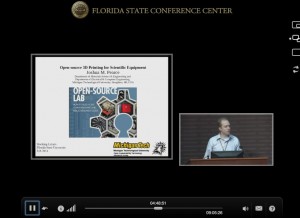
Joshua Pearce (MSE/ECE) presented an invited talk on Open Source 3D Printing at Stacking Layers: A symposium on 3D printing technologies and applications in Tallahassee, Florida, recently.

Stacking Layers Presentation
Joshua Pearce presentation begins at 04:46:00. Click the image to launch the presentation page. Choose the Tuesday presentaton link.

From Tech Today.

3D printing with metal at Michigan Technological University

3D printing has become a useful tool, but so far has been limited in the materials it can use. Michigan Tech researchers are now developing a way to print 3D objects using metal.

View the YouTube Video, by Michigan Tech.

In the News

Research completed by graduate student Brennan Tymrak (ME), alumna Megan Kreiger (MSE) and Pearce (MSE/ECE) was highlighted by 3D Printing Industry in“Michigan Tech Study Suggests Some RepRap 3D Prints Are As Strong as Commercial 3D Printers.”

The life cycle analysis research of distributed recycling by alumnae Megan Kreiger (MSE) and Meredith Mulder (MSE), current MSE student Allie Glover, and Pearce (MSE/ECE) was covered extensively by the media including CNN/MoneyYahoo News and Ars Technica.

From Tech Today.

Michigan Tech Study Suggests Some RepRap 3D Prints Are As Strong as Commercial 3D Printers

If you thought that plastic parts produced from your average RepRap desktop 3D printer were in any way weaker than those made with commercial 3D printers, you may be proven wrong. The research lab of Dr. Joshua Pearce at Michigan Technological University has once again put out a study in favour of low-cost 3D printing.

There’s still a great deal of research ahead of the team, to further elucidate the properties of objects printed with low-cost 3D printers, such as the effects of chemical post-processing on the strength of a print. Pearce explains, “This study only looked at the tensile strength in the plane of the print bed, next we need to expand this study to look at interlayer adhesion.”

Read more at 3D Printing Industry, by Michael Molitch-Hou.

Milk Jug
Milk Jug

In the News

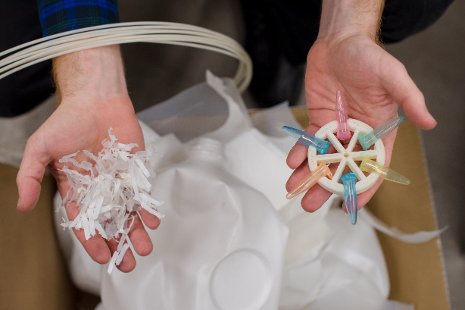
CBS Detroit and its Technology Report published an article about Associate Professor Joshua Pearce’s (MSE) work using recycled milk jugs for 3D printing material. See CBS Detroit.

From Tech Today.

In the News

Research completed by graduate student Brennan Tymrak (ME), alumna Megan Kreiger (MSE) and Joshua Pearce (MSE/ECE) was highlighted in the EE Times article“Measuring Open Source Hardware 3D-Printed Material Strength.”

***
Pearce was also interviewed about how 3D printing is environmentally green on Living on Earth–PRI’s Environmental News Magazine.

***
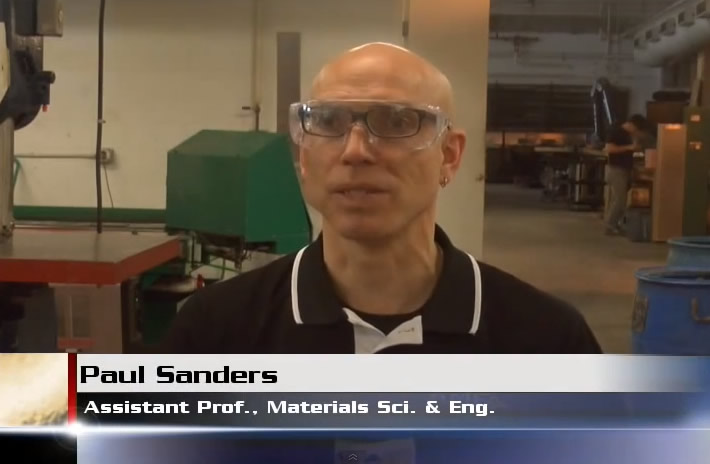
Professor Paul Sanders (MSE) and Pearce were interviewed on ABC10.

From Tech Today.

3-D Printing is Green

CURWOOD: Back before the industrial revolution, if you needed some thing, you or someone else would make it by hand. Then along came the production line and big machines that could mass produce items quickly and cheaply. And now we are headed back to future with so-called 3D printing, where a fairly small machine can make just about any metal or plastic object simply by following precise instructions from a computer. A team at Michigan Technological University has studied the possible environmental and the financial benefits of 3D printing. Joshua Pearce led the research and explains the surprising results.

Read the transcript or listen to the audio stream/download at Living on Earth, with Steve Curwood and Joshua Pearce.

Michigan Tech creates 3-D printer

“What our group has done hear at Michigan Tech is radically pushed the cost of 3-D printers down. So commercial 3-D printers that could do plastic used to cost $20,000. Now with the Open Source project, that cost has come under $1,000 and the ones we are building with our students cost under $500,” Materials Science and Engineering Associate Professor Dr. Joshua Pearce said.

Assistant Professor Paul Sanders said when he heard about 3-D printing with plastic, he questioned if it could be done with metal.

“This is essentially welding but it’s different because instead of joining two big pieces of metal, we’re making everything out of the weld wire itself,” he said.

Read more and watch the video at ABC 10, WBUP | WBKP.

Paul Sanders ABC10 3D

In the News

Pearce was also interviewed by 3D Printing Industry in the article “3D Printing Plastic — Distributed Recycling and Distributing the Benefits.”

***
Michigan Tech’s 3D-printing program was highlighted in The Conversation article“Researchers can be ‘digital blacksmiths’ with 3D printers.”

From Tech Today.

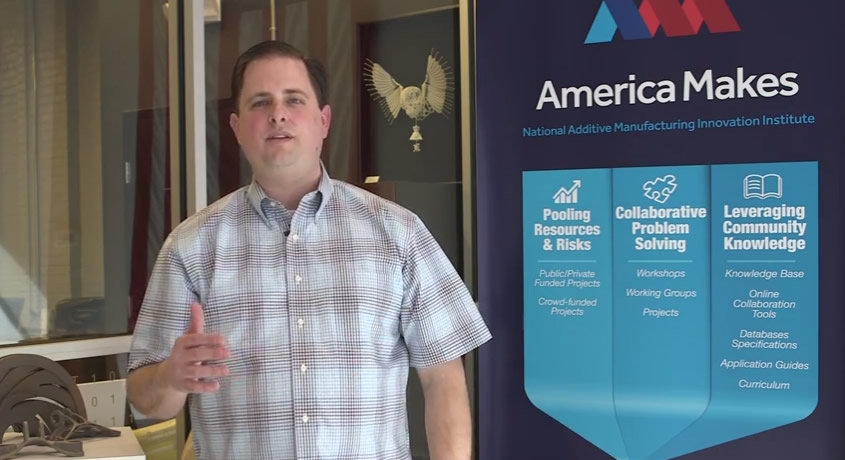
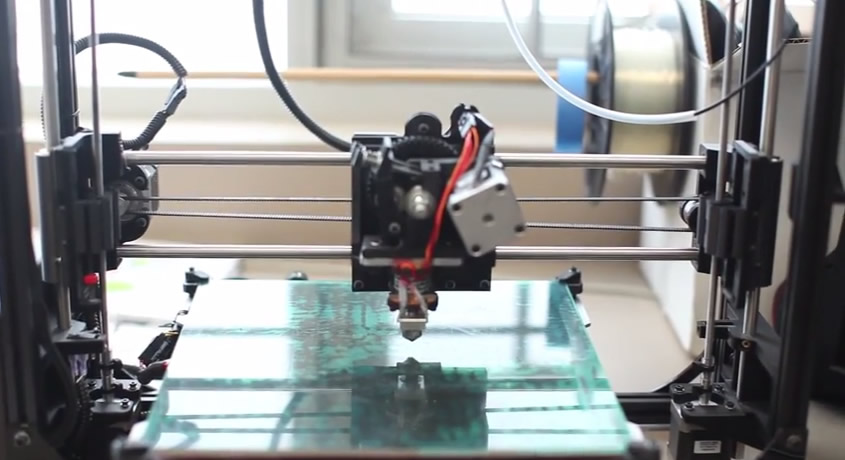
America Makes – Michigan Tech Low Cost 3D Metal Printer

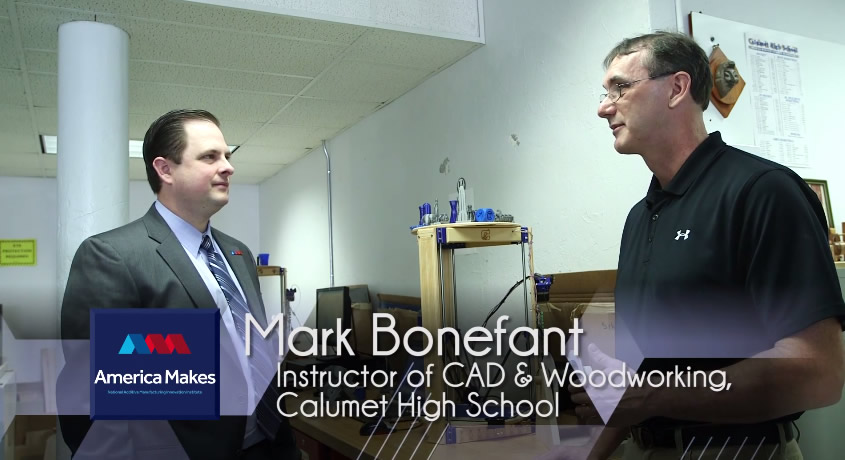
America Makes is the National Additive Manufacturing Innovation Institute. They focused on 3D metal printing initiatives at Michigan Tech in the new video “America Makes Moment.” Several people from Michigan Tech were interviewed, including President Glenn Mroz, Associate Professor Joshua Pearce, and Mark Bonefant, Instructor of CAD & Woodworking, Calumet High School. Featured were several students, instructors, and researchers, including Assistant Professor Paul Sanders.

Watch the YouTube Video, hosted by Rob Gorham, Deputy Directory of Technology Development at America Makes.

Rob Gorham
Rob Gorham

Glenn Mroz
Glenn Mroz

Joshua Pearce
Joshua Pearce

3D Printer
3D Printer

PhD Student
PhD Student

Mark Bonefant
Mark Bonefant

Rob Gorham and Paul Sanders

3D Printers in November News

Ethical Filament FoundationThrough research at the University’s Open Sustainability Technology Lab, Michigan Tech was a launch supporter of the Ethical Filament Foundation, whose goal is to create an environmentally friendly and ethically produced filament for the rapidly growing 3-D printing market. The foundation hopes to open up a new market for value added products that can be produced by waste picker groups in low-income countries. The launch of the Ethical Filament Foundation was covered in the media such as TechCrunch
http://techcrunch.com/2013/11/07/ethical-additive-manufacturing

From Tech Today.

Charity Targets 3D Printing’s Plastic Waste Problem With Standards For An Ethical Alternative

The Foundation has been founded by techfortrade in partnership with Dreambox Emergence which provides 3D printing units for community based manufacturing in Guatemala, and Michigan Technological University.

Read more at TechCrunch, by Natasha Lomas.

Commentary: Open-source hardware for research and education

The software industry has had a similar revolution of shoulder-standing, in the form of the free and open-source computer software movement. Free and open-source software (FOSS) is available in source-code form and can be used, copied, modified, and redistributed without restriction, or with restrictions only to ensure that it remains open to future recipients and users.

Two recent open-source design and production developments are driving those reductions: Arduino microcontrollers and the RepRap three-dimensional printer.

Read more at Physics Today, by Joshua Pearce.

3D Printing a Greener Alternative to Traditional Manufacturing

“The bottom line is, we can get substantial reductions in energy and CO2 emissions from making things at home,” Dr. Joshua Pearce, who conducted the study, said. “And the home manufacturer would be motivated to do the right thing and use less energy, because it costs so much less to make things on a 3D printer than to buy them off the shelf or on the Internet.”

Read more at 3D Printer World, by John Graber.

Pearce Pens a 3D Printing Guide for Scientists on a Budget

Joshua Pearce is not one for understatement. “This is the beginning of a true revolution in the sciences,” says the author of “Open-Source Lab.” For cash-strapped researchers, he could be right.

Read more at Michigan Tech News.

Slideshow: 3D Printing Is Cheap & Green for Plastics

A team led by Michigan Technological University’s Joshua M. Pearce conducted preliminary lifecycle analyses of three small plastic objects: a child’s building block, a spout for a watering can, and a citrus juicer. The three objects chosen were considered typical of those people might want to print at home, and because open-source .STL files are easily available. They were also chosen to test different variables, such as the effect of fill percentage on environmental impact or geometrical complexity. The team included Pearce, associate professor of materials science & engineering, electrical engineering and computer engineering, and Megan Kreiger, graduate student in materials science & engineering.

Read more at Design News, by Ann R. Thryft.

In the News

“America Makes,” the National Additive Manufacturing Innovation Institute, driven by the National Center for Defense Manufacturing and Machining (NCDMM), proudly welcomed eight new members including Michigan Tech for their work in 3D printing.

Joshua Pearce (MSE/ECE) published an article in Elsevier Connect 3D-Printing Your Lab Equipment–It’s Cheaper Than You Think.

From Tech Today.

3D-printing your lab equipment—it’s cheaper than you think
3D printing and open-source designs are emerging as powerful tools for accelerating science

3D printers do what engineers like to call additive manufacturing – that is, they make real physical objects by laying down sub-millimeter-thick layers of material (currently mostly plastic) one after another in a specific pattern governed by a digital design. This allows 3D printer users to make products to their own specifications, so they do not have to “make do” with what is available off the shelf at their local store or even on the Internet.

Read more at Elsevier Connect, by Joshua M. Pearce.

3D Printers for Peace – Contest Results

The results of the Michigan Tech 3-D Printers for Peace Contest are in:

3D Printers for Peace - 1st
First Prize: Open-Series 1 3-D Printer for 3-D Printed Immunization Records

1st Prize an open-source Series 1 3-D printer, provided by Type A Machines went to John Van Tuyl from Hamilton, On who designed VaxBeads, which are 3-D printed immunization records. VaxBeads offer the potential to ease the determination of what vaccines a child needs in the developing world. Each bead represents a different vaccine. The shape and colour of each bead is unique to a specific vaccine.

This innovative idea showcased the ability of 3-D printing as each bead is customized on the spot with the child’s initials, date of birth, and an identifying number. It is the designer’s hopes that the beads would have more intrinsic value to the patients than standard vaccination cards.

3D Printers for Peace - 2nd Prize
Second Prize: MOST 3D Printer Kit for Solar Powered Water Purification Cone

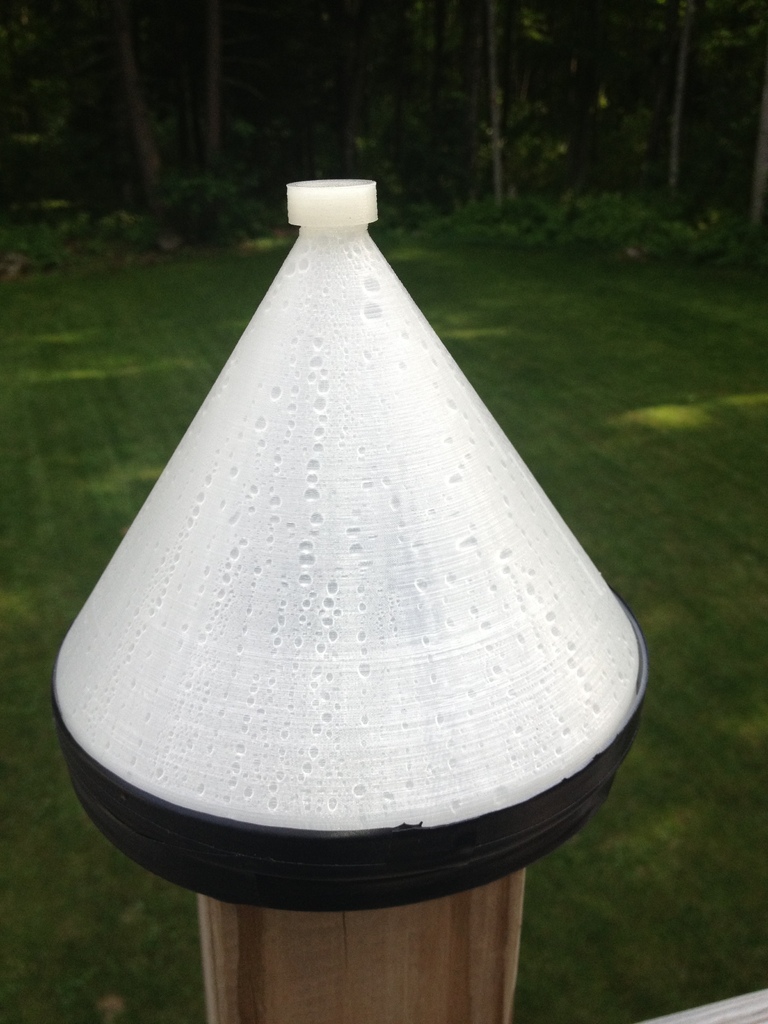
2nd prize (Michigan Tech’s MOST version of the RepRap Prusa Mendel open-source 3D printer kit) went to Michigan Tech student, Matt Courchaine, for his Solar Powered Water Purification Cone. In disaster areas or among the millions of people that do not have improved water supplies clean water is a precious commodity. This printable design allows users to make clean water from contaminated supplies. The white, semi transparent plastic cover of the solar cone allows sunlight to pass through it and evaporate dirty water contained in the black base tray. Clean water then condenses on the cooler white plastic of the cone and drips into a holding reservoir, which is part of the cone for later drinking.

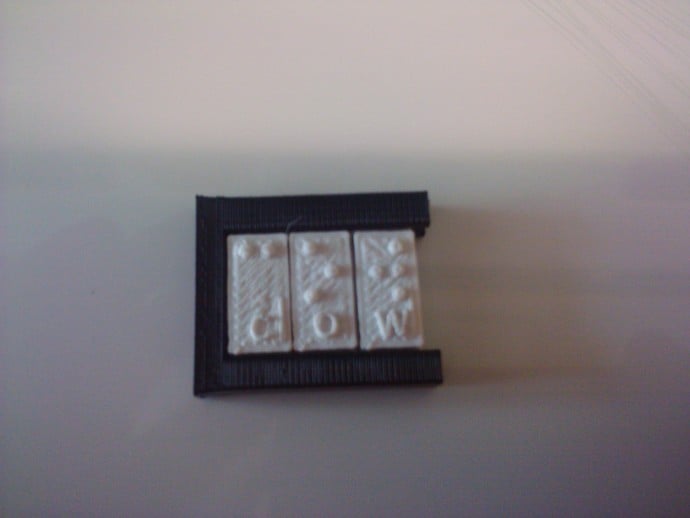
3rd prize, MatterHackers sampler pack of filament, was awarded to Aaron Meidinger for the design of a Braille Tablet, which is a tool for a sighted person to help a blind person to learn braille or just a quick way to leave a note for a friend. One prints out a braille platform and a scrabble set of letters, along with some of the punctuation and a nice pile of the blank tiles to use it to write any short message.

3D Printers for Peace - 3rd Prize
Third Prize: MatterHackers Filament for Braille Tablet

All the open source entries to the contest demonstrated the technical ability and promise of low-cost 3-D printers to provide for humanities needs and advance the cause of peace.

Visit the contest website.

Immunization Beads Garner Top Prize in 3D Printers for Peace Contest

The judges were impressed with the design’s originality and practicality. “VaxBeads are a novel idea; no one has done anything like that yet,” said Pearce. “John demonstrated the ability of 3D printing to address a real need in the developing world. You could print beads fast enough to hand to children, and if they were to wear the necklace to the doctor’s office, it would be quick and easy to identify missing vaccinations.”

Read more at Michigan Tech News, by Marcia Goodrich.

Winner in 3D printer contest designs vaccination record system

“What I’m hoping this does is change the conversation to start really thinking about the constructive uses of 3D printers, not just on manufacturing, but trying to solve some of the most pressing problems, particularly in the developing world,” said associate professor of materials science and contest creator, Joshua Pearce.

Read more at Upper Michigans Source, by Sarah Blakely.

Paul Sanders on Partnering with LIFT

LIFT, short for Lightweight Innovations for Tomorrow, is a nonprofit organization established through a partnership with the U.S. Department of Defense, academia, and private industry. Its multifaceted mission includes training workers for high-tech manufacturing jobs, advancing defense-related technology, and preparing more companies to deal in the technology that would qualify them as defense contractors.

LIFT works with Michigan Tech by attracting partners to academia, bringing both funding and industry players into projects.

Paul Sanders, a professor of materials science and engineering at Michigan Tech, has listed several interactions with LIFT. One is connecting Michigan Tech with Southfield-based Grede Foundry on a cast-iron drive train component development project.

Currently, Sanders and his team are working on mechanical property characterizations on a project LIFT brought to them involving hypersonics and additive manufacturing.

Soon to follow will be testing on custom powders LIFT is working on.

“We like the location of LIFT, we like the finances that LIFT has, and we like their emphasis on talent and training.”

Paul Sanders

Michigan Tech also finds it appealing that LIFT is so close to the kinds of students the university wants to attract to its degree programs but doesn’t always have easy access to in the Upper Peninsula.

According to Cassy Tefft de Munoz, Michigan Tech’s executive director of enrollment initiatives, the university has brought thousands of students through LIFT’s facility — some in the sixth and seventh grades — to help get them interested in STEM.

Read more at DBusiness, by Dan Calabrese.

Advancing hypersonic aerospace systems with 3D printing

Just announced this Spring was a related LIFT initiative: sponsored research by undergraduate teams at Michigan Technological University to develop new materials and “road maps” for hypersonics applications. Considering the progress made by the LIFT ramjet project, it’s clear that students’ ideas can be worth paying attention to.

Read more at Design World, by Rachael Pasini.

Related

The Fast Get Faster: Hypersonics and 3D Printing

MTU and LIFT Partner to Design Future Additive Manufacturing Materials, Manufacturing Processes

New Technology for Custom 3DP Alloys

DBusiness Daily Update: OU Credit Union Agrees to 10-year, $5M O’rena Naming Rights Deal, and More

MSE Entries in Expo 2012

Expo2012 Undergraduate Expo Entries

SENIOR DESIGN
Title and Representative

Economic Recovery of Alloying Elements from Grinding Swarf
Alicia Steele

Reduce Distortion in Ferritic Nitrocarburizing of Gray Iron
Carol Deming

Fatigue in Stainless Steel Components Produced by Powder Metallurgy & Hot Isostatic Pressing
Samantha Leonard

EZAC Creep Testing Team
Deane Kyle

Effects of Mn and Sn on Ductile Iron
Dale Goodloe

Residual Stress of Gray Iron Brake Rotors
Carol Dem

Waupaca FNC Case Depth
Ashwin, Vekaria

ENTERPRISE TEAMS

Advanced Metalworks Enterprise
Zac Dvorak

About

This is an example of a WordPress page, you could edit this to put information about yourself or your site so readers know where you are coming from. You can create as many pages like this one or sub-pages as you like and manage all of your content inside of WordPress.