

Michigan Tech PhD candidate Will Johnston was selected for the 2026 Rising Stars in Mechanical Engineering workshop, a competitive program that prepares emerging researchers for academic careers. Held at Stanford University in September, the workshop brought together approximately 30 doctoral students and postdoctoral researchers from across the country. The program, which rotates annually among Stanford, MIT, UC Berkeley, and Carnegie Mellon University, prepares early-career researchers for academic careers in mechanical engineering.
Turning a 3D-Printing Defect into a Design Feature
Johnston, a member of Michigan Technological University’s Mechanics, Acoustics, and Dynamics Lab (MADLab), focuses his dissertation research on tensegrity-assisted inflatable structures: 3D-printed inflatables with an internal fiber architecture that gives them precise, controllable shapes that are nearly impossible to achieve with conventional inflatables. The technology has potential applications in aerospace components, deployable space structures and biomedical devices such as stents.
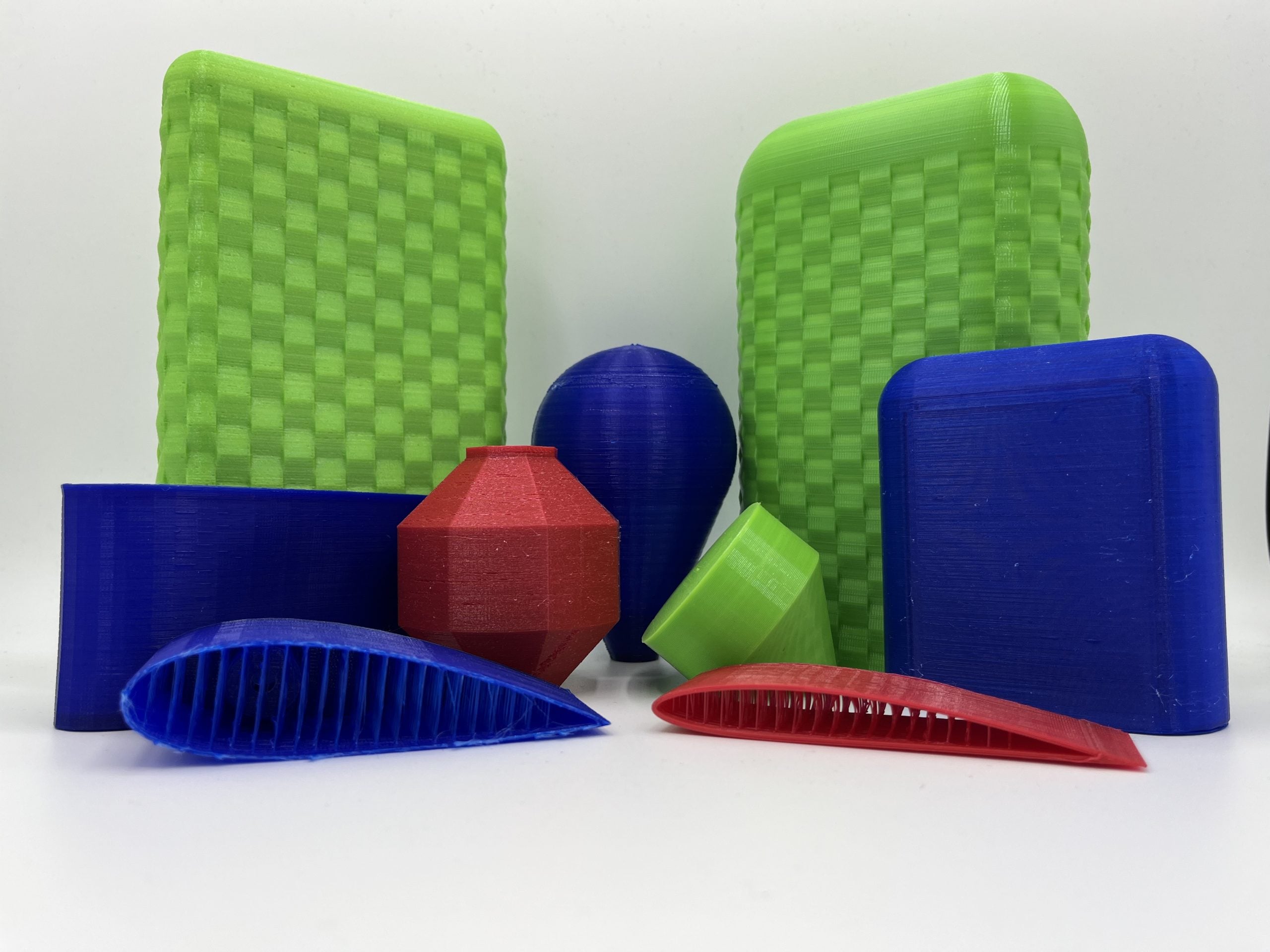
At the workshop, Johnston delivered a lightning talk that inverts conventional engineering logic: in 3D printing, stringing (the taffy-like filaments a printer leaves as it moves between points) is typically treated as a defect to be eliminated. Johnston’s work leverages stringing as a design feature, using those fibers to build structures with properties that conventional manufacturing can’t replicate. By rethinking how 3D-printed fibers behave, Johnston is developing inflatable structures whose shapes and mechanical properties can be controlled through their internal architecture.
A Manufacturing Researcher at the Right Moment
Johnston was one of the few manufacturing-focused researchers in the cohort. Workshop organizers highlighted manufacturing as an area of growing emphasis across leading engineering programs, noting that Stanford itself is expanding its faculty in the field. It’s an advantage Johnston has cultivated deliberately, since his research bridges multiple engineering disciplines. “If you’re interested in hiring a manufacturing person who can go beyond manufacturing, that’s what I bring,” Johnston said.
“Will has a gift for seeing possibilities where others see limitations, and the persistence to turn those possibilities into working technologies,” said Bhisham Sharma, associate professor in the Department of Mechanical and Aerospace Engineering, who has advised Johnston since his undergraduate days at Wichita State University and brought him to Michigan Tech in 2023. “He is the strongest student I have advised — not simply because of what he has accomplished, but because of the originality and independence of his thinking. His selection is well deserved and reflects the caliber of research our graduate students can pursue at Michigan Tech.”
Recognition, Research, and the Road to a Faculty Career
Johnston is a National Science Foundation (NSF) Graduate Research Fellow, co-inventor on a U.S. patent for inflatable structure fabrication, and the student team lead behind TenseFlatables, which won first place in the Manufacturing and Materials category at the SAE Create the Future Design Contest, and AeroFeathers, which won an honorable mention in SAE’s Aerospace and Defense category.
The workshop also covered the faculty job search, including research and teaching statements and how to communicate a research vision to hiring committees. Johnston is currently applying for assistant professor positions and plans to defend his dissertation in the spring of 2027.