Category: Applied Cognitive Science and Human Factors

ACSHF Forum: Robert Gutzwiller

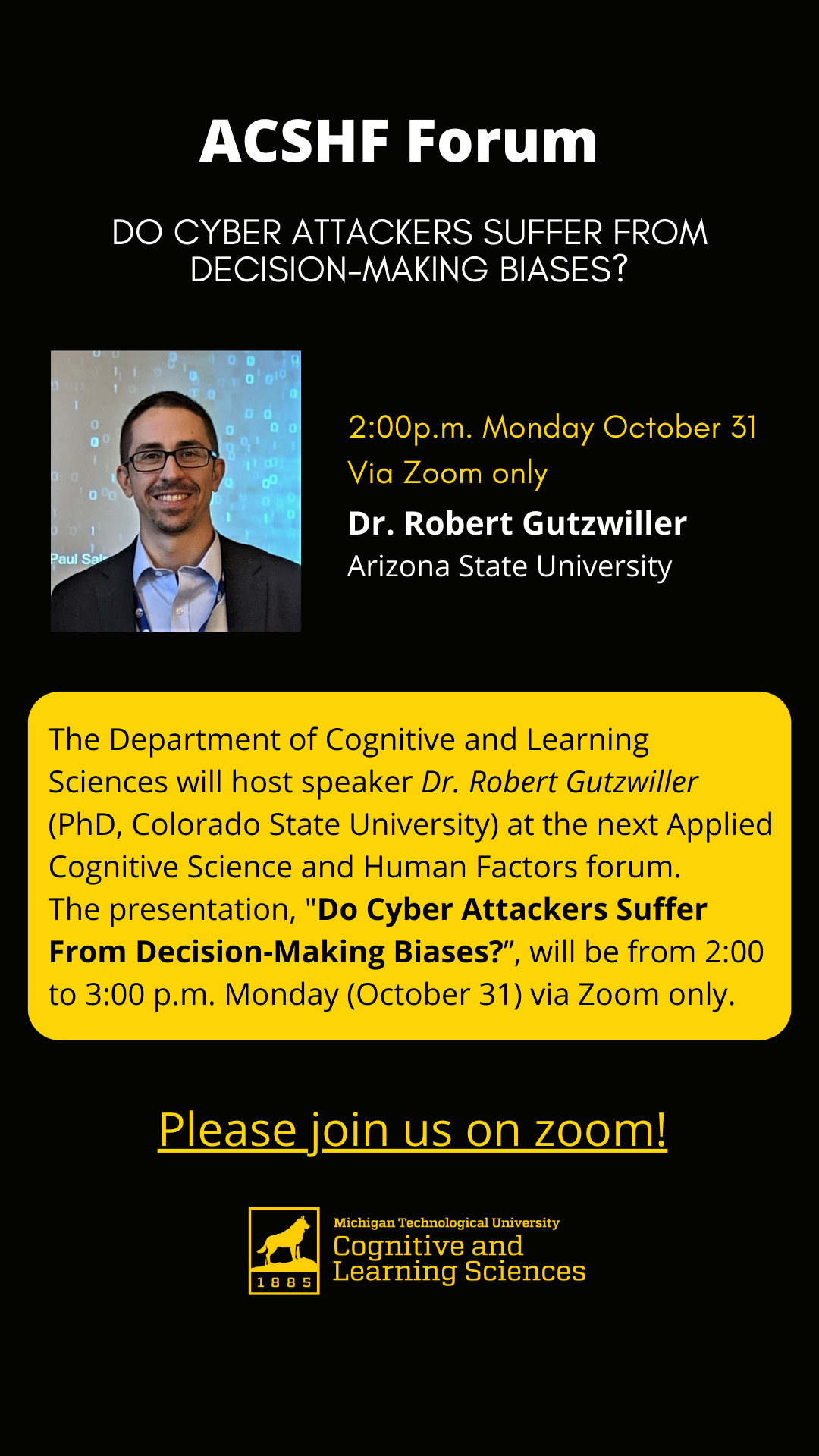
The Department of Cognitive and Learning Sciences will host Dr. Robert Gutzwiller (Arizona State University) at the next Applied Cognitive Science and Human Factors Forum on Monday (Oct. 31) from 2-3 p.m. via Zoom only.

Title:
Do Cyber Attackers Suffer From Decision-Making Biases?

ABSTRACT:
We report on whether cyber attacker behaviors contain decision making biases. Data from a prior experiment were analyzed in an exploratory fashion, making use of think-aloud responses from a small group of red teamers. The analysis provided new observational evidence of traditional decision-making biases in red team behaviors (confirmation bias, anchoring, and take-the-best heuristic use). These biases may disrupt red team decisions and goals, and simultaneously increase their risk of detection. Interestingly, at least part of the bias induction may be related to the use of cyber deception. Future directions include the development of behavioral measurement techniques for these and additional cognitive biases in cyber operators, examining the role of attacker traits, and identifying the conditions where biases can be induced successfully in experimental conditions
CLS at Human Factors & Ergonomics Society International Annual Meeting

Michigan Tech was well represented at the HFES International Annual Meeting held in Atlanta, GA last week. CLS faculty in attendance were Kelly Steelman, Susie Amato-Henderson, and Briana Bettin (CLS/CS), along with ACSHF graduate students Tauseef Mamun, Lamia Alam, Lauren Monroe, and Nishat Alam.

Mamun co-chaired the session “Human AI Robot Teaming (HART)” and presented his research “Assessing Satisfaction in and Understanding of a Collaborative Explainable AI (CXAI) System through User Studies” conducted with Lamia Alam and Shane Mueller (CLS) and Robert Hoffman (IHMC).

Amato-Henderson co-chaired the session “COVID-19 Pandemic and Remote/Hybrid Learning – Education” and presented her research with Jon Sticklen (EF) “The Relationship between Teaming and Sense of Connection in a First-Year Engineering Program”.

Monroe presented her research “The Effects of Varying Music Tempo on Vigilance Performance and Affective State” conducted with Samantha Smith (CLS)

Bettin (CLS/CS) presented her research “Identifying and Addressing Risks in the Early Design of a Sociotechnical System through Premortem” conducted with Kelly Steelman (CLS), Charles Wallace (CS), Dana Pontious (CLS), and Elizabeth Veinott (CLS).

ACSHF Forum: Grad Student Presentations

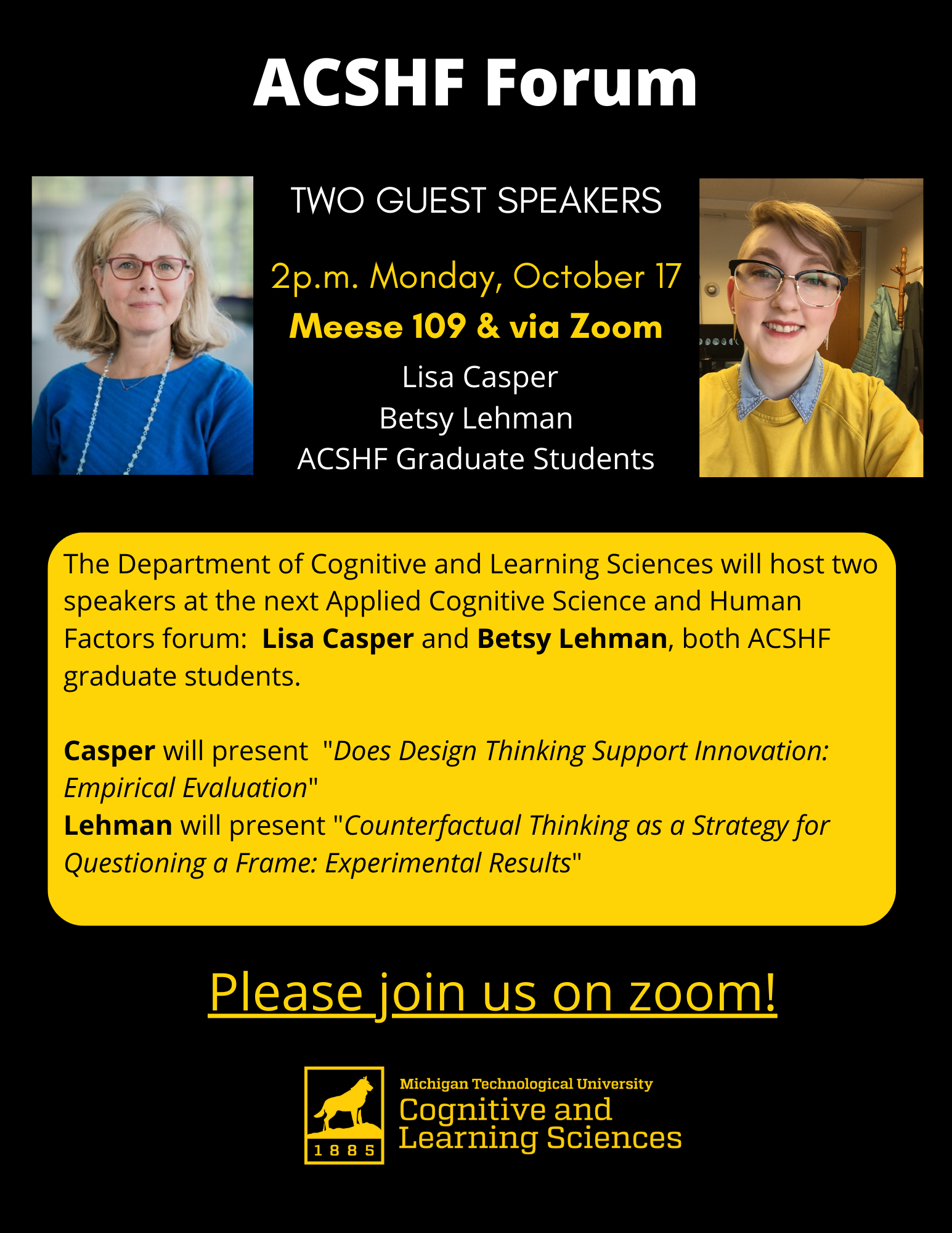
The Department of Cognitive and Learning Sciences will host ACSHF students Lisa Casper and Betsy Lehman at the next Applied Cognitive Science and Human Factors forum Monday (October 17) from 2:00pm to 3:00pm in Meese 109 and via Zoom.

Lisa Casper will present her research titled “Does Design Thinking Support Innovation: Empirical Evaluation

Abstract: Design thinking (DT) is a tool to support team innovation however, few empirical studies have examined it. In this study, we experimentally compared the effect of two approaches for DT ideate brainstorming on the number of ideas generated and the perceived innovativeness of those ideas.  As part of a semester-long DT project, 145 participants comprising 48 teams were challenged to develop an innovative solution for one of 17 United Nations sustainability goals (https://sdgs.un.org/goals).  Half of the teams engaged in a standard DT brainstorming ideation process, while the other half participated in an experimental brainstorming condition. Participants generated ideas and provided subjective ratings of the process and their team’s solution. Ideas were content-coded on several dimensions by two independent raters.  We found that teams in the DT experimental brainstorming techniques condition generated almost 58% more ideas than those in the DT baseline condition in the same amount of time, but their ideas were not rated as more innovative. What these data suggest for innovation and conducting research on innovation will be discussed.

Betsy Lehman will present her research titled Counterfactual Thinking as a Strategy for Questioning a Frame: Experimental Results

Abstract: Understanding how people make sense of situations and question the theories they hold may be critical in many circumstances, from communicating about climate change to improving DEI at work. Questioning a perspective is assumed to be a precursor to changing it (Klein et al., 2007), yet the research on the questioning process is limited. In a previous study, we found that factors involved in counterfactual thinking (Roese & Olson, 1995), mutability of the situation and ease of generating counterfactuals, appeared highly relevant in the sensemaking process. In the present experiment, we tested this effect by manipulating ease of generation and a mutability focus strategy. This research focuses on understanding the mechanisms of perspective shifting to support applications such as programs to reduce implicit bias.

KCP Future Faculty Fellowship Award – Tim Raymond

The Michigan Tech Graduate School has announced that ACSHF MS student Tim Raymond is the recipient of a King-Chávez-Parks (KCP) Future Faculty Fellowship for academic year 2022-2023. Tim explains how he first became interested in teaching through his involvement in martial arts classes in his early teens. His passion grew from there and he continues to pursue and define his knowledge of teaching through education and real-world experiences.

Ever since my early teen years I have been involved in teaching. At 13 years of age I was leading martial arts classes for even younger students. Although the techniques were still quite rudimentary, I found a passion within teaching that has continued to evolve. My teacher as he taught me had enough insight into how much I enjoyed teaching that he began to teach me how to teach. Instead of just throwing concepts or techniques at me, he made sure I understood them all at a deeper level with the intention I continue teaching them. 

I can’t say that academia has always been a major concern for me. Due to unforeseeable reasons, I dropped out of high school when I was 17 years old to help out with the family business. I never thought I would return to a school setting but after many bumps in the road, I eventually found my way back.

The most amazing part about being an educator or at least aspiring to be one is that we are continuously humbled every day through our interactions with colleagues and people above us. These interactions can lead us to new and unique paths that we would have never imagined. My time here at MTU has brought me to psychology and eventually grad school where under my current advisor, Elizabeth Veinott, I have recently been exposed to research regarding the railroad industry. 

While on this new journey through academia I have been able to find ways to combine the knowledge I am receiving from Michigan Tech with my knowledge of the ‘real-world’ and I endeavor daily to become an educator that teaches not just the concepts or ideas but how we can use them within industry and alongside our daily lives.

ACSHF Forum: Cindy Sifonis

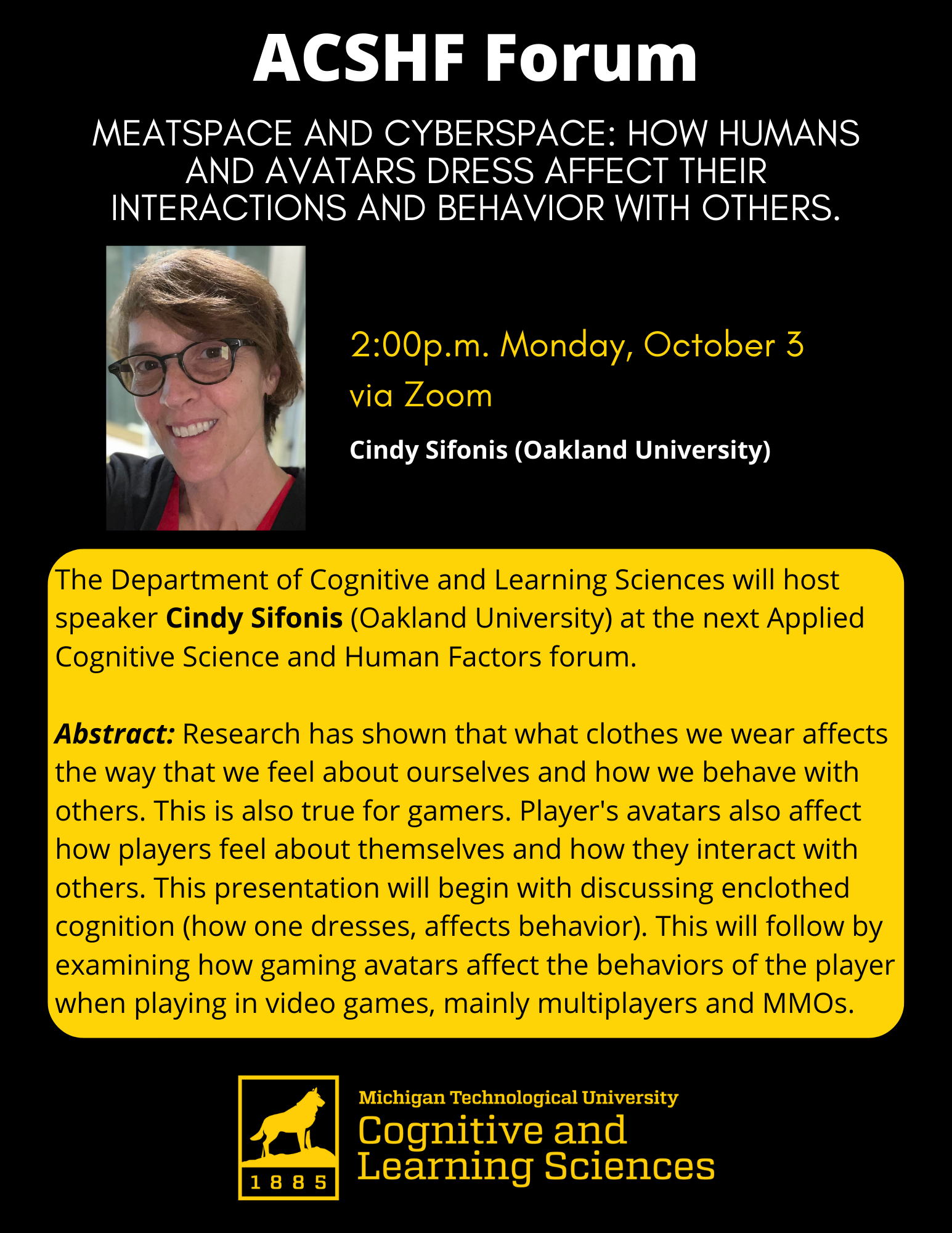
The Department of Cognitive and Learning Sciences will host speaker Cindy Sifonis (Oakland University) at the next Applied Cognitive Science and Human Factors forum. The presentation, “Meatspace and Cyberspace: How humans and avatars dress affect their interactions and behavior with others.”, will be from 2:00 to 3:00 p.m. Monday (October 3) via Zoom.

Abstract: Research has shown that what clothes we wear affects the way that we feel about ourselves and how we behave with others. This is also true for gamers. Player’s avatars also affect how players feel about themselves and how they interact with others. This presentation will begin with discussing enclothed cognition (how one dresses, affects behavior). This will follow by examining how gaming avatars affect the behaviors of the player when playing in video games, mainly multiplayers and MMOs.

ACSHF Forum: Kelly Steelman, CLS chair

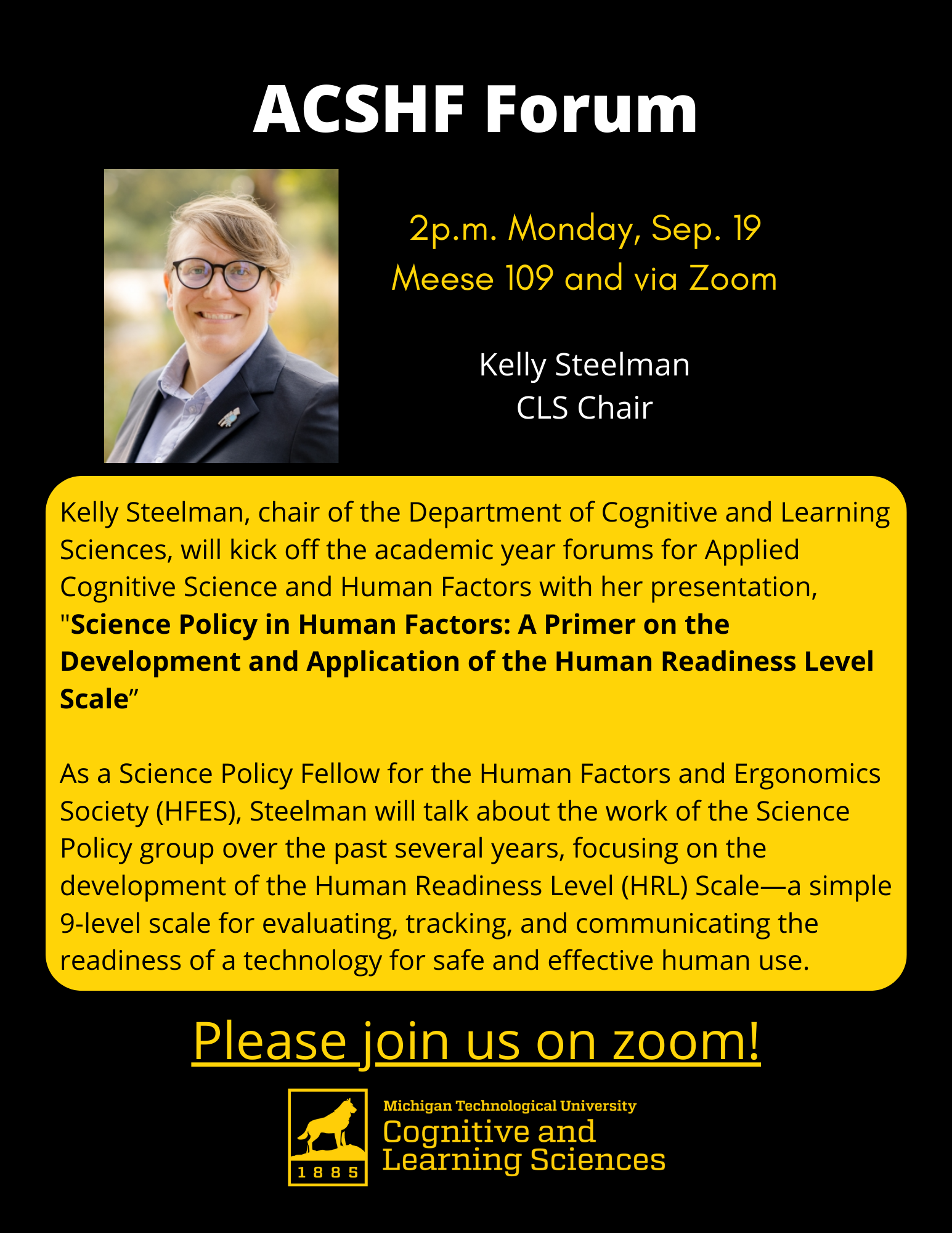
Kelly Steelman, chair of the Department of Cognitive and Learning Sciences will kick off the academic year forums for Applied Cognitive Science and Human Factors with her presentation, “Science Policy in Human Factors: A Primer on the Development and Application of the Human Readiness Level Scale”, from 2:00 to 3:00 p.m. Monday (September 19) in Meese 109 and via Zoom.

As a Science Policy Fellow for the Human Factors and Ergonomics Society (HFES), Steelman will talk about the work of the Science Policy group over the past several years, focusing on the development of the Human Readiness Level (HRL) Scale—a simple 9-level scale for evaluating, tracking,and communicating the readiness of a technology for safe and effective human use.

Complete abstract:
In 2019, Dr. Kelly Steelman was selected as a Science Policy Fellow for the Human Factors and Ergonomics Society. In this presentation, Steelman will talk about the work of the Science Policy group over the past several years, focusing on the development of the Human Readiness Level (HRL) Scale—a simple 9-level scale for evaluating, tracking, and communicating the readiness of a technology for safe and effective human use. It is modeled after the well-established Technology Readiness Level (TRL) framework that is used throughout the government and industry to communicate the maturity of a technology and to support decision making about technology acquisition. The HRL scale is defined in the ANSI/HFES 400-2021 Standard and is currently being socialized throughout the government, Department of Defense,  and industry.
Dr. Steelman will discuss the promise of the HRL Scale and associated standard as tools for increasing awareness of the field of human factors and for establishing requirements for human-systems evaluation—and the involvement of human-systems experts—throughout the development lifecycle.

Brandon Woolman presents research findings at MI Society for Neuroscience

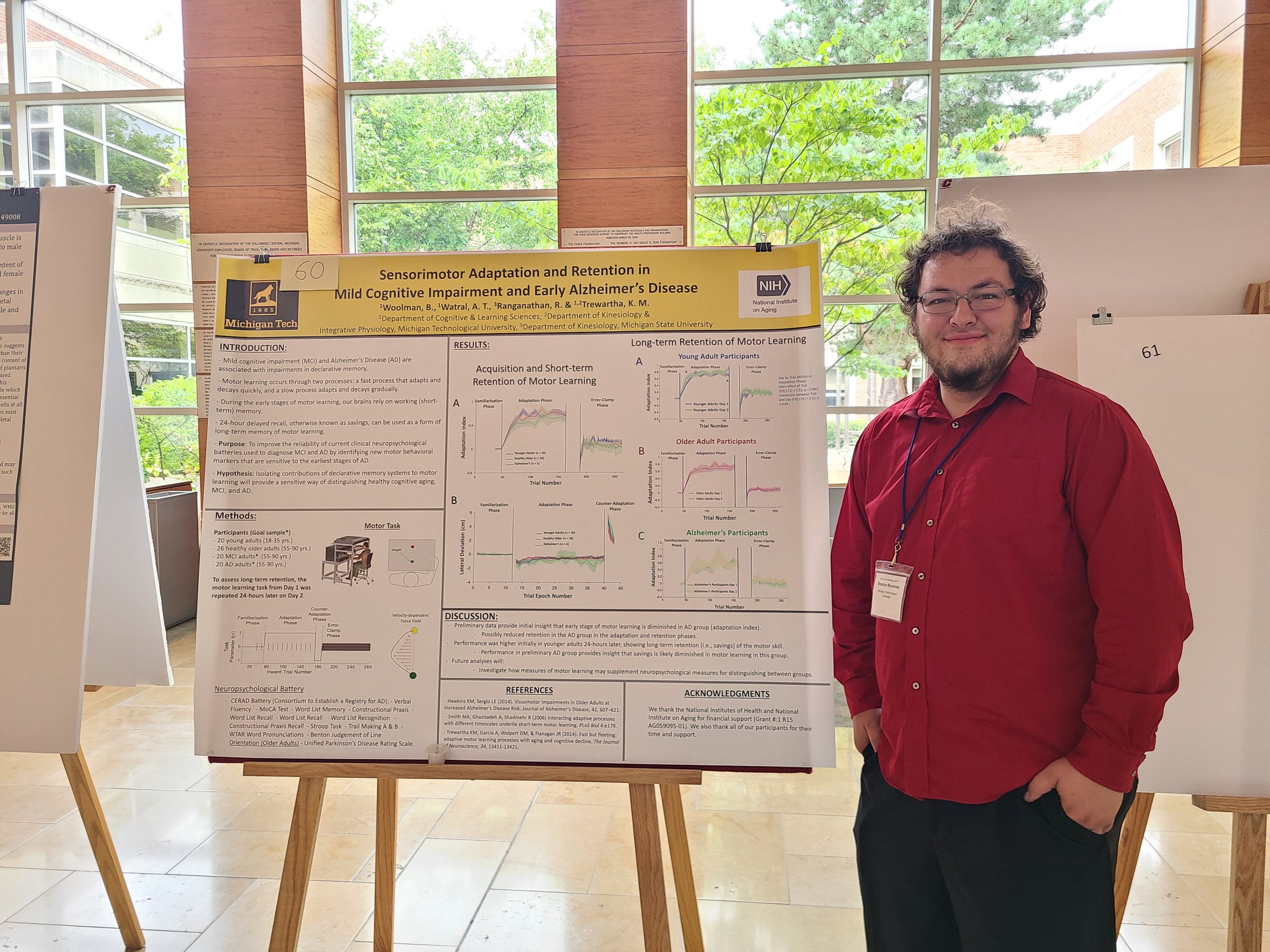
Applied Cognitive Science and Human Factors (ACSHF) MS student Brandon Woolman presented his team’s research findings during the Michigan Chapter Society for Neuroscience at Central Michigan University on August 20.

Woolman’s, along with teammates Alexandra Watral (ACSHF PhD candidate), Rajiv Ranganathan (Kinesiology, Michigan State University), and advisor Dr. Kevin Trewartha, research titled “Sensorimotor Adaptation and Retention in Mild Cognitive Impairment and Early Alzheimer’s Disease,” is made possible by grant funding from the National Institute on Aging (NIH).

The study included preliminary data from participants diagnosed with the early stages of Alzheimer’s Disease (AD), and control groups of cognitively healthy older and younger adults. All of which performed a force-field adaption task using a specialized robotic device (KINARM). The team investigated whether the early stages of motor learning are affected by early AD, and whether those patients exhibit additional impairments in short-term (i.e., within the testing session) and long-term retention (after a 24-hour delay) of a newly acquired motor skill.

Participants were instructed to reach for visual targets, and while their arms moved, the robot would apply a velocity-dependent force perpendicular to the direction of the target. The mechanical load hinders smooth movements toward the target, but over time participants
adapt by applying forces to counter the load. Short-term retention of force-field adaption was assessed in a final block of trials on Day 1. Participants returned a day later to perform the same motor task to assess long-term skill retention over a 24-hour delay.

The work aims to determine whether acquisition, short- and long-term retention measures in a motor learning task, can identify differences between early AD and healthy aging. Measuring these differences could aid in the diagnosis of Alzheimer’s Disease in its earliest stages.

For more information and details on related research, see Dr. Trewartha’s Aging Cognition Action Lab website.

Brittany Nelson and the Summer Institute on Bounded Rationality

ACSHF PhD student Brittany Nelson (bottom left) at the Max Planck Institute for Human Development in Berlin, Germany

Summer is a time for adventure and learning. ACSHF PhD student Brittany Nelson earned her spot to experience both as the recipient of a 2022 Summer Institute on Bounded Rationality scholarship.

The program offers a forum for young scholars from around the world in various disciplines to share their approaches, discuss their research, and inspire each other. This year’s Summer Institute took place June 14 – 22, at the Max Planck Institute for Human Development in Berlin, Germany. Brittany shares her experience with us here.


Photo of Brittany Nelson

I’m very grateful to have attended the Max Planck Summer Institute on Bounded Rationality in Berlin, Germany. I heard from some of the best researchers in the world who study decision making (e.g., Dr. Gerd Gigerenzer and Dr. Ralph Hertwig). While there I developed and refined new research ideas, created a professional network with excellent graduate student researchers, learned new methodologies from interdisciplinary fields, and refined my presentation skills in front of leading experts! On the last day I heard an inspiring talk from Dr. Naomi Oreskes who discussed the responsibility of scientists to disseminate our science within our society. I really enjoyed my time there and am significantly better researcher for it. [Hear Dr. Oreskes message in her Ted Talk below.]

Brittany was also awarded a King-Chávez-Parks (KCP) Future Faculty Fellowship this past spring in support of her doctoral studies. Under the advisement of Dr. Erich Petushek, her current Ph.D. research involves identifying, measuring, and improving key factors that impact healthy lifestyle decisions.

For more CLS summer adventures and the latest happenings, follow us on Instagram @clsmtu and like us on Facebook.

Measuring Changes in Motor Learning Outside the Laboratory

The Aging, Cognition, and Action Lab in CLS is currently investigating the validity of a new web-based application for measuring changes in motor learning that occur in healthy aging and Parkinson’s disease. Traditional laboratory approaches to measuring motor learning impose barriers to accessibility for many participants, while few options for portable devices such as smartphones and tablets have been developed. An effective web-based approach would allow testing to occur remotely, improving the reach to multiple populations of interest.

As a part of their investigative research, Dr. Kevin Trewartha and his team are seeking healthy older adults to participate in the study, as well as those diagnosed with Parkinson’s disease. Interested participants are otherwise free from medical conditions that affect movement besides Parkinson’s disease, are between the ages of 60 and 90, and are familiar with computers and how to use them. Participants should also be free from other medical conditions that impair cognitive function.

Photo of PhD student Alexandra Watral

The research is spearheaded by ACSHF PhD student Alexandra Watral who received a Songer Research Award for this project. This award is funded through a generous donation from MTU alumni Matthew Songer, (Biological Sciences ’79) and Laura Songer (Biological Sciences ’80) to the College of Sciences and Arts.

For more information or to see if you qualify for the study, contact the Aging, Cognition and Action Lab at 906-487 2378.

Assessing the validity of an online assessment of motor learning, Alexandra Watral, 2022

Student Spotlight: Warat “Pomm” Khaewratana

CLS congratulates its most recent PhD recipient, Warat “Pomm” Khaewratana. 

Dr. Khaewratana successfully completed his dissertation, “Word games for education: Investigating the effectiveness of adding elaboration tasks to crosswords for learning technical vocabulary,” in May 2022.

Receiving a Royal Thai Scholarship to study in the United States, Pomm set out to help resolve the problem regarding a lack of skilled laborers in Thailand’s workforce. His motivation was to create effective and innovative workers with knowledge in the latest technology and skills obtained through specialized training and curriculum. He began his graduate studies at Rochester Institute of Technology (RIT), New York, and earned the degree Master of Science in Manufacturing and Mechanical Systems Integration before arriving at Michigan Tech. 

Pomm was accepted to the Applied Cognitive Science and Human Factors (ACSHF) PhD program in Fall 2018. He focused his doctoral research on the challenge in STEM education to not only memorize technical terms but learn and remember how to apply them in practice. He examined the gaming technique of crossword puzzles combined with strategies to enhance memory for training technical information. See dissertation abstract below for more information regarding this research.

Abstract: One challenge in STEM education is the learning of technical terms. In order to reason about higher-order scientific concepts, knowledge of technical vocabulary is often a prerequisite. Improving the knowledge may enhance learning of higher-order concepts because it reduces cognitive load students experience while learning. To that end, we need innovative learning-aid tools that help students not only in learning and remembering technical terms but also in applying the learned knowledge in broader concepts. This dissertation investigates the hypothesis that learning gain from crossword solving can be used to teach technical terms. Furthermore, I am also examining the hypothesis that an additional elaboration technique will enhance the effect of the crossword puzzle. In a series of seven experiments, I investigated the effect of crossword with add-on elaboration on students’ ability to retain memory of learned technical terms and to provide more in-depth explanations of those terms. Across experiments, I investigated (a) three different types of elaboration technique, (b) collaboration vs. individual participation, (c) in-person vs. online training, and (d) short vs. long delay. Across experimental variations, results indicated that using a crossword alone produced a statistically significant learning effect relative to a control condition. Although adding structured elaboration did provide benefits when added to crossword-based study, the results were mixed where additional time was given to crossword, and different elaboration techniques did not provide specific enhancement on memory retention. Implications for theoretical perspectives on learning technical vocabulary and best practices to implement crossword in educational settings are discussed.

Pomm will join Rajamangala University of Technology Lanna in Chiang Mai, Thailand as a teaching professor as part of the Royal Thai Government fully-funded international scholarship agreement. 

Pomm says the best memory of his time at Michigan Tech were all the group activities provided by Graduate Student Government (GSG), CLS department socials, and other university events. “I was able to try new things that I may not have gotten the chance to do on my own. Or if I did, it would not have been the same as experiencing it with others,” he explains. 

He also gave special thanks to his Co-advisors Elizabeth (Beth) Veinott and Shane Mueller, committee members (Shari Stockero, Amanda Gonczi, and Qian Zhang), colleagues, CLS staff, and chair Kelly Steelman. In closing, Pomm stated “I am who I am now because of them. Graduate student life can be very challenging. These people have helped me to succeed and prepare for my future.”

######

Special shout out to colleagues Isaac and Stephanie Flint, Thomas Offer-Westort, Kaitlyn Roose, Anne Linja, Lamia Alam, and Shruti Amre.