Fall 2026 Husky Minor Fair – List of Minors to Explore

Below are the minors that will be represented by the host academic department. Those minors with and asterisk (*) next to their name are Essential Education Minors. As your academic advisor about how you could possibly earn these minors by taking no additional credits that your degree schedule requires. The Michigan Tech Fall 2026 Husky Minor Fair will take place on

Academic Unit Academic Minors
Visual and Performing Arts Art, Jazz Studies, Music, Music Composition, Music Performance, Sound, Technical Theatre, Theatre Arts, Theatre Performance
Humanities AI Ethics*, Diversity Studies, Ethics and Philosophy, Global Cultures*, Journalism, Media Production, Modern Languages, Writing, Communication Skills, Creativity and Expression*
Social Sciences American Studies, Global Community Development Partnerships, Global Studies, Law and Society, Public History, Public Policy & Law*, Social and Behavioral Studies, Sustainability Studies*
School of Health, Human & Biological Systems Biological Sciences, Psychology, Public Health, Microbiology, Ecology, Fish Biology, Pre–Health Professions, Human-Centered Design*, Individual Health and Well-being, Population Health*, Plant Biotechnology, Plant Sciences, Nanoscale Science, Bioprocessing Engineering, Coaching
Applied Computing Cybersecurity (TCYM), Data Acquisition and Industrial Control (TDAC), Robotics (IRBM)
Geological and Mining Engineering and Sciences (GMES) Earth Sciences, Applied Geophysics, Geological Engineering, Mining Engineering
Biomedical Engineering Biomedical Engineering, Biomaterials Engineering, Medical Devices, Tissue and STEM Cell Engineering
Mechanical and Aerospace Engineering Aerospace Engineering, Manufacturing
Chemical Engineering Mineral Processing, Bioprocess Engineering, Alternative Energy Technology, Polymer Science and Engineering, Applied Process Control (new in Fall 2027)
Civil, Environmental and Geospatial Engineering (CEGE) Construction Management, Ecological Engineering, Humanitarian Engineering, Municipal Engineering, Rail Transportation, Surveying, Water Resource Recovery Technology
Chemistry Chemistry, Medicinal Chemistry
College of Computing Computer Science, Artificial Intelligence
College of Business Business, Business IT Solutions, Construction Management, Economics, Economics and Society*, Entrepreneurship*, Entrepreneurship/ Technology and Innovation, FinTech, Global Business

Give Your Degree an Edge: Explore the 2026 Academic Minor Fair

What: Michigan Tech Academic Minor Fair
When: Tuesday, October 6, 3:30 pm – 5 pm
Where: East Reading Room – Van Pelt Library on Campus

The workplace is changing at an unprecedented pace. In a recent LinkedIn survey, employers were asked what were the Top 10 Skills Needed by Every Professional by 2027 to stay ahead of the pack. The skills that will shape careers and organizations in 2027 include:

AI Literacy Will Become a Core Workplace Skill
Continuous Learning Will Replace One-Time Education
Critical Thinking Will Become More Valuable Than Information
Communication Will Remain a Competitive Advantage
Data Literacy Will Be Essential Across Every Function
Adaptability Will Define Career Growth
Digital Collaboration Will Power Global Teams
Cybersecurity Awareness Will Be Everyone’s Responsibility
Emotional Intelligence Will Differentiate Great Leaders
Skills-Based Hiring Will Become the New Standard

The LinkedIn survey noted “The Future of Work isn’t about replacing people with technology. It’s about empowering people with the skills to work alongside technology. The professionals who succeed in 2027 will be those who embrace lifelong learning, adapt to change, think critically, communicate effectively, and use AI as a productivity partner rather than a replacement.”

In today’s competitive job market, employers are looking for flexible candidates who can bring diverse skills and knowledge to their role on the corporate/project teams. Completing an academic minor in addition to your major adds skills noted as employer desired above. A completed minor can end up enriching a student’s professional career and personal life. Minors can give you a unique edge in your career/job search, by illustrating your unique combination of abilities that set you apart from other professionals in your field.

The Michigan Tech Minor Fair is an opportunity for students to explore curriculum that can help them identify their own personal interests, give you an “edge up” in your job search, while adding skills that will prepare you for a career that has yet to be created. We hope to see you on Tuesday, October 6 at 3:30 pm in the Van Pelt Library East Reading Room to help you explore your minor opportunities.

See the list of Minors that will be shared with you by their academic units on the Essential Education Blog. For academic units still wanting to participate in the MInor Fair, contact Steve Patchin at shpatchi@mtu.edu.

Essential Education Kick-Off, Husky Folio Lab, and Updated Instructor Resources

Hello Essential Education Instructors,


Welcome to the Fall 2026 semester!


Thank you for teaching an Essential Education course this semester. Before classes begin, there are a few planning requirements to complete. The information, resources, and events below will help you prepare to implement Essential Ed in your course(s).


Essential Ed Planning & Reporting for Your Course

You have been enrolled in the Essential Ed Planning and Reporting Canvas course. This course will guide you through the planning and reporting process in PebblePad for the 2026–2029 Essential Ed improvement cycle. (List of Fall 2026 courses)


What to Expect

You will receive a separate Canvas assignment for each Essential Ed course you are teaching.

Note: Each Essential Ed course you teach has its own Planning and Reporting Workbook. If you teach multiple courses, you will see a separate Canvas assignment to access the workbook for each course.

For each Essential Ed course, complete the Planning Page by identifying the Essential Ability(ies) supported in your course and how students will develop them through assignments/practice, reflection, and a Husky Folio assignment documenting evidence of learning and growth.


Planning Pages are due on the first day of classes – August 31, 2026.


At the end of the semester, you will complete a report for one of your Essential Ed courses. Additional guidance and support materials are available in the Instructor Resources Hub (in particular the Course Setup Guide, Instructor EA Planning and Reporting, and Husky Folio Setup Guide.


Upcoming Events

Sign up for events here: Registration: Essential Ed Kick-Off & Husky Folio Implementation Lab


Essential Education Kick-Off
August 19 & 20 from 10:00 a.m.–12:00 p.m.
Rekhi G006
Join us for an overview of Essential Education requirements, planning and reporting expectations, Essential Ability requirements by course list, and a hands-on session to begin preparing your course. Please bring your laptop.


Husky Folio Implementation Lab
August 25 | 12:00–3:00 p.m.
Rekhi G006


Get support with PebblePad, Husky Folio implementation, and course planning and reporting. Time will be available to work on your course with assistance. Please bring your laptop. Light refreshments will be provided, and you are welcome to bring your lunch.


Updated Instructor Resources Hub

The Instructor Resources Hub has moved from Canvas to a Google Drive folder, making it easier to search, navigate, and keep current.


The Hub has also been substantially updated with new guidance, examples, FAQs, and resources for course planning, Essential Abilities, Husky Folio, and assessment and reporting. Even if you’ve used the resources before, we encourage you to explore the updated resources.


Later this semester, after testing is complete, the Hub will also include Eddie, an AI assistant that can answer questions and help you quickly find Essential Education resources throughout the semester.


We look forward to working with you this semester. For assistance, contact your in-unit liaison or essentialed@mtu.edu.

Best,

The Essential Ed Team

Reflecting on Year One of Essential Education: Connection, Collaboration, and Continued Growth

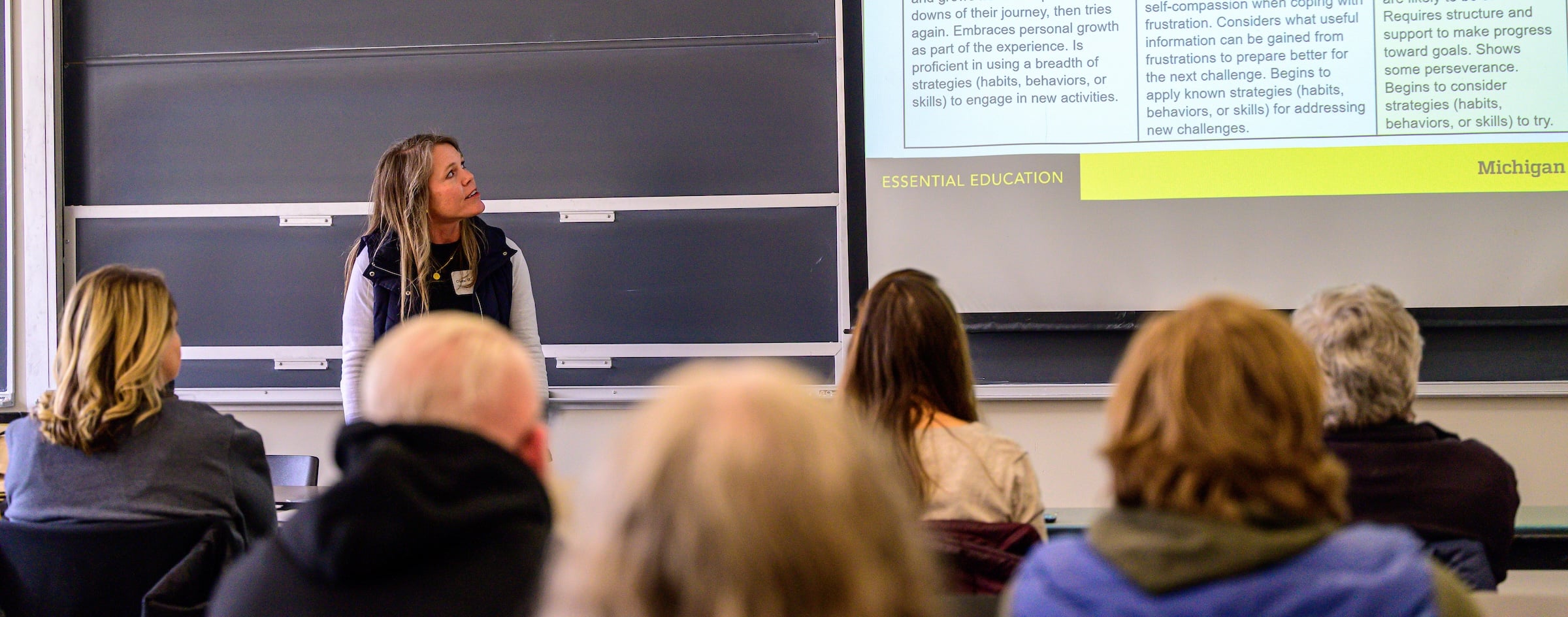
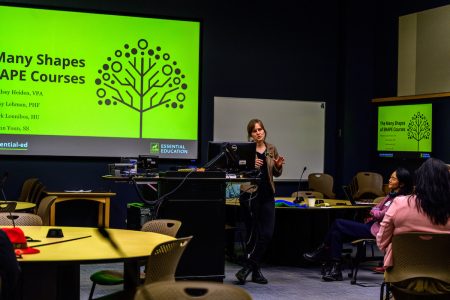
Participants listening to a presentation at the Essential Ed Symposium

This spring, faculty, staff, and campus partners came together at the 2026 Essential Education Symposium to reflect on the first year of Essential Education at Michigan Tech and to work toward a shared vision for student learning.

The Symposium showed that Essential Education is collaborative, evolving, and focused on helping students connect their academic experiences.

Building an Integrative Learning Experience

Essential Education supports integrative learning by connecting general education, majors, and future careers, while building skills to address complex problems from multiple perspectives.

The curriculum emphasizes high-impact, experiential learning, engaging students in applied, collaborative experiences throughout their time at Michigan Tech. It offers flexibility for students through customizable pathways and for instructors in teaching and assessment methods.

Essential Education highlights the relevance of SHAPE disciplines (Social Sciences, Humanities, and Arts for the People and Economy/Environment) through real-world and interdisciplinary experiences, helping students understand the purpose and value of their education.

Symposium Sessions Spark Reflection and Conversation

Throughout the Symposium, attendees explored how these goals are taking shape in classrooms, programs, and partnerships across campus.

Symposium feedback revealed that participants valued sessions that offered practical examples and ideas, such as “Husky Folio Made Easy,” “Reflection and Metacognition Seminar,” and “Purposeful Teaching with AI,” as well as interactive peer feedback workshops like “Teaching Squares.” These provided strategies for reflection, assessment, and engagement.

Faculty also expressed appreciation for concrete examples of Essential Abilities integrated in course design, assignments, and assessments in adaptable, meaningful ways.

Panels and presentations sparked conversations about student learning and community engagement. Attendees noted that the ePortfolio panel highlighted hands-on learning successes, the community partners panel showcased effective collaborations, and the student panel revealed both opportunities and challenges faced during Essential Education implementation.

In addition, Marika Seigel, associate provost for undergraduate education, presented a reflection on the community’s collective progress over the past year, which was another meaningful moment that underscored how much work has already been accomplished through collaboration across departments and programs.

Collaboration Across Campus

Beyond the formal sessions, many participants emphasized that one of the Symposium’s greatest strengths was the opportunity to connect with colleagues.

Informal conversations, cross-departmental networking, and hearing directly from instructors about their experiences created space for authentic dialogue, idea-sharing, and community building. For some participants, leading or co-presenting a session was itself a rewarding experience — a chance to contribute to the broader conversation around teaching and learning at Michigan Tech.

Symposium conversations reflected a commitment to supporting students academically and to developing them into adaptable, engaged individuals for a complex world.

Recognizing the 2026 Exemplary Instructors

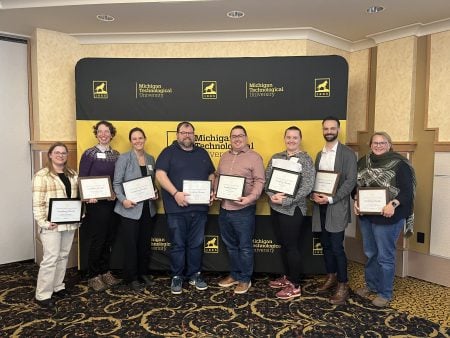
The Symposium also recognized faculty and staff who exemplify Essential Education’s goals and values through the 2026 Exemplary Instructors Seminar.

This year’s honorees included:

Several of this year’s Essential Education Exemplary Instructors pose for a photo during the Essential Education Symposium. The award recognizes educators who exemplify the goals and values of Essential Education through innovative and impactful teaching practices.

Seminar

  • Kayla Michelson

Foundations & SHAPE

  • Dr. Leeann Youn
  • D-Jay Bidwell
  • Jordan Dagenais
  • Dr. Laura Kasson Fiss
  • Claire Helakoski
  • Jack Van Treese

Activities for Well-being and Success

  • Katy Ellenich

Math, Science, & STEM

  • Nick Folcik
  • Ann M. Humes

Experience

  • Dr. Tara L. Bal
  • Dr. Angie Carter

Arts & Culture and Intercultural Competency

  • Anne Beffel

These instructors were recognized for their commitment to learning, innovative teaching, and the creation of high-impact educational experiences across the Essential Education curriculum.

Looking Ahead

As Essential Education evolves, the Symposium celebrated progress and reminded attendees that this work is ongoing.

Over the past year, faculty and staff have experimented with new approaches, refined assessments, integrated high-impact learning, and helped students understand the value of their education.

As the first year of Essential Education comes to a close, the Symposium offered an encouraging reminder that this work is being shaped collectively — through experimentation, collaboration, reflection, and a willingness to learn from one another.

Husky Folio Launchpad: From Dashboard to Delivery

Stop wondering how to fit Husky Folio into your course and start building!

Save the Date:

9:00 am – 3:00 pm, Thursday, April 30

Integrating Husky Folio into your course doesn’t have to feel overwhelming. Join us for this supportive, hands-on workshop where you can explore the tools, ask questions, and start building at your own pace. With a mix of targeted morning sessions and an open, guided implementation studio in the afternoon, you can choose the experience that fits your needs—and leave with practical progress you can use right away.

Refreshments and lunch are on us!

Schedule

Morning: Technical Foundations

9:00 – 9:45 am PebblePad Basics: Get familiar with the PebblePad dashboard, key terminology, and the various components of the tool from a learner’s perspective.
9:45 – 10:30 am Structured Templates and Workbooks: Learn to design and build structured learning materials for your students, guiding them through complex assignments or required portfolio components.
10:45 am – 12:00 pm Behind the Scenes: Master ATLAS, the administrative side of Husky Folio. You’ll learn how to connect your course to PebblePad, link to it from Canvas assignments, review student work submitted to ATLAS, and provide feedback.

Afternoon: Implementation Lab

1:00 – 3:00 pm Implementation Studio: Now that you are familiar with the tools, let’s build your assignment(s). This is a dedicated, supported “studio” session where you can work on your own assignments, templates, or ATLAS setup.  Whether you are starting a simple reflection prompt or a complex workbook, our team will be on hand to help you troubleshoot and finalize your components so they are ready for your students.

What to Bring:

  • Your laptop (and charger!)
  • Syllabus & prompts

And bring your ideas, your questions, and your course materials—we’ll help you turn them into something meaningful for your students. We’re excited to build alongside you and support your work.

Questions? Please email essentialed@mtu.edu.

Add a Minor to your Major – Husky Minor Fair – Save the Date

What: Michigan Tech Academic Minor Fair
When: Wednesday, January 28, 2026, 3:30pm – 5 pm
Where: East Reading Room – Van Pelt Library on Campus

The National Association of Colleges and Employers (NACE) surveyed employers in 2025 to inquire what talents they were looking for in new graduates. The top 10 skills employers are searching for include:

  • Problem-solving skills (88,3%)
  • Ability to work in a team (81.0%)
  • Communication skills (written) (77.1%)
  • Initiative (73.7%)
  • Strong work ethic (73.2%)
  • Technical skills (73.2%)
  • Communication skills (verbal) (69.3%)
  • Flexibility/adaptability ((67.0%)
  • Analytical/quantitative skills (67.0%)
  • Detail-Oriented (65.9%)

Additional valued skills included: Interpersonal Skills, Computer Skills, Leadership, Entrepreneurial Skills, Creativity, and Strategic Planning Skills.

Employers noted they wanted to hear how prospective hires acquired these skills in their diverse coursework, projects, and experiences, sharing these stories through their resumes and in the follow-up interviews. Employers stated this would provide recruiters with evidence that the candidate had acquired and already utilized skills to do the job and excel at it. 

In today’s competitive job market, employers are looking for flexible candidates who can bring diverse skills and knowledge to their role on the corporate/project teams. Completing an academic minor in addition to your major adds skills noted as employer desired above. A completed minor can end up enriching a student’s professional career and personal life. Minors give you a unique edge in your career/job search, by illustrating your unique combination of abilities that set you apart from other professionals in your field. 

The Michigan Tech Minor Fair is an opportunity for students to explore curriculum that can help them identify their own personal interests, give you an “edge up” in your job search, while adding skills that will prepare you for a career that has yet to be created. We hope to see you on Wednesday, January 28 at 3:30 pm – 5 pm in the Van Pelt Library East Reading Room to help you explore your minor opportunities.

Come learn about Minors that could add to your Major at the Michigan Tech Minors Fair:

  • *AI Ethics (HU) 
  • Communication Studies (HU)
  • *Diversity Studies (HU)
  • Ethics & Philosophy (HU)
  • *Global Cultures (HU)
  • German (HU)
  • German International (HU)
  • Journalism (HU)
  • Media Production (HU)
  • Spanish (HU)
  • Spanish International (HU) 
  • Writing (HU)
  • American Studies (SS)
  • Global Community (SS)
  • Development Partnerships (SS)
  • Global Studies (SS)
  • Law and Society (SS)
  • Public History (SS)
  • *Public Policy and Law (SS)
  • Social and Behavioral Studies (SS)
  • *Sustainability Studies (SS)
  • Applied Geophysics (GMES)
  • Earth Sciences (GMES)
  • Geological Engineering (GMES)
  • Mining (GMES)
  • Systems Engineering (Eng Fundamentals)
  • Cyber Security (Applied Computing)
  • Data Acquisition (Applied Computing)
  • Industrial Controls (Applied Computing)
  • Biomedical Engineering (Biomed Eng)
  • Biomaterials Engineering (Biomed Eng)
  • Medical Devices and Instrumentation (Biomed Eng)
  • Tissue and STEM Cell Engineering (Biomed Eng)
  • Public Health (KIP)
  • *Population Health (KIP)
  • Coaching (KIP)
  • Sustainable Biomaterials (CFRES)
  • Ecology (CFRES)
  • Plant Biotechnology (CFRES)
  • Plant Sciences (CFRES)
  • Computer Science (College of Computing)
  • Mathematics (Math)
  • Statistics (Math)
  • Psychology (PHF)
  • *Human Centered Design (PHF)
  • *Sneak peek at Individual Health and Wellness (PHF)
  • Mineral Processing (Chem Eng)
  • Polymer Science and Engineering (Chem Eng)
  • Alternative Energy Technology (Chem Eng)
  • Bioprocess Engineering (Chem Eng)
  • Ecological Engineering (Civil, Environ, Geospatial Eng)
  • Construction Management (Civil, Environ, Geospatial Eng)
  • Surveying (Civil, Environ, Geospatial Eng)
  • Railroad Engineering (Civil, Environ, Geospatial Eng)
  • Municipal Engineering (Civil, Environ, Geospatial Eng)
  • Water Resource Recovery Technology (Civil, Environ, Geospatial Eng)
  • Aerospace Engineering (MAE)
  • Manufacturing (MAE)
  • Business (CoB)
  • Business IT Solutions (CoB)
  • Construction Management (CoB)
  • Economics (CoB)
  • *Economics and Society (CoB)
  • *Entrepreneurship (CoB)
  • Entrepreneurship, Technology, and Innovation (CoB)
  • FinTech (CoB)
  • Global Business (CoB)
  • Art (VPA)
  • *Creativity and Expression (VPA)
  • Jazz Studies (VPA)
  • Music (VPA)
  • Music Composition (VPA)
  • Music Performance (VPA)
  • Sound (VAP)
  • Theatre Arts (VPA)
  • Theatre Performance (VPA)
  • Technical Theatre (VPA)
  • Chemistry (Chemistry)
  • Medicinal Chemistry (Chemistry)
  • Electrical Engineering (ECE)

Key for Departments:

  • Chem Eng – Chemical Engineering
  • PHF – Psychology and Human-Factors
  • Math – Mathematics
  • CFRES – College of Forest Resources and Environmental Science
  • MAE – Mechanical and Aerospace Engineering
  • CoB – College of Business
  • VPA – Visual and Performing Arts

* Michigan Tech Essential Education Minors

For academic units still wanting to participate in the Minors Fair, contact Steve Patchin at shpatchi@mtu.edu

Essential Education – Fall 2025 and Spring 2026 Course Planning Tool and Reporting Information

As noted in the October Tech Today article and the October 15 Essential Ed Newsblog, faculty support Michigan Tech’s Essential Education continuous improvement process by completing Planning Tools at the start of each semester and EA Reporting at the end, following a three-year cycle.

Why This Matters

By reflecting on and refining how their courses support the Essential Abilities, instructors help students engage with a clearer, more intentional course design. This reflection promotes deeper learning and helps students develop and demonstrate the skills essential for academic achievement and career success.

Submitted EA Reports are peer reviewed, allowing colleagues to share constructive feedback and identify trends that inform broader program improvements.

Planning Tool Updates

Thank you to all who are contributing to the rollout of Essential Education courses this year!

From faculty Planning Tool submissions, the Essential Education Course List Teams and Steering Committee responded to instructor requests for support and acted on suggestions to improve processes and available resources.

Instructors teaching in Spring 2026 will notice several updates already incorporated into the new Planning Tools.

Instructor EA Reporting – Soft Launch Expansion

The soft launch for Instructor Essential Abilities (EA) Reporting began last spring with a small number of courses and has now expanded to include three course lists this academic year: Foundations and lower-level Math and Science courses.

Feedback from this phase will guide refinements to both the process and support materials in preparation for the full launch of instructor reporting for all course lists in AY 2026–27, which marks the start of the full Essential Education three-year continuous improvement cycle.

Soft Launch Instructions for Fall 2025 Instructors

Faculty teaching Fall 2025 Essential Education Foundations or lower-level Math and Science courses received an email on October 25 with submission instructions.
When ready to report, instructors should:

If there are multiple sections of the course (the same or multiple semesters), contact essentialed@mtu.edu for assistance.

Important Dates for Instructors

Fall 2025 Courses

  • Monday, August 25 – Planning Tools due (all Essential Ed courses)
  • Friday, January 16 – Instructor EA Reports due (Foundations and lower-level Math/Science only)

Spring 2026 Courses

  • Monday, January 5 – Planning Tools due (all Essential Ed courses)
  • Wednesday, April 29 – Instructor EA Reports due (Foundations and lower-level Math/Science only)

Summer 2026 Courses

  • Planning Tools due the first day of instruction
  • Instructor EA Reports due three days after the final exam period (Foundations and lower-level Math/Science only)

Support and Resources

Workshops are being scheduled upon request, and office-hour sign-ups will be available later in the semester.

For assistance, please contact:

  • Essential Ed Steering Committee and Course List Team Members in your unit
  • The Essential Ed support: essentialed@mtu.edu
  • EA Reporting: Jeannie DeClerck, Assessment Manager
  • HuskyFolio Support: AJ Hamlin, Director of Husky Folio

Thank you for your continued commitment to the Essential Education program. Your time, reflection, and participation are vital to strengthening our courses, supporting student learning, and sustaining meaningful program improvement.

Save the Date – Michigan Tech’s 2026 Essential Education Symposium

Michigan Tech’s 2nd Annual Essential Education Symposium will take place on Wednesday, April 29, 2026, on campus, the week after Spring Semester Final Exams. The 1st Annual Essential Ed Symposium took place on Wednesday, April 30, 2025. It was highlighted by our special guest, Shane Sutherland, Founder/CEO/CMM of PebblePad, an internationally recognized higher-education ePortfolio platform. His lunchtime Keynote focused on how other academic institutions around the world are using ePortfolios to maximize student reflection, communicate skill acquisition and application, and document their academic accomplishments to future employers and academic programs.

The 2026 Essential Ed Symposium will feature highlights from the launch of each element of Essential Education. More exciting sessions relating to Essential Ed, its impact on students, faculty support resources, and best practices, skill needs of future employers, will be announced in early spring. These elements are highlighted in this short video, “What is Michigan Tech’s Essential Education?” 

We encourage you to visit Michigan Tech Essential Ed YouTube channel . This is the home of the videos being created to promote Michigan Tech’s Essential Education program rollout, including outlining the value of this educational experience to current and future students. Videos of future Symposium presentations and materials serving as resources for instructors teaching Essential Education program courses will also be available on this channel. 

Here are some quick links to a sample of the 2025 Symposium presentations, beginning with highlights of the full event. 

For more information on the rollout of Michigan Tech’s Tech Forward 1.0 initiative, Essential Education, review Michigan Tech’s Essential Education Newsblog.

Michigan Tech’s Essential Education Experiences – Applying the Essential Abilities

Essential Education Experiences (E3) are 3-credit, upper-division courses, intended for students in their junior year (at the discretion of the course instructor). In E3 courses, students will actively apply their Essential Abilities through hands-on learning designed to increase their social awareness, global understanding, civic engagement or cultural competencies. E3 projects or activities engage with communities beyond the traditional classroom in the advancement of public good.

E3 courses should include a significant curricular component rooted in the SHAPE (Social Sciences, Humanities, and Arts for People and the Environment/Economy) disciplines that connects to the immersive or community engaged activity. Instructors can design their own projects for the course or connect courses to existing student activities (i.e. volunteering, student leadership roles, etc.). Engagement can happen at different locations, including on-campus, in our local community, abroad, or virtually.

Required Course Elements
All Experience courses must have the following course elements:

  • Experiential Learning: The instructor should provide an academic framework, best practices, and space for reflection and discussion to strengthen student hands-on learning. At least half of academic work should be dedicated to a real-world project or activity (i.e. direct service, reflection, research, project work, immersion, etc). 
  • Best Practices and Ethical Standards: Faculty should ensure that best practices and ethical standards for community engagement are upheld throughout the project or activity and teach those standards to students in the course, drawing on disciplinary expertise.
  • Critical Reflection: Assignments connected to the experience should be included regularly throughout the semester. Critical reflection assignments should promote, for example, self-awareness, continuous learning, and the integration of theory and practice.
  • Applied SHAPE Approaches: Academic content should be based in SHAPE disciplines, emphasizing interdisciplinary and integrative approaches to knowledge and problem-solving.
  • Husky Folio: Student work should be showcased in an individual-effort Husky Folio submission (a PebblePad workbook or portfolio). This should include reflection related to how the student applied at least one Essential Ability from the Contribute/Transform learning goal (described below) in their Experience. It might also include examples of student project work (done individually or as a member of a team), connections to previous learning, reflections on community impact, or how they will apply their Essential Abilities going forward.
  • Substantial Support for ONE Essential Ability from the Contribute/Transform Learning Goal 
    – Select one Essential Ability from the Contribute/Transform Learning goal as noted as options in the table below: 

Learning Goals Essential Abilities Essential Ed Experience Courses
Think Critically Question Assumptions
Evaluate Information
Analyze Ethical Implications
Communicate Communicate Quantitatively
Communicate Contextually
Foster Collaboration
Adapt Explore Diverse Perspectives
Reflect
Welcome Challenge
Contribute/Transform Engage in Civic Life 1 required for this goal
Innovate Solutions 1 required for this goal
Create 1 required for this goal
  • For the Essential Ability selected, include the following in the course:
    • Instruction and assignment(s) to help students develop the EA.
    • One assessment task that encourages students to demonstrate EA mastery at a level 3.

Michigan Tech’s Essential Education Experiences includes courses such as:

  • ENG 4070 – Peer Mentoring Practicum
  • FW 3114 – Reading the Forest
  • FW 3760 – Human Dimensions in Natural Resources Stewardship
  • HON 4070 – Leadership Practicum
  • HU 3000 – Humanities Experience: Community-engaged learning
  • HU 3289 – HU Experience: German Abroad
  • HU 3370 – The Documentary Experience
  • MUS 3700 – Visual and Performing Arts Tour
  • PSY 3511 – Teaching Digital Newcomers
  • SS 3541 – The Copper Country
  • SS 3913 – Sustainable Living Practicum
  • SS 4050 – Advanced GIS Methods
  • SS 4700 – Communities and Research
  • SS 4921 – Washington Experience Seminar
  • THEA 4190 – Directing for Theatre
  • UN 3013 – Interdisciplinary Experience

See the full list of Michigan Tech’s Essential Education Experiences here.

To learn more about Michigan Tech’s Essential Education Experience courses, check out our website which will have updates as classes are added when approved in Fall 2025.

Michigan Tech’s Essential Education Minors – Options that Fit Your Interests

Michigan Tech’s Essential Education Minors allow students to earn a credential completely within the structure of Essential Education. These are specific minors that are created to satisfy the spirit of Essential Education by introducing students to multiple disciplinary perspectives, as a complement to their major.

Explore three of the nine Essential Education Minors below. Which compliments your major and peaks your interests?


Human-Centered Design

The Human-Centered Design (HCD) minor at Michigan Tech prepares students to see the world through the lens of people – understanding not just how technologies and systems work, but how they truly impact the individuals and communities who use them. Rooted in internationally recognized design standards (ISO 9241-210:2019 and ANSI/HFES 400-2021), this minor emphasizes designing for usability, accessibility, and positive user experiences while also considering broader social and environmental impacts.

What makes this minor unique is its emphasis on ethical, sustainable, and community-focused approaches. Students will explore how design decisions shape daily life, from the interfaces we interact with to the systems we rely on. For example, you might work on designing a community space for inclusivity, creating safer and more intuitive healthcare technologies, or developing a digital tool that helps reduce energy use. Every project challenges you to think holistically – balancing technical feasibility, user needs, and long-term societal impact.

By completing the HCD minor, you’ll graduate with a versatile skill set that makes you stand out in todays job market. Industries from engineering to healthcare, computing to business, are seeking professionals who can integrate human-centered thinking into their work. This minor shows that you’re not just solving problems – you’re solving the right problems in what’s that make life easier.

Economics and Society

The Economics and Society Minor is designed for students who want to understand how economic forces shape communities, businesses, and public policy. Unlike a traditional economics minor, this program is deeply interdisciplinary – students explore core economics alongside courses in social sciences, humanities, communication, mathematics, and more. With 19 credits, the program integrates seamlessly with the Essential Education framework while giving students flexible pathways tailored to their own interests.

What makes this minor unique is the emphasis on real-world application. Students can pair foundational courses like Principals of Economics and Microeconomic theory with special topics such as Environmental Economics, Game Theory, or Energy Economics. Beyond economics, students dive into courses such as Environmental Communication, Indigenous Natural Resource Management, or Social Inequality. This combination ensures that graduates don’t just learn theory – they practice connecting economics to societies most pressing questions, whether climate change, financial decision-making, or cultural perspectives on development. 

Sustainability Studies

This interdisciplinary minor allows students to:

  • Build a foundational understanding of sustainability topics through multiple lenses
  • Customize their learning with courses across departments and colleges
  • Strengthen their ability to think crucially about sustainability issues in a global context

At Michigan Tech, we believe sustainability education should be:

  • Accessible to students in all disciplines
  • Rooted in real-world, experiential learning
  • Inclusive of diverse perspectives and lived experiences

Whether through coursework, minors, living-learning communities, or hands-on projects, our sustainability programs are designed to meet students where they are – and help them grow into leaders ready to shape a sustainable future for all. 

List of Michigan Tech’s Essential Education Minors

  • AI Ethics
  • Creativity and Expression
  • Economics and Society
  • Entrepreneurship
  • Human-Centered Design
  • Leadership
  • Population Health
  • Public Policy and Law
  • Sustainability Studies

To learn more about these minors, visit Michigan Tech’s Essential Education Newsblog . In the coming weeks we will continue to provide highlights of these minors from the academic teams and departments/colleges that developed them. 

To learn more about what course choices you have for each of Michigan Tech’s Essential Education Minors, follow this link. Take a moment to design your own Essential Education Minor within the available themes that compliments your own major and personal interests.