
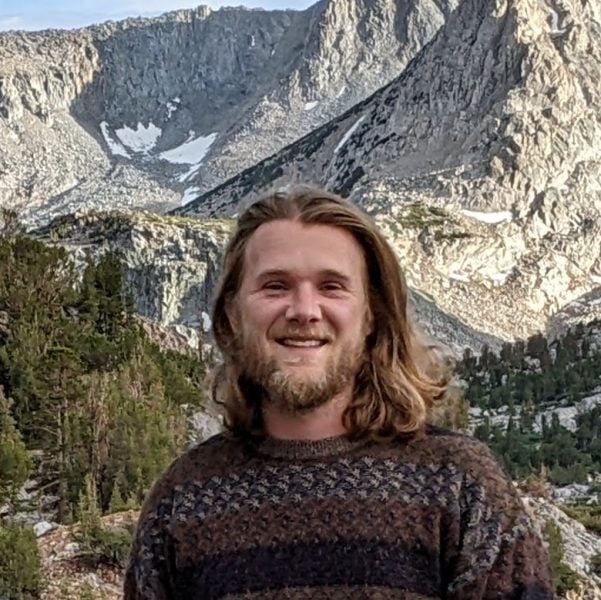
I began my PhD research at the beginning of the pandemic, TA-ing labs online and trying to carry out experimental research in a quarantined lab. This taught me a degree of flexibility and spontaneity that has carried through the rest of my degree. Over the course of my PhD I’ve TA’d geology classes, a multi-university course on climate science and policy, I’ve taught the Summer Youth Program for geology, organized a workshop in Washington DC on the UN framework Convention on Climate Change, sampled geological areas for the USGS mapping and exploration efforts, organized social and research events for graduate student government, was coordinator of the GSG softball league, sat on the advisory boards of a forest conservation campaign and an international ecological network, helped organize physics and geological conferences at MTU, and even organized a couple music and art festivals. I like to think that, starting a PhD directly after Peace Corps service, I continued my community focused ethos and incorporated it into my degree.
My research has focused on deciphering the early processes of Earth and solar system evolution, including planetary magnetic field evolution, tectonic dynamics, and paleoenvironmental conditions. While these processes have shaped the modern Earth system, many aspects remain poorly understood. Within this framework, I have carried out three research projects using paleomagnetic, rock-magnetic, geochemical, and electron microscopy methods.
The first project, analyzing Iron-Nickel alloys in meteorites has demonstrated the possibility of analyzing primary magnetic signals in a large suite of meteorites that were previously thought to be bereft of primary magnetic signals. The second project on Iron formations has demonstrated a novel way to interpret paleoenvironments of formation based on rock -magnetic analysis. The third project on Upper Peninsula dike swarms provide a more detailed reconstruction of the 2.1–1.85 billion-year-old tectonic history of the Lake Superior region, constrain its geodynamic evolution, and offer crucial insights into the Earth’s magnetic field history, including the timing of the solid inner core formation.
I am grateful to the Graduate school, my advisor, and my committee for this opportunity to carry out interesting and novel research while also being an active and engaged community organizer.