Search Results for "thesis and dissertations acrobat tips"

Degree Progress Checklist – a Michigan Tech App

The Graduate School is pleased to announce a new Michigan Tech app, the Graduate Degree Progress Checklist.

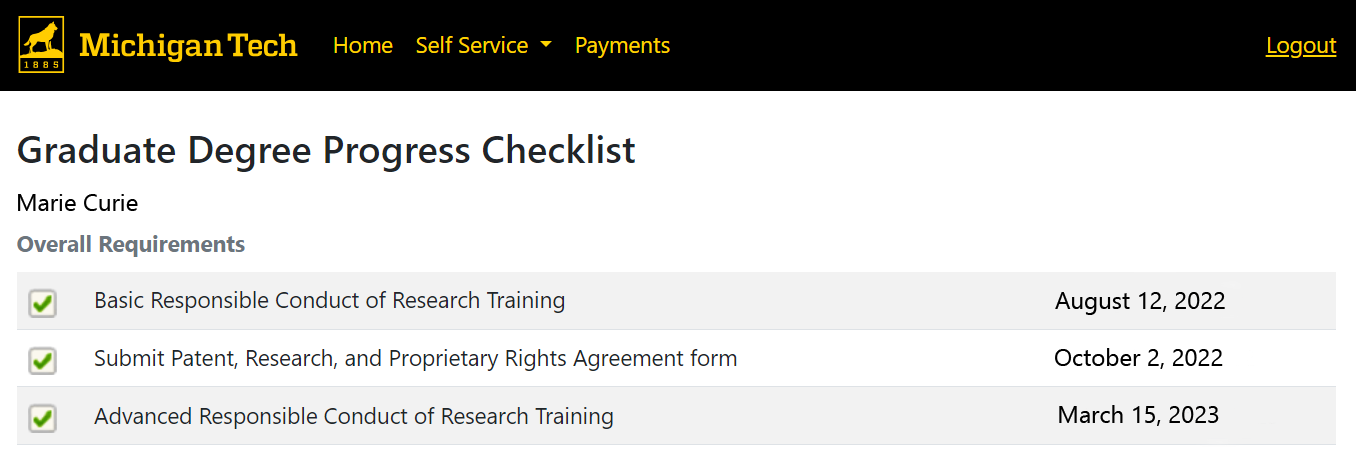
The checklist contains a personalized list of all items students are required to complete for each graduate degree they are pursuing along with the date received. Please note that most forms are manually entered in banner, and may require up to five business days to show as received on the checklist.

The top of the list has overall requirements for students. Note that your list may not include all items, since coursework students are no longer required to complete Advanced RCR training.

The top of the Degree Progress Checklist indicating overall requirements for a graduate degree.
A screen shot of the top of the Degree Progress Checklist indicating overall requirements for a graduate degree.

Spring 2012 Professional Development Seminars

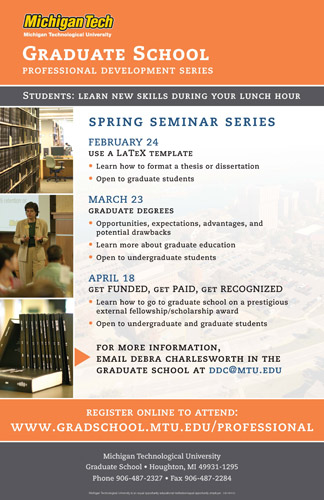
The Graduate School is pleased to announce it’s spring series of Professional Development Seminars held during the noon hour.  These seminars are open to undergraduate and graduate students as indicated below.  Seating is limited.  Please register online to reserve your seat and confirmation of the location.

Spring 2012 Professional Development Seminar Series

February 24

Use a LaTeX Template

March 23

Graduate Degrees

  • Opportunities, expectations, advantages, and potential drawbacks
  • Learn more about graduate education
  • Open to undergraduate students
  • Register online to reserve a seat

April 18

Get FUNDED, Get PAID, Get RECOGNIZED

  • Going to Graduate School as a DOD scholar, NSF fellow, or EPA STAR
  • Learn how to go to graduate school on a prestigious external fellowship/scholarship award
  • Open to undergraduate and graduate students
  • Register online to reserve a seat

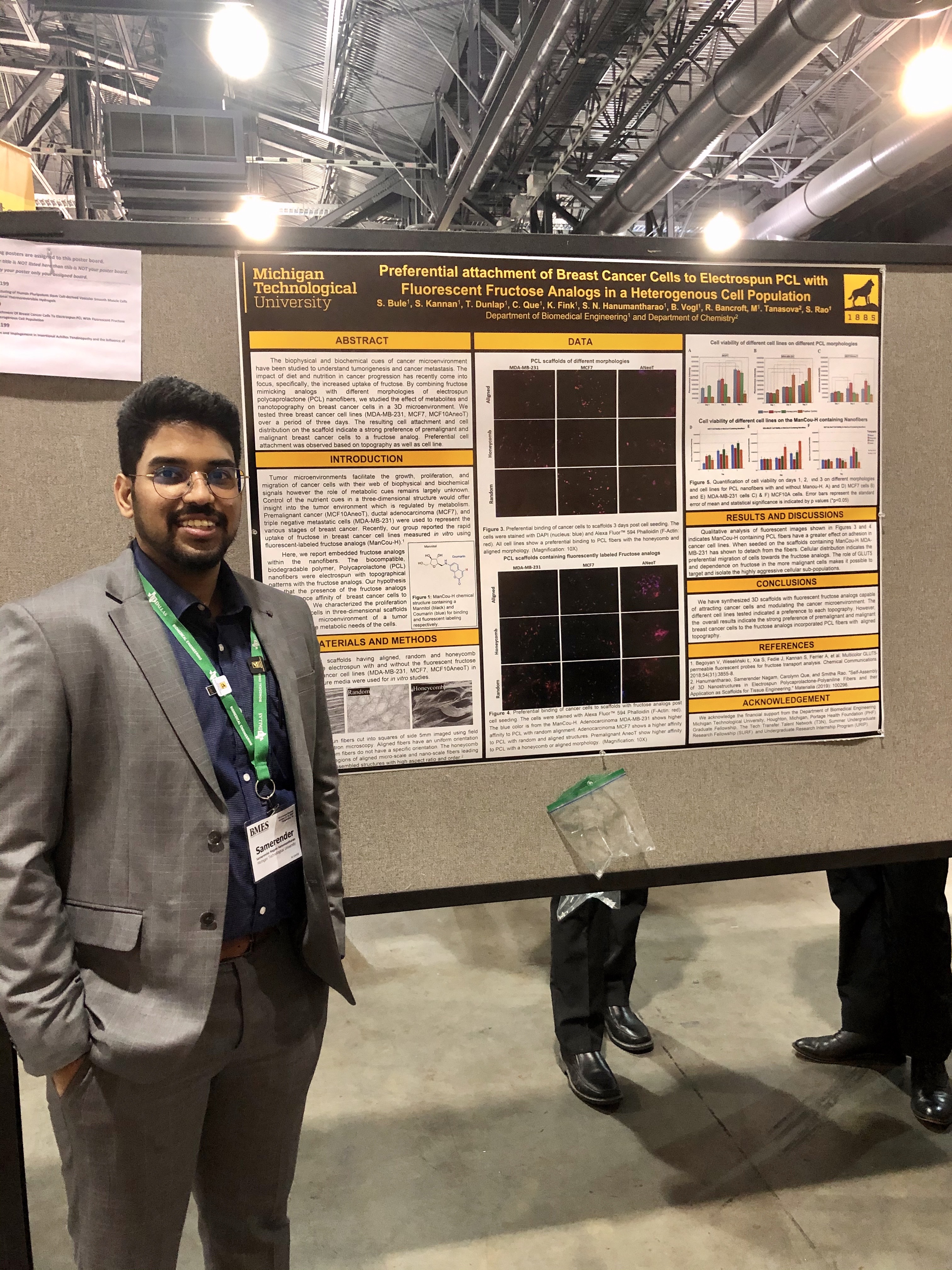
Portage Health Foundation Graduate Assistantship Spring 2019 Recipient – Samerender Nagam Hanumantharao

Samerender Nagam Hanumantharao
Biomedical Engineering

I received my Master of Science in Biomedical Engineering from Michigan Tech with the thesis titled “A 3D Biomimetic Scaffold using Electrospinning for Tissue Engineering Applications”. Under the guidance of Dr. Smitha Rao, I have continued my research effort in the field of tissue regeneration focusing on biophysical cues in the micro- and nano- scale that impact tissue growth. Tissue regeneration is a complex process that involves a myriad of biological pathways working in tandem. When this harmony is disturbed, it leads to complications which can be fatal. The healing of wounds caused by diabetic foot ulcer is one such disease that prevents complete healing, and involves time-consuming and expensive rehabilitation. My research focuses on identifying the biophysical cues involved in tissue regeneration for wound healing applications and developing a bandage that accelerates the wound healing process using the native cells of the body. The bandage functions by mimicking the physical characteristics of local tissues providing a framework for the cells to attach and proliferate thereby closing the wound.

I look forward to utilizing this opportunity to develop improved scaffolds and enable technologies to enhance our understanding of the various signaling pathways involved in wound healing. I will continue to identify commercial applications and develop my skills both as a researcher and an entrepreneur. The PHF assistantship will be invaluable in my pursuit. I want to thank the Portage Health Foundation, the department of biomedical engineering at Michigan Tech and my advisor Dr. Rao for the help, support and guidance.

Doctoral Finishing Fellowship Spring 2020 Recipient – Samerender Nagam Hanumantharao

Samerender Nagam Hanumantharao
Biomedical Engineering

I moved to the city of Houghton to pursue my M.S. degree in Biomedical Engineering in Fall 2015. I completed my Masters’ thesis, titled “ A 3D Biomimetic Scaffold using Electrospinning for Tissue Engineering Applications” under the guidance of Dr. Smitha Rao in Spring 2017. I continued to work with Dr. Rao in pursuit of my Ph.D. My PhD work focuses on understanding and exploiting the role of biomechanical cues in chronic wound healing and cancer. Interestingly, these two diseases share some common factors that can be used to make bandages that can accelerate wound healing or trap metastatic cancer cells.  I want to thank the Graduate School for the funding during the last stage of my research.

DOE’s Science Graduate Student Research Program Accepting Applicants

The Department of Energy’s (DOE) Office of Science Graduate Student Research (SCGSR) program is currently accepting applications for its 2014 solicitation. The SCGSR program provides the opportunity for U.S. graduate students to conduct part of their graduate thesis research at a DOE national laboratory in collaboration with a DOE laboratory scientist for a period of three to twelve consecutive months with the goal of preparing graduate students for scientific and technical careers.

The program is now open to current Ph.D. students in qualified graduate programs at accredited U.S. academic institutions. The supplemental award provides for additional costs of living and travel expenses directly associated with the SCGSR research project during the award period. Applications are due 5:00pm EDT on Wednesday, September 24 and the Office of Science expects to issue approximately 100 awards for project periods anytime between January and September 2015.  ​

Doctoral Finishing Fellowship Spring 2021 Recipient – Subin Thomas

I joined Michigan Tech in the Fall of 2016 to pursue my Ph.D. in Atmospheric Sciences. My research at Tech focused on the development of a numerical model to study the processes in the Michigan Tech Cloud Chamber advised by Dr. Raymond A. Shaw. Being part of the cloud chamber group, I experienced the synergy between theory, experiments, and numerical simulations first hand. These experiences have helped us as a group to understand the complexities and subtleties of a seemingly simple system and we have communicated these findings to the larger audience through conferences and publications. These expeditions were only been possible because of the collaboration with an open-minded approach to problems by the past and current group members of the cloud chamber group. Furthermore, during this short period of time – I had the opportunity to work with the scientists from Pacific Northwest National Laboratory and Brookhaven National Laboratory on different but related projects to my thesis for extended periods.
Furthermore, my experience at Michigan Tech has been enhanced by the support from Dr. Ravindra Pandey (the Department Chair of Physics), the office staff (of Physics, of Atmospheric Science, of IPS), my colleagues and friends across the campus. Finally, I am grateful to the Graduate school for their support through a Doctoral Finishing Fellowship, which will allow me to finish writing my dissertation and research publications.

Wildlife Conservation Award

The Safari Club International (SCI) Michigan Involvement Committee (MIC) is a non-profit corporation composed of representatives of each of the Michigan chapters of SCI.  The Committee coordinates collaboration between SCI, its Michigan chapters, and the Michigan Department of Natural Resources (DNR); provides scholarships and grants to graduate students; and supports other wildlife conservation and education activities deemed appropriate by the organization.

The Award

Goal: To preserve and perpetuate the right to hunt and the commitment to conservation within the wildlife profession and potential future leaders of the DNR.

Purpose: To provide financial assistance to a graduate student, preferably one working on a DNR-funded university research project associated with the preservation of hunting.

Fund Financing: A minimum annual fund of $3,000 has been established by SCI MIC to finance the grant program.  Additional grants may be awarded if funding is available.  Grant amounts may vary depending upon the number of awards and the fund balance.

Award Duration: The grant will be available for use for one year between September 1 and August 31 of the next year.  An award recipient can compete for additional grants in subsequent years with other applicants.  If invited by participating chapters, each selected student will be required to visit the chapter at least once during the year of the award.

How to Apply

To Be Eligible:

1)    Student must be accepted or enrolled in a Wildlife or related discipline graduate program at a college or university in Michigan.

2)    Must be planning a career in the Wildlife Management field.

3)    Student must be familiar with hunting, hunting ethics, the role of hunting in wildlife management, and hunting’s role in society.

4)    If enrolled in a MS or MA program, it must be a thesis-based degree.

Application: There is no separate application form.  Please send a resume which outlines your background, along with three reference letters from individuals knowledgeable of your field skills and experience.  Include your name and graduate institution where enrolled on all materials submitted.  In addition, in 500 words or less, provide a response to the questions:  “Twenty years from now, what should the elements of wildlife management be, and what role do you see yourself playing in this profession?”

Selection Process: An SCI MIC committee will review application materials and select finalists.  A subcommittee will interview finalists and select the award recipient(s) by September 1, 2011.

Send all materials, by June 15, 2011 to Paul Royce, SCI-Lakeshore  Chapter, 9881 84th Avenue, Zeeland, Michigan  49464

Doctoral Finishing Fellowship Spring 2021 Recipient – Rashi Yadav

Doctoral Finishing fellowship

There are a number of aspects in my life that inspired me to be a scientist. I grew up in Chandimandir Cantt, India and as a young girl, I wanted to be an army officer. I remember being awestruck whenever I would see soldiers as they worked relentlessly to protect people and I would think how fulfilling that would be. As I reached high school, I found myself appreciating various scientists that have contributed in revolutionizing the whole world. A scientist can defeat a microorganism capable of wiping out the human population. That is just incredible! That’s why I tell everyone that I am extremely proud of my work line as our unceasing efforts will eventually benefit the society and that is my key motivation which is extremely fulfilling. I am so glad that I am close to my 12 years long dream of getting a Ph.D.

I am very fortunate that I worked with Dr. Ebenezer Tumban, who guided me to conduct professional and analytical research and also taught me several aspects of life by setting up a great example by his deeds. I have done multiple projects under his guidance including assessing MS2-L2 based virus-like particles (VLPs) against Human Papillomavirus (HPV) associated with genital and oral cancer. In addition to this, I have worked on development of a novel thermostable bacteriophage VLP platform-based vaccine.

My experience of pursuing Ph.D. at Michigan Technological University has been incredible. It has been a life-time experience; MTU has the most beautiful summer and winter, though sometimes I have seen extreme winter. But, I must say it is absolutely worth it. I got several opportunities to participate in competitions at MTU and have won awards such as 3-minute thesis, summer fellowship, finishing fellowship etc.  When I am not doing research, I like to spend my time exploring places, going for a hike, painting and dancing.

I am so grateful to Graduate school, MTU for awarding me this prestigious doctoral finishing fellowship. I am so elated and thankful to the people who have supported me in my journey.

New Leahy-Smith America Invents Act (AIA) Patent Law Affecting Research Commercialization

The Leahy-Smith America Invents Act ( AIA), also known as the Patent Reform Act of 2011, went into effect on March 16, bringing with it significant changes to the US Patent system.  The most important change from the AIA law moves the United States to a first-to-file system from the previous first-to-invent system.  Whereas the old system provided inventors with a mechanism to prove they were the first to invent and secure patent protection, the new system is essentially a race to the patent office.  If two independent researchers came up with the same invention at the same time, the first one to file a patent application will be awarded the patent.  In the past you could rely on dated lab notebooks and notes to prove you were the first one to invent.

The old system also provided a one-year grace period to file a US patent from the time the invention was publicly disclosed. Until the new patent laws are clarified through future court case rulings, researchers should consider any public disclosure a patent-barring event.

The increasingly stringent requirements for patents to include a complete and enabling written description, compounded with the effective loss of the one year grace period, makes it more important than ever to prepare and submit invention disclosure documents to the Office of Innovation and Industry Engagement well in advance of any planned public disclosures.  Early submission of invention disclosure documents will assist in the timely development of strategies related to technology validation and related patent-filing activities before conference presentations, manuscript publications, thesis/dissertation defenses, or other events.

If you have any questions, please do not hesitate to contact Michigan Tech’s Innovation and Industry Engagement Office at 487-2228.

Published in Tech Today

Priyanka Kadav represents Michigan Tech in regional 3MT competition

Priyanka Kadav recently represented Michigan Tech in the Three Minute Thesis (3MT) competition at the Midwestern Association of Graduate Schools (MAGS) annual meeting. The MAGS meeting was held in Milwaukee, Wisconsin from April 6-8, 2022. Priyanka is a PhD candidate in Chemistry advised by Dr. Tarun Dam.

Prior to representing Michigan Tech at MAGS, she earned the top prize at Michigan Tech’s 3MT competition. The Graduate Student Government sponsors a local 3MT competition each fall. Each university in our region was invited to send one representative to the MAGS annual meeting.

Her presentation was titled, “Capture and Release (CaRe): A novel protein purification technique.” The Graduate School is proud of her accomplishments and how well she represented Michigan Tech!

Priyanka Kadav's slide representing her dissertation.
Priyanka Kadav’s slide for her 3MT presentation describing the protein purification technique she is developing in her dissertation.
Priyanka Kadav (far left) with her 3MT competitors and judges.