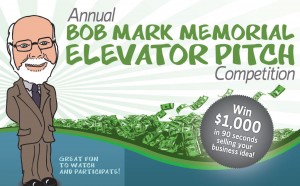
Event: Bob Mark Elevator Pitch Competition
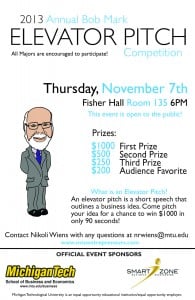
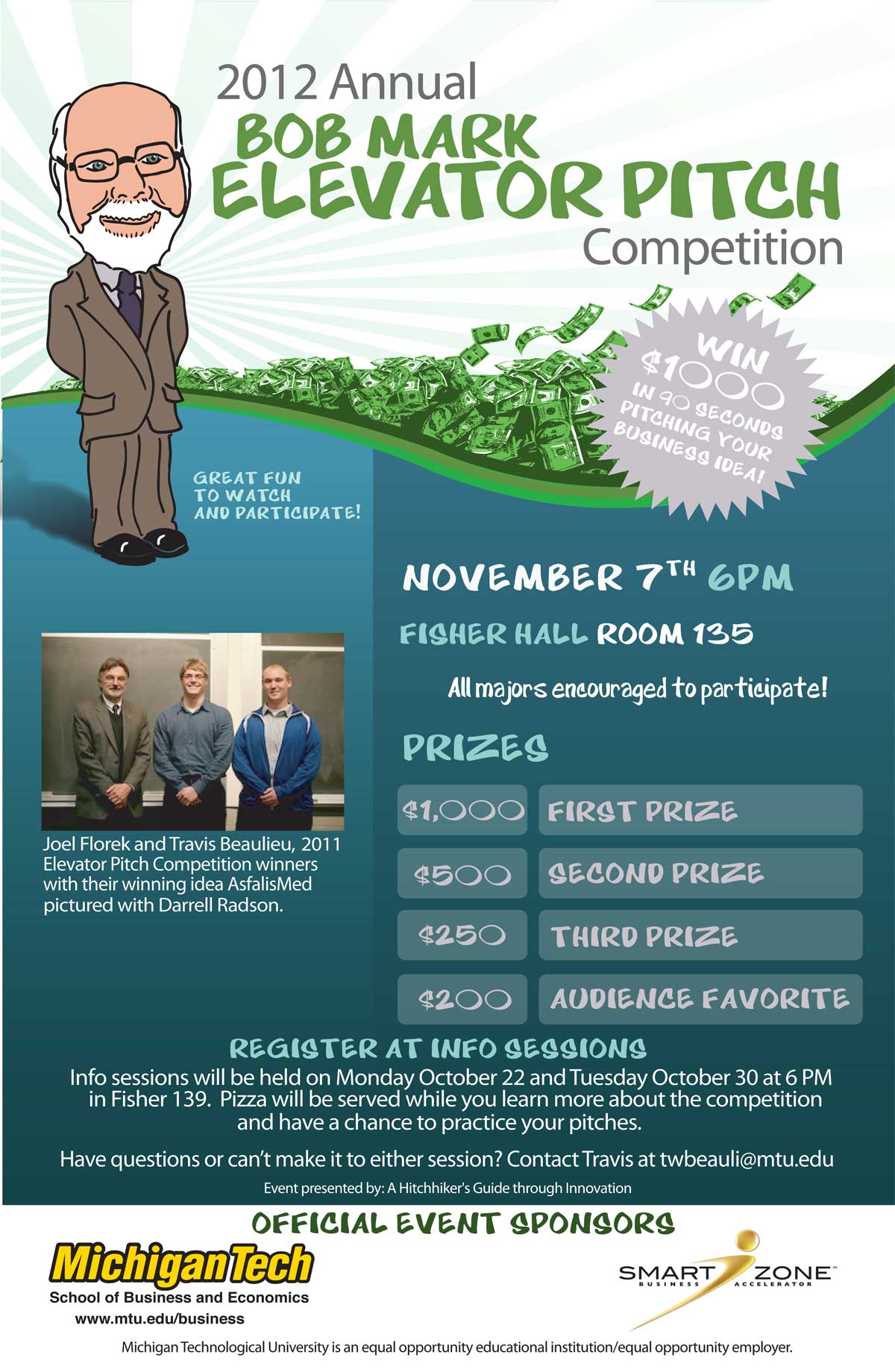
Saturday, October 20th, 2012Where can you win $1,000 for just 90 seconds of your time? At the 2012 Bob Mark Elevator Pitch Competition! Join us on Wednesday, November 7 in Fisher 135 at 6pm for the fun!
In the competition, contestants have a limited time (like on an elevator ride) to sell a concept to someone who doesn’t have previous knowledge about their business. A 90-second time limit is placed on the competitors, who will also be competing for second ($500), third ($250), and audience-favorite ($200) prizes. Please join students, faculty, staff, and community members for this year’s event. You won’t be disappointed!
This event is a tribute to the late Bob Mark, Professor of Practice within the School of Business and Economics. Mark started and ran the first four years of the Elevator Pitch Competition and brought the Business Plan Competition to Michigan Tech. The Bob Mark Elevator Pitch Competition and other efforts support his entrepreneurial spirit that continues to live on in students, faculty, and staff.
Get Involved
If you are interested in participating in this event, review the EPC Information and Rules or download the 2012 Bob Mark Elevator Pitch Competition Judge’s Score Sheet. To participate, attend an information session (the next one is scheduled for Tuesday, October 30th at 6pm in Fisher 139) and contact Travis: twbeauli@mtu.edu with any questions.
Advice from Bob Mark
- Do not say “we have no competition.”
- If you are stating guessed numbers, try using 3, 7, or 9 to make the numbers sound more realistic.
- Memorize your first and last statements, let everything in the middle flow naturally.
- Be confident in everything you say and avoid terms such as “maybe.”
- There is an audience favorite prize so invite all of your friends to vote for you!
This event is sponsored by the Michigan Tech School of Business and Economics and the Michigan Tech Smart Zone.
And the Survey Says . . . Or Does It?
Tuesday, March 13th, 2012
MBA student, Tao Guo
As part of our modern culture, people are inundated with questions regarding their personal opinions and experiences. College students, in particular, often experience the brunt of these inquiries. During their college careers, students may fill out countless surveys regarding their personal interests, classes, professors, and even some for their educational institution.
What if the information collected during these surveys isn’t always reliable? Should college students be surveyed in the same manner as non-students?
As a Michigan Tech MBA student, Tao Guo asked these questions while working as a research assistant. This inquiry led to a research project and a refereed paper presentation at the 2010 Marketing Management Association Fall Educators’ Conference in Indianapolis.
The paper, “The Effect of Rating Scales on Systematic Differences Between Students and Nonstudents in Survey Research,” was written with help from Junhong Min, assistant professor of marketing, and the late Bob Mark, professor of practice.
“Tao came to me with a question about using surveys in consumer research that kept leading to more questions. His enthusiasm and dedication to this project led to the honor of presenting at the conference. We’re very pleased with his work,” notes Min.
Guo’s initial research found two divergent views exist about the usefulness of college students as subjects. One stream of research questions the use of student samples, while the other shows no difference between student samples and nonstudent samples. Guo tried to fill this gap by examining when the differences between student samples and nonstudent samples occur.
Tackling a common practice found in consumer research studies that survey college students, Guo took a closer look at the use of scales. When examining data from student assessment surveys, he found that either a five-point scale or a seven-point scale was typically used. Both of these scales are employed to measure how strongly the subject agrees with a survey statement. His results empirically illustrate how the five-point scale is more effective at capturing the differences between student and nonstudent samples. In addition, Guo discovered that behavior-related questions (e.g., frequency, the number of purchases) are more sensitive to differences between students and nonstudents than attitude questions (e.g., willingness to purchase, perceived importance).
“The research suggests to the practitioners that they should interpret their results with caution when student samples are involved,” says Guo.
Guo researched the subject for five months. The opportunity to present his paper was a notable achievement for a student, since most presenters at the conference were professional business educators from universities across the nation.
“The professor hosting my section was very excited about my findings and gave me a lot of suggestions for further research,” he said. “I learned a lot by listening to others’ presentations and established several new connections with MBA students and faculty from other universities.”
Guo is from Zhoukou, a small town in Henan Province in central China. He attended Northeastern University in Shenyang, China, where he majored in English and minored in finance. Before coming to the US, he worked for four years at Northeastern University, including a position as deputy director of the Engineer Training Center.
“I came to realize the value of higher education and overseas experience after I interacted with several very successful scholars and corporate executives,” says Guo. “That’s why I made up my mind to switch my career and pursue an MBA degree in America.”
Support from faculty was important to Guo. “I have really appreciated the broad range and depth of interests of the faculty in the School of Business and Economics. Other than professors Min and Mark, I also worked on an independent study with Assistant Professor Maria Schutte. Every time you feel like you have a question or you want to learn something, you can always find the right professor. And they are all willing to help.”
Because of Guo’s research and his successful student career at Tech, he has been accepted into the PhD program in Personal Financial Planning at Texas Tech University. “I am very grateful to Michigan Tech for the opportunity to do research as an MBA student and for my educational experience in general. It was an overall great learning experience and will be very beneficial to me in my future endeavors.”
This article was originally published in Impact, the Michigan Tech School of Business and Economics magazine.
It’s Here! Impact Magazine Fall/Winter 2011 Issue
Monday, December 5th, 2011
The third issue of Impact features the Business Development Experience, an experiential learning component of undergraduate business curriculum.
Impact is Michigan Tech’s School of Business and Economics semi-annual publication. It illustrates how our students, alumni, School, and University are changing our world.
This issue discusses the future of business education, renewed AACSB accreditation, successful alumni stories, the spring 2011 undergraduate trip to Silicon Valley, two faculty who have become co-editors of an influential policy journal, and MBA student research on survey data. Read Impact now.
See past issues of Impact on our website.
The School of Business and Economics would like to recognize key people who have continued to make Impact a reality. University Marketing and Communciation’s Crystal Verran, Dennis Walikainen, and Bill Tembruell. Also, writer Erin Kauppila. Thank you all for your hard work.
Pitching the Perfect Game (Plan): Students Sell Their Business Ideas
Wednesday, November 16th, 2011At the Bob Mark Memorial Elevator Pitch Competition at Michigan Technological University on Nov. 14, 2011, students had three minutes to sell their next great business idea to a panel of judges. The pitches were as wide-ranging as they were clever.
Placing first–and winning the $1,000 top prize–was AsfalisMed, the creation of Travis Beaulieu and Joel Florek. Beaulieu is an applied physics major with a concentration in entrepreneurship and a minor in mathematics. Florek is a first-year engineering student and a member of the Pavlis Institute for Global Technological Leadership. Their business would put everyone’s medical information on wallet-sized identification cards.
“We started with a USB drive,” Florek said, “before we moved on to student IDs. We’ve been working on it every night for a long time.”
“Yeah, we’ve been diligent,” Beaulieu agreed. “And we are going to present it to 10 other campuses across the nation.”
AsfalisMed also is a semifinalist in the statewide Accelerate Michigan innovation competition taking place in Ypsilanti, Mich., this week.
David Shull took home second place and $500 with his business, Picket, a textbook rental operation. His idea differed from similar current operations in one significant way.
“It’s peer to peer,” he said, “students working directly with other students. Using a QR code [scanned by their cellphones], they can make a connection in 30 seconds to a minute.”
Shull said his business would profit by getting a service fee, similar to eBay and PayPal. He said students would also be able to recover all their costs.
The SafePlug took third place. It was the brainstorm of biomedical engineering student Anne Dancy and mechanical engineering student Brett Jenkins. It would automatically turn off heat-producing appliances for those who have forgotten to do so.
“A bracelet would turn off the devices—hair dryers, electric blankets, portable heaters—if the person moved more than 50 yards away,” Dancy said.
By their calculations, they could sell the item and show a 40 percent return on each sale.
Other elevator pitches focused on web-based news-gathering applications, wedding services, better bicycle tires for Africa, healthier bakeries, Chinese language coaches and services for visiting the elderly with a cup of coffee.
It was the first elevator pitch competition named for the late Bob Mark, the Michigan Tech School of Business and Economics professor who started the competition in 2007.
TV6 news coverage and interview with Dean Darrell Radson.
Published in Michigan Tech News
By Dennis Walikainen


Older Entries