
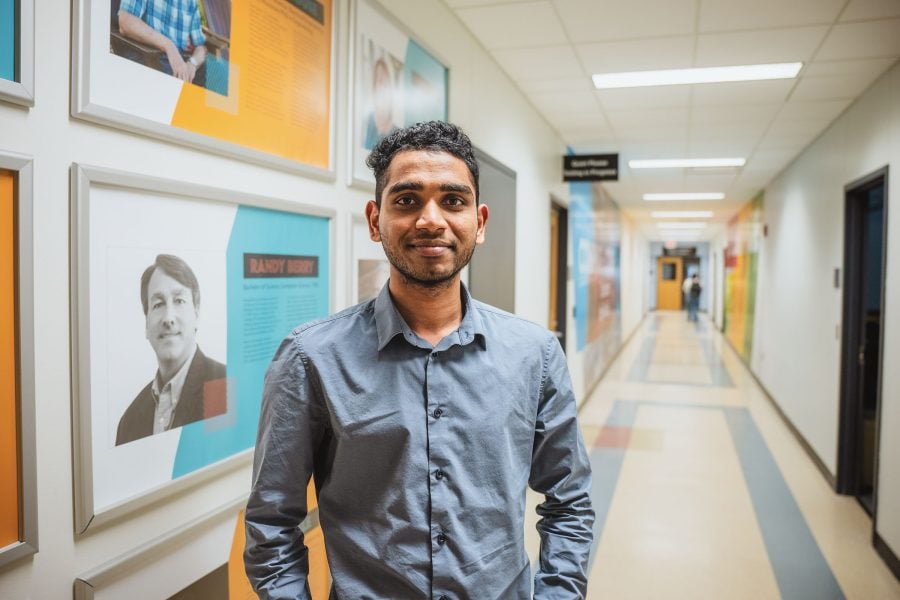
PhD student Tagore Kosireddy views artificial intelligence from dual vantages as both a learning coach in the highly acclaimed Building Adult Skills In Computing (BASIC) program at Portage Lake District Library and as a researcher.
Kosireddy, who earned his master’s degree in Data Science from Tech in 2025, is focusing his doctoral work in Computer Science with a concentration in AI. He’s advised by Assistant Professor of Computer Science Evan Lucas.
In this College of Computing Q&A, find out how Kosireddy, who BASIC founder and Computer Science Professor Charles Wallace describes as a “wonderful and enthusiastic tutor,” came to be involved in the program and how his work in Associate Professor Leo Ureel’s Computer Science Education Group (CS-ERG) has centered his research on ways to make AI both safe and accessible.
Q: How did you get involved in the BASIC program at the Library?
TK: When I came to Tech in 2023, I took a course in artificial intelligence taught by Professor Ureel. I was really interested in chatbots, and he told me about this project where a group of people were trying to help older community members with technology. That caught my attention right away, because I wanted to build things that actually help people. So I started joining the weekly team meetings and going to the library to help out, and I have been doing it ever since.
Q: What do you most enjoy about tutoring?
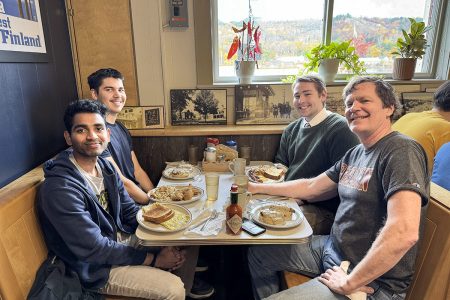
TK: The creativity of it. There are so many different ways to explain one thing, and the fun part is figuring out which way is easiest for that person to do and to remember. I also love the interaction with the community. Through it I have learned a lot, not just about Tech but also about the history of Houghton.
Q: What are some of the most common tasks that people need help with?
TK: People come in with all kinds of issues, especially with their mobile devices. A lot of them want to learn how to stay connected, whether that’s sending email or using FaceTime to see their grandkids. Others want to learn how to use new devices for things like editing photos. Most of it comes down to the everyday tasks that make their lives a little easier.
“Tagore never misses a tutoring session, and his patience and compassion for the people he is assisting is exemplary. He has found a way to combine his drive to help others with innovative and important research.”
– Professor Charles Wallace, BASIC founder
Q: How do you describe your research when a friend or acquaintance who is not in the computing field asks you about it?
TK: I tell them to imagine a five-year-old asking for something. The child knows what they want, but they don’t quite know how to express it. Maybe they ask for X when they really want Y, or they just don’t have the right words for it. If you put that same kind of request into today’s AI, it will often dump a pile of information on you instead of understanding what you actually wanted. So my research comes down to this: when a user asks for something, let’s first decode the language. Do they mean this, or that? Let’s get clarity before giving an answer. Let’s get the resources right, and let’s speak at the same level as the user, so they can actually learn and do the task step by step and check the results carefully.
Q: What drew you to your research?
TK: I always enjoyed machine learning, pulling insights out of data and running models to see how they work and what you can do with them. As my interests grew, I really got into playing with chatbots. Then I met the right people working on the right project: Chuck, Kelly (Steelman), Leo, and Evan, who are all wonderful professors. Everyone gave me the right resources and pointed me in the right direction. I see this as a privilege and as a way to give back to the Husky community, because spending time with these people and learning from them makes me happy, and I learn something new every time. It is an experience you cannot buy. I am far from home, and every time someone comes and talks to me and treats me like family, it reminds me what a good community I am in.
Q: There are a lot of questions and confusion about AI in the general public these days. What do you wish more people knew about AI?
TK: Everything in this world has its pros and cons. There are AI services that can help people a lot, and there are others people should be careful with. My advice is to stay optimistic, give it a try, and see for yourself. Ask yourself the honest questions: Why should I use this, or why should I not? How is it useful? What can I actually do with it?
Q: What’s next for you and your research?
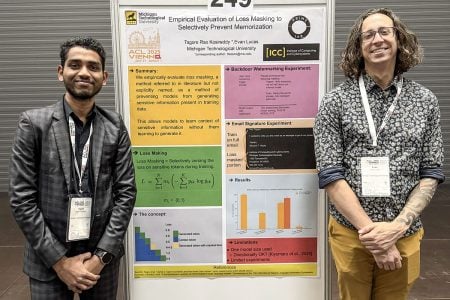
TK: Right now I am working on finding the sensitive information hidden inside these AI models, using a mix of mechanistic interpretability techniques and backdoor methods. My advisor and I will soon be presenting our research at two workshops at ACL. Long term, I want to keep working on building safe AI for everyone—AI that helps people in their daily lives without them having to worry about their information being leaked.
About the College of Computing
The Michigan Tech College of Computing, established in 2019, is the first academic unit in Michigan dedicated solely to computing, and one of only a handful such academic units in the United States. The college is composed of two academic departments. The Computer Science department offers four bachelor of science programs in computer science, cybersecurity, data science, and software engineering; four master of science programs in applied computer science, computer science, cybersecurity, and data science; and a doctoral program in computer science. The Applied Computing department offers four bachelor of science programs in cybersecurity, electrical engineering technology, information technology, and mechatronics; two master of science programs in health informatics and mechatronics; and a doctoral program is in computational science and engineering.
Questions? Contact us at computing@mtu.edu. Follow the College of Computing on Facebook, Instagram, LinkedIn, and X.