
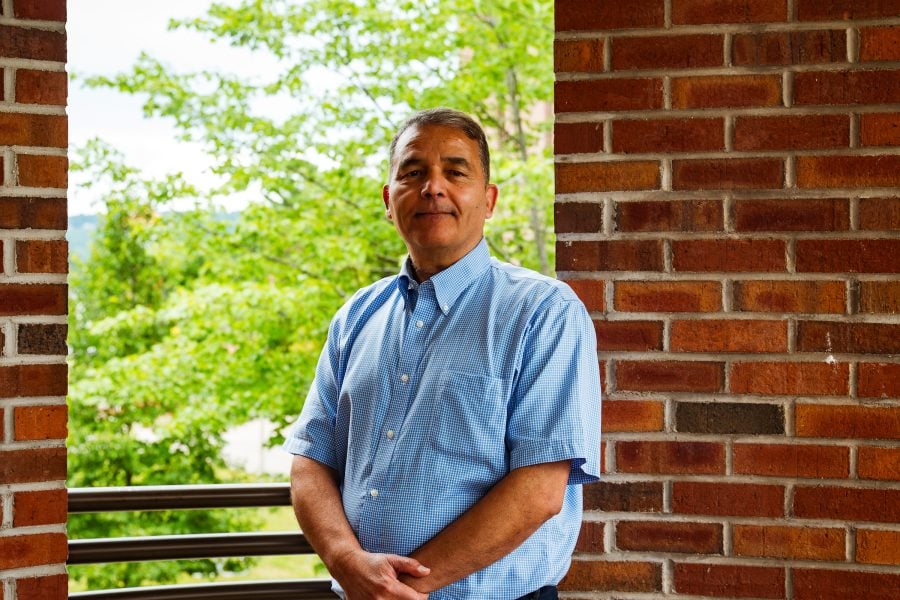
Anwar Walid took the helm of Michigan Tech’s Institute of Computing and Cybersystems (ICC) on Aug. 17, succeeding Timothy Havens as executive director.
Walid brings a blend of academic, research, and industry leadership to Michigan Tech. He previously served as an adjunct professor of electrical engineering at Columbia University while building a career in research and technology leadership in industry. A fellow in both ACM (Association for Computing Machinery) and the IEEE (Institute of Electrical and Electronics Engineers), his awards include the 2022 IEEE INFOCOM Test of Time Paper Award, the 2019 ACM SIGCOMM Networking Systems Award, the 2017 IEEE Communications Society William R. Bennett Prize, and the ACM Sigmetrics Best Paper Award.
With seven specialized centers and more than 100 members, ICC, founded in 2015, promotes collaborative research and learning experiences across disciplines, across the University, and around the globe. Finding a new leader to carry on the Institute’s mission and foster its continued growth was a formidable undertaking, said Dennis Livesay, Dave House Dean of Computing.
“We’re grateful to Tim for his leadership and service,” said Livesay. “He set an exceptional standard, and we knew that finding our next director would be a challenging search. The high-caliber candidate we sought would already be successful and well-positioned. Fortunately for us, Anwar recognizes the unique opportunity presented by Michigan Tech and ICC. I’m excited to see his vision for the Institute’s continued growth and impact put into action.”
In this College of Computing News Q&A, Walid shares more about his career, why he came to Tech, and his goals for ICC.
Q: You just arrived on campus. Where did you come from, how are you settling in, and what are your first impressions of our community here on the Keweenaw Peninsula?
AW: I came to Michigan Tech from the New York/New Jersey area after a career that has included industrial research, technology organizations, and academia.
I am still getting settled, but I have already been impressed by how welcoming people have been and by the strong sense of community at Michigan Tech. Having spent much of my career in major metropolitan areas, the Keweenaw is a very different setting, and I am looking forward to exploring it—not just in August, but through my first Michigan winter. I am especially looking forward to seeing the Northern Lights here.
Q: What drew you to Michigan Tech and the ICC?
AW: What attracted me most was the combination of strong research, a highly collaborative culture, and the opportunity to connect computing, AI, and cybersecurity with important real-world problems. ICC brings together researchers from many disciplines and plays an important role in creating connections and opportunities for research that crosses traditional academic boundaries.
I was also attracted by Michigan Tech’s strong connections with industry. That fits well with my own experience, and I see opportunities to strengthen and expand those relationships.
Q: You have extensive experience in both industry and academia. What do you think makes ICC unique, and how will you help the Institute continue to move forward?
AW: ICC’s strength is its interdisciplinary research community. Computing, AI, and cybersecurity increasingly play important roles across science, engineering, and many other disciplines. ICC serves as a catalyst for bringing together complementary expertise and creating pathways for collaboration around research problems that cross traditional academic boundaries.
My role is first to listen and understand what is already working well, and then build on those strengths. I want to help our researchers grow their programs, develop new collaborations across Michigan Tech, strengthen partnerships with industry and government, build multi-institutional research partnerships with leading national and international universities, and pursue larger externally funded research opportunities.
Q: You spent a major part of your career at Bell Labs. Tell us about your work there and why you found it rewarding.
AW: Bell Labs had an enormous influence on how I think about research. My work there spanned networking and distributed systems, optimization, artificial intelligence and machine learning, and cybersecurity, with applications ranging from communication networks and smart grids to financial technology. I also had the opportunity to lead research organizations and work with outstanding researchers across many disciplines.What made Bell Labs special was the combination of fundamental research and real-world impact. You could work on a difficult theoretical problem while also asking whether the result could change how an actual system operates. Over the course of my career, my research contributed to more than 20 patents and to technologies that were ultimately deployed in large-scale Internet and telecommunications systems and incorporated into the Linux kernel.
That experience—taking ideas from fundamental research through implementation and real-world use—has strongly shaped how I approach research.
Q: What are your preliminary goals as you begin leadership of ICC?
AW: My first goal is to listen. I want to meet our researchers and center directors, understand their work and aspirations, and learn where ICC can help them be even more successful.
I also want to strengthen connections across Michigan Tech. Some of the most interesting research opportunities emerge at the intersection of different disciplines and areas of expertise. ICC is a catalyst for bringing those capabilities together, developing strong research programs, pursuing external funding, and building partnerships with industry and government.
Q: Looking into the future, have you identified any long-term objectives for ICC?
AW: I would like ICC to become an even stronger engine for interdisciplinary research at Michigan Tech. A major objective is to grow externally funded research, including larger collaborative and multi-institutional programs, while developing deeper partnerships with industry, government, and academic institutions in the U.S. and internationally, and creating opportunities for faculty and students to work on ambitious problems with real societal and technological impact.
Computing, AI, and cybersecurity will continue to create opportunities across many disciplines. I want to build on ICC’s existing strengths and momentum while identifying new opportunities for collaboration, research growth, and impact.
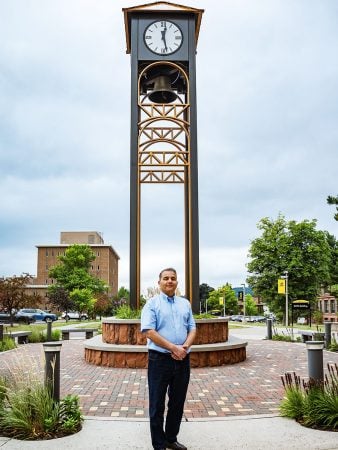
Q: In addition to your role as ICC’s executive director, you’re joining the College of Computing faculty as a professor of practice. Please share a few insights into your approach to teaching and tell us what you most enjoy about it.
AW: One thing that has already stood out to me at Michigan Tech is the importance placed on students and teaching, and that resonates strongly with me. I have taught at Columbia, and my approach is to combine strong theoretical foundations with applications to real problems in industry and research. I want students to understand not only the underlying concepts, but also how those ideas work when applied to real-world systems and constraints.
I particularly enjoy project-based learning because it gives students the opportunity to take what they learn in the classroom and apply it in practice. As a faculty member at Michigan Tech, I am also looking forward to developing my research program, working with undergraduate and graduate students, and collaborating with colleagues in the College of Computing and across the University. For me, teaching, research, and real-world application reinforce one another.
Q: When people who are not computer scientists or engineers ask you about your research, how do you describe it?
AW: I work on making intelligent systems better at understanding complex situations, predicting what may happen next, and making reliable decisions.
Earlier in my career, much of that work involved communication networks and distributed systems. Today, a major focus is artificial intelligence and its application to complex systems and real-world problems.
Q: When you take a break from work or studies, what do you enjoy doing?
AW: I enjoy traveling, staying active, walking, and hiking. I also ski, so I am looking forward to working on my skiing in the Keweenaw. Moving here also gives me an opportunity to explore this unique and beautiful part of the country, discover the area’s trails and outdoor activities, and make the most of my first Keweenaw winter.
For more on the transition, see a salute to Havens and a welcome to Walid on the ICC Newsblog.
About the College of Computing
The Michigan Tech College of Computing, established in 2019, is the first academic unit in Michigan dedicated solely to computing, and one of only a handful such academic units in the United States. The college is composed of two academic departments. The Computer Science department offers four bachelor of science programs in computer science, cybersecurity, data science, and software engineering; four master of science programs in applied computer science, computer science, cybersecurity, and data science; and a doctoral program in computer science. The Applied Computing department offers four bachelor of science programs in cybersecurity, electrical engineering technology, information technology, and mechatronics; two master of science programs in health informatics and mechatronics; and a doctoral program is in computational science and engineering.
Questions? Contact us at computing@mtu.edu. Follow the College of Computing on Facebook, Instagram, LinkedIn and Twitter.