

The Michigan Tech College of Computing is welcoming new faculty while celebrating established faculty members as they reach new career milestones.
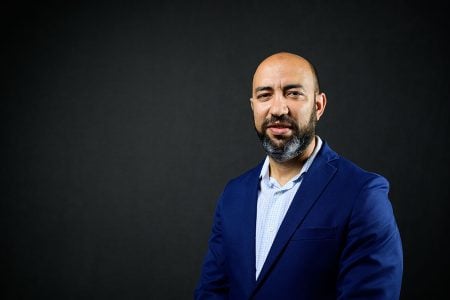
Bassam Abdelghani joins the College as a visiting assistant teaching professor in the Department of Applied Computing. A research engineer at the Michigan Tech Advanced Power Systems Research Center specializing in machine learning, spectroscopy, and sustainability, Abdelghani’s work includes the solvent-targeted recovery and precipitation (STRAP) project designed to tackle one of recycling’s most stubborn problems: mixed plastic waste.
Currently a PhD student in the MTU College of Engineering’s Department of Mechanical and Aerospace Engineering, he earned his master’s degree in electrical and computer engineering at the University of Detroit Mercy.
“Michigan Tech has been my academic home, and I’m grateful for the chance to give back as a teacher. I’m looking forward to working with applied computing students, helping them gain confidence in the lab, and sharing my passion for using technology to solve real-world problems,” Abdelghani said.
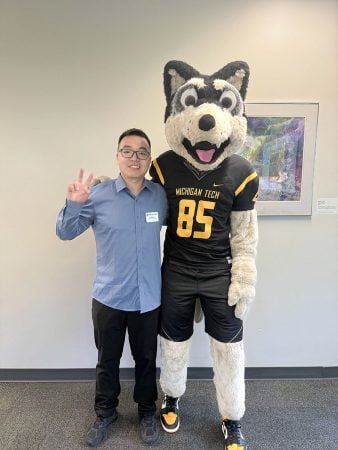
Newcomer Yunlong Xing has been appointed assistant professor in both Applied Computing and the Department of Computer Science. Xing, who earned his PhD at George Mason University in 2026, specializes in software and systems security. His research focuses on automated program repair and IoT (internet of things) security, along with the use of large language models for security, including vulnerability detection, reasoning, patch generation, and verification.
He’s interested in collaborations involving artificial intelligence (AI) for software engineering and security as well as software and hardware co-design that involves optimizing algorithms, software systems, and hardware architecture to achieve excellence in performance, efficiency, and scalability.
“I’m excited to join Michigan Tech and become part of the Computing community. I enjoy working with students and bringing real-world security problems into the classroom. Through my research, I hope to develop practical and trustworthy techniques that make software and connected systems more secure, while building collaborations across software security, AI, and IoT,” said Xing.
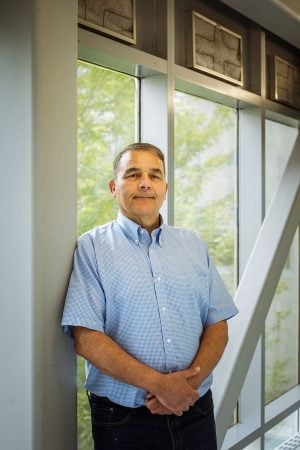
Professor Anwar Walid is also serving in both the applied computing and computer science departments, along with taking the helm as executive director of the Institute for Computing and Cybersystems (ICC).
Walid, who shared what drew him to Michigan Tech and his vision for ICC in a recent College of Computing Newsblog Q&A, brings extensive industry experience to his roles, along with a research focus on making intelligent systems better at understanding complex situations, predicting what may happen next, and making reliable decisions. He is particularly interested in AI and its application to complex systems and real-world problems.
When it comes to teaching, Walid is an advocate for project-based learning that gives students the ability to apply what they’ve learned in the classroom.
“As a faculty member, I’m looking forward to developing my research program, working with undergraduate and graduate students, and collaborating with colleagues in the College of Computing and across the University. For me, teaching, research, and real-world application reinforce one another,” Walid said.
Faculty Earn Promotions and Honors
Four faculty members in the computer science department have been recognized with promotions:
- Serein Al-Ratrout has been promoted to associate teaching professor.
- Leo Ureel has been promoted to associate professor, with tenure.
- Brianna Bettin has been promoted to associate professor, with tenure.
- Keith Vertanen has been promoted to professor.
Other noteworthy Computing[MTU] faculty accomplishments include the induction of Applied Computing Professor of Practice Victoria Walters into the 2026 Michigan Tech Academy of Teaching Excellence, Tim Van Wagner’s 2026 Michigan Tech Center for Faculty Excellence Instructional Award in the Innovative or Out of Class Teaching category, and the selection of Tim Havens as recipient of the 2026 Michigan Tech Research Award.
“Our faculty continue to set a high bar for excellence in teaching, research, and service that benefits our students, our community, and industry throughout the region, state, and nation,” said Dennis Livesay, dean of the College of Computing. “We’re fortunate to have the benefit of their dedication and expertise as the College of Computing leads the way in meeting the new opportunities and challenges before us.”
About the College of Computing
The Michigan Tech College of Computing, established in 2019, is the first academic unit in Michigan dedicated solely to computing, and one of only a handful such academic units in the United States. The college is composed of two academic departments. The Computer Science department offers four bachelor of science programs in computer science, cybersecurity, data science, and software engineering; four master of science programs in applied computer science, computer science, cybersecurity, and data science; and a doctoral program in computer science. The Applied Computing department offers four bachelor of science programs in cybersecurity, electrical engineering technology, information technology, and mechatronics; two master of science programs in health informatics and mechatronics; and a doctoral program is in computational science and engineering.
Questions? Contact us at computing@mtu.edu. Follow the College of Computing on Facebook, Instagram, LinkedIn and Twitter.