Search Results for "thesis and dissertations acrobat tips"

How to access a document in Perceptive Content

Graduate School forms submitted by students are electronically stored in Perceptive Content (formerly known as ImageNow).  All member of the graduate faculty and authorized staff may access these forms by opening the Perceptive Content program, and logging in with their Michigan Tech ISO ID and password.  Students do not have access to Perceptive Content.  Dissertation, thesis, or report reviews are available to students through Canvas (for pre-defense documents) or Digital Commons (for post-defense documents).

Faculty can also choose not to utilize Perceptive Content to access the student’s review.  These faculty may ask their student to share the review file with them, or contact the Graduate Program Assistant for access to the file. The email notification lets the faculty member know that the review is available.

Perceptive Content may be installed on any University computer running the Windows operating system; contact IT for assistance. There is no longer a web client for Perceptive Content.

If your computer is unable to have Perceptive Content installed, the software can also be accessed on the University’s remote server, remote.mtu.edu. See information from IT on how to connect using a Windows or Mac computer and note that a VPN will be needed to access from off campus.

Once logged in, click on the “Documents” icon.  If you have access to more than one set of documents, click on the arrow next to the “Documents” icon and select “Graduate School.”  Note that the name of the software is now Perceptive Content, some windows in the program may still list ImageNow in the title bar of the window.

Notifying the Graduate School of a final oral examination

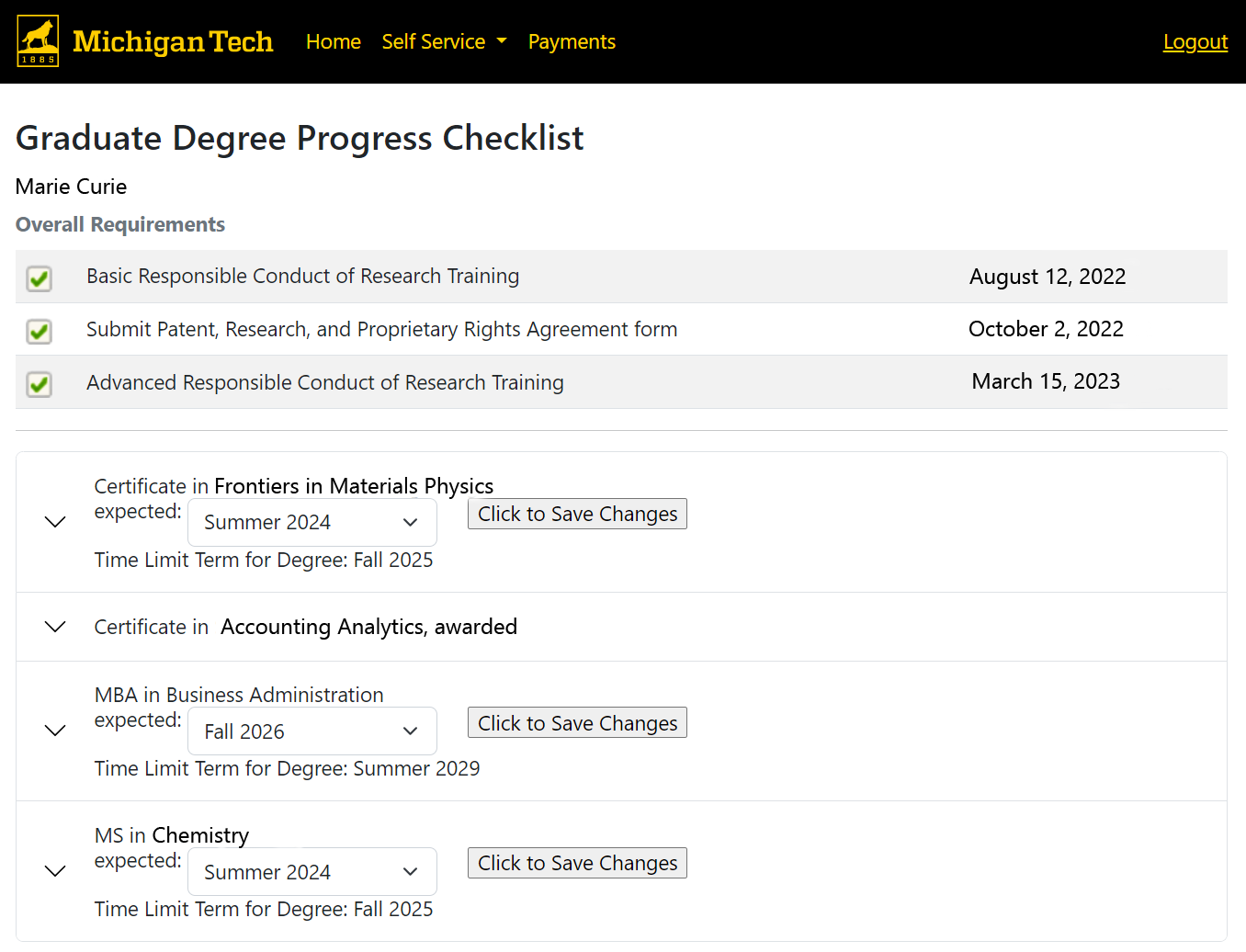
A final oral examination (“defense”) is a milestone for students completing a dissertation, thesis, or report. To schedule a defense, students arrange a date, time and location for their committee to meet following the procedures in their graduate program. Once this has been determined, students must notify the Graduate School of their defense information on our Michigan Tech app, the Graduate Degree Progress Checklist.

Log into the Graduate Degree Progress Checklist.

Select the degree of interest by clicking on the arrow next to the degree in the list. If a degree is missing, please contact the Graduate School.

A screenshot of the degree progress checklist showing the list of degrees available for this student.

The DOE Office of Science Graduate Student Research (SCGSR) program is now accepting applications!

Dear Colleagues,

The Department of Energy’s (DOE) Office of Science is pleased to announce that the Office of Science Graduate Student Research (SCGSR) program is now accepting applications for the 2020 Solicitation 2.  Applications are due 5:00pm Eastern Time on Thursday, November 12, 2020.

We would like to bring to your attention 4 new transdisciplinary research areas for encouraging graduate training activities at the convergence of multiple disciplines and communities, including Microelectronics, Data Science, Conservation Laws and Symmetries, and Accelerator Science. We strongly encourage applications in these areas.  Detailed information about the program, including eligibility requirements and access to the online application system, can be found at: https://science.osti.gov/wdts/scgsr/.  

The SCGSR program supports supplemental awards to outstanding U.S. graduate students to conduct part of their graduate thesis research at a DOE national laboratory/facility in collaboration with a DOE laboratory scientist for a period of 3 to 12 consecutive months—with the goal of preparing graduate students for scientific and technical careers critically important to the DOE Office of Science mission.

The SCGSR program is open to current Ph.D. students in qualified graduate programs at accredited U.S. academic institutions, who are conducting their graduate thesis research in targeted areas of importance to the DOE Office of Science. The research opportunity is expected to advance the graduate students’ overall doctoral thesis/dissertation while providing access to the expertise, resources, and capabilities available at the host DOE laboratories/facilities. The supplemental award provides for additional, incremental costs for living and travel expenses directly associated with conducting the SCGSR research project at the DOE host laboratory/facility during the award period.

The Office of Science expects to make approximately 95 awards in 2020 Solicitation 2 cycle, for project periods beginning anytime between June 14, 2021 and October 4, 2021.

Since its inception in 2014, the SCGSR program has provided support to over 580 graduate awardees from 141 different U.S. universities to conduct thesis research at 18 DOE national laboratories/facilities across the nation.

The SCGSR program is sponsored and managed by the DOE Office of Science’s Office of Workforce Development for Teachers and Scientists (WDTS), in collaboration with the six Office of Science research programs offices and the DOE national laboratories/facilities, and program administration support is provided by the Oak Ridge Institute for Science and Education (ORISE).

For any questions, please contact the SCGSR Program Manager, Dr. Ping Ge, at sc.scgsr@science.doe.gov.

U.S. Department of Energy, Office of Science

Graduate Research Opportunities at DOE National Laboratories

The Department of Energy’s (DOE) Office of Science is pleased to announce that the Office of Science Graduate Student Research (SCGSR) program is now accepting applications for the 2018 Solicitation 1.  Applications are due 5:00pm Eastern Time on Tuesday, May 15, 2018.

Detailed information about the program, including eligibility requirements and access to the online application system, can be found at: https://science.energy.gov/wdts/scgsr/.

The SCGSR program supports supplemental awards to outstanding U.S. graduate students to conduct part of their graduate thesis research at a DOE national laboratory/facility in collaboration with a DOE laboratory scientist for a period of 3 to 12 consecutive months—with the goal of preparing graduate students for scientific and technical careers critically important to the DOE Office of Science mission.

Productivity and Technology

Academics are lucky – they get two (or three if you count summer) chances to start a fresh leaf every year. Each new start is an opportunity to re-energize yourself and be more productive.  Are you looking for some inspiration on how to use technology to be more productive?  If so, check out these two resources:

How to Write a Competitive, Fundable Proposal

Join the Graduate School and Research and Sponsored Programs for a seminar on “How to Write a Competitive, Fundable Proposal”  June 16, 11 am.

Seniors and current graduate students interested in applying for external funding or a National Science Foundation Graduate Fellowship will gain:

  • 6 proposal writer tips
  • 7 proposal writing guidelines
  • 4 effective proposal package strategies

Once you register, you will receive a confirmation with the location and a reminder of the date and time.  Space is limited, so register early!  The presentation will be available online for those unable to join us at this time.

First In Series of Federal Funding Workshops – Sept 15th and 16th.

A federal fellowship/scholarship writing workshop will be held on Wednesday, September 15th  and Thursday, September 16th at 4:00 in Fisher 135.

You will only need to attend one of the workshops, as they are the same workshop, different days and time.

During the workshop we will review 3 samples of NSF GRFP personal statement essays. Tips will be given on how to organize your essay, utilize wording, and meet the merit criteria expected by reviewers

Prepare for the workshop by:

1. Understanding how NSF defines “broader impacts”

2. Brainstorming answers to NSF “personal statement” questions


    If you (or someone you know) plan on attending, please RSVP to Jodi Lehman (jglehman@mtu.edu).

    December 14: Graduate School Brown Bag Lunch and Learn

    Has the end of the semester left you feeling overwhelmed and wondering how you can manage the demands of your work, school, and family?

    If so, on December 14th from noon – 1pm, join presenters from Counseling and Wellness Services as they present tips relevant to time management for graduate students.  We’ll provide soft drinks (soda and water), chips, and desert – bring your own lunch.

    Register online to save your seat and receive the location of the seminar.  Seating is limited – register early!

    Questions?  Contact Debra Charlesworth.

    Fall Finishing Fellowship Applications Due June 26th

    Applications for fall Finishing Fellowships are now open.  The Graduate School anticipates funding up to 10 fellowships per semester with support ranging from $2,000 to full support (stipend plus tuition).  Applications are due to the Graduate School no later than 4pm on June 26th.

    Students are eligible if all of the following criteria are met:

    1. Must be a PhD student.
    2. Must expect to finish during the semester supported as a finishing fellow.
    3. Must be in Research Only Mode.
    4. No other source of support for fall semester.

    Refer to our web page for full details regarding eligibility, application procedure, and evaluation criteria.  Our online presentation also provides some tips to prepare your application.

    Contact Debra Charlesworth or Heather Suokas with additional questions.