
 By Karen Johnson, ICC Communications Director
What if an everyday surface, like a table, could be transformed into a rich, interactive surface that can remotely operate things like computers, entertainment systems, and home appliances?
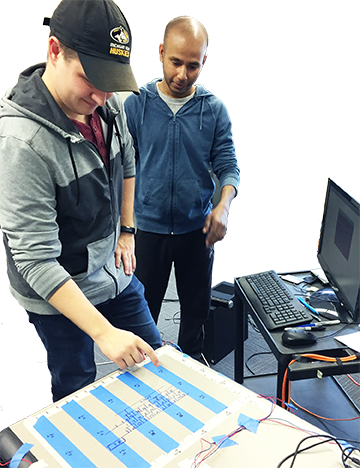
That’s what Michigan Tech Institute of Computing and Cybersystems (ICC) researchers Keith Vertanen and Scott Kuhl set out to do with a $44K seed grant from Electrical and Computer Engineering alumnus Paul Williams ’61.
Vertanen, assistant professor of computer science, and Kuhl, associate professor of computer science, are members of the ICC’s Center for Human-Centered Computing, which integrates art, people, design, technology, and human experience in the research of multiple areas of human-centered computing. They were assisted in this research by PhD candidate Siva Krishna Kakula, Computer Science, and undergraduate Zachary Garavet, Computer Engineering.
The team’s research goals were threefold: to create machine learning models that can precisely locate a user’s taps on a surface using only an array of inexpensive surface microphones; demonstrate the feasibility and precision of the models by developing a virtual keyboard interface on an ordinary wooden table; and conduct user studies to validate the system’s usability and performance.
The researchers are working on a related technical conference paper to present to their peers. Their outcomes included a prototype virtual keyboard that supports typing at rates comparable to a touchscreen device; possibly the first-ever acoustic sensing algorithm that infers a continuous two-dimensional tap location; and novel statistical models that quickly adapt to individual users and varied input surfaces.
Further, their results, hardware, and data sets can be applied to future collaborative work, and were used in the researchers’ $500K National Science Foundation proposal, “Text Interaction in Virtual and Augmented Environments,” which is under review.
Future applications of the research include enriched interactions in Virtual Reality (VR) and Augmented Reality (AR), compared to existing vision-only based sensing; and on-body interaction, like using your palm as an input surface.
Vertanen and Kuhl plan to continue this research, working to improve the accuracy of tap location inference, build richer interactions like swiping or tapping with multiple fingers, develop wireless sensor pods that can be quickly and easily deployed on any flat surface, and explore the display of virtual visual content on surfaces via Augmented Reality smartglasses.
View a video about this research at https://youtu.be/sF7aeXMfsIQ. Download a summary of the research from the ICC website at icc.mtu.edu/downloads.
Seed grant donor Paul Williams is also the benefactor of the Paul and Susan Williams Center for Computer Systems Research, located on the fifth floor of the Electrical Energy Resources Center. The 10,000-square-foot, high-performance computing center—the home of the ICC—was established to foster close collaboration among researchers across multiple disciplines at Michigan Tech
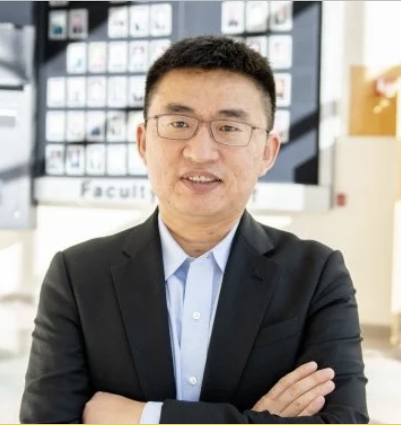 Research by Kuilin Zhang (CS) was featured in the story “MTU Researchers develop optimization model to fill in the gaps in connected vehicle data in the April 26, 2019, issue of Green Car Congress. View the article here:
  By Karen Johnson, ICC Communications Director
 by Michael R. Meyer, Director William G. Jackson CTL
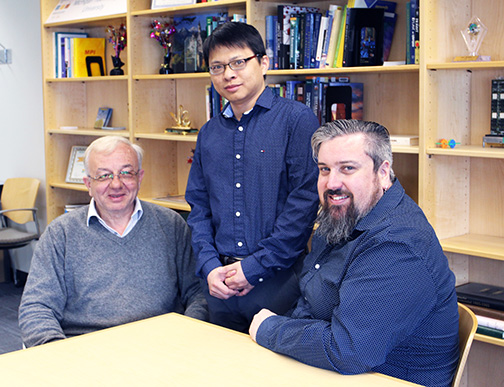 At the annual awards banquet of the Michigan Tech Institute of Computing and Cybersysytems (ICC), on Friday, April 12, three ICC members received the ICC Achievement Award in recognition of their exceptional contributions to research and learning in the fields of computing.
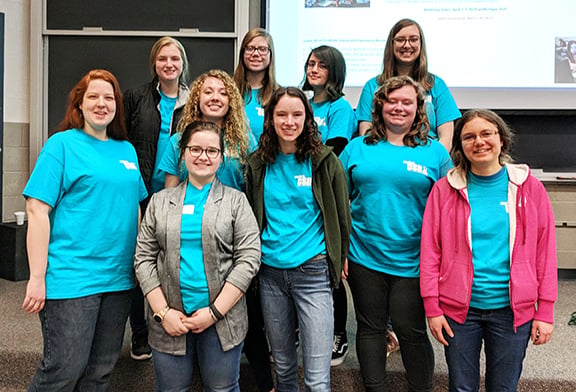 Michigan Tech hosted the workshop “Exploring Computer Science Research” last Friday – Sunday (April 5-7). The workshop was one of 15 Google has sponsored in the U.S. and was organized by four CS Faculty: Leo Ureel, Linda Ott, Jean Mayo and Laura Brown; Jean Mayo and Laura Brown are members of the ICC. The workshop was for women and underrepresented groups to explore research and graduate school opportunities in computer science.