
On Saturday, October 3, 2026, the 3rd Henes Workshop on Computational and Applied Mathematics, organized by Professor Jiguang Sun, was held at Michigan Technological University. Supported by the endowed Henes Professorship and the Department of Mathematical Sciences at Michigan Tech, the workshop brought together prominent mathematicians from across the United States, including Peter Monk, SIAM Fellow, and Fioralba Cakoni, AMS and SIAM Fellow. Participants discussed recent developments on computational and applied mathematics. The scientific program can be found on the workshop website.
The Department of Mathematical Sciences is happy to announce that two math majors were selected by the College of Sciences and Arts (CSA) to perform research for a REU project in the Mathematical Sciences department this fall. They are Bella Farrell (to work with Professor Yang Yang) and Lizzy Mansfield (to work with Professors Dave Hemmer and William Keith).
CSA-REU students receive a stipend of (up to) $2,250 for the semester, paid at a rate of $15 per hour. They will work on their research project, participate fully in two CSA-REU professional development activities, and deliver a short video summarizing their research at the end of the semester.
Congratulations to Bella and Lizzy!
(and many thanks to our profs. Hemmer, Keith and Yang for their dedication and work with our Michigan Tech undergraduates students)
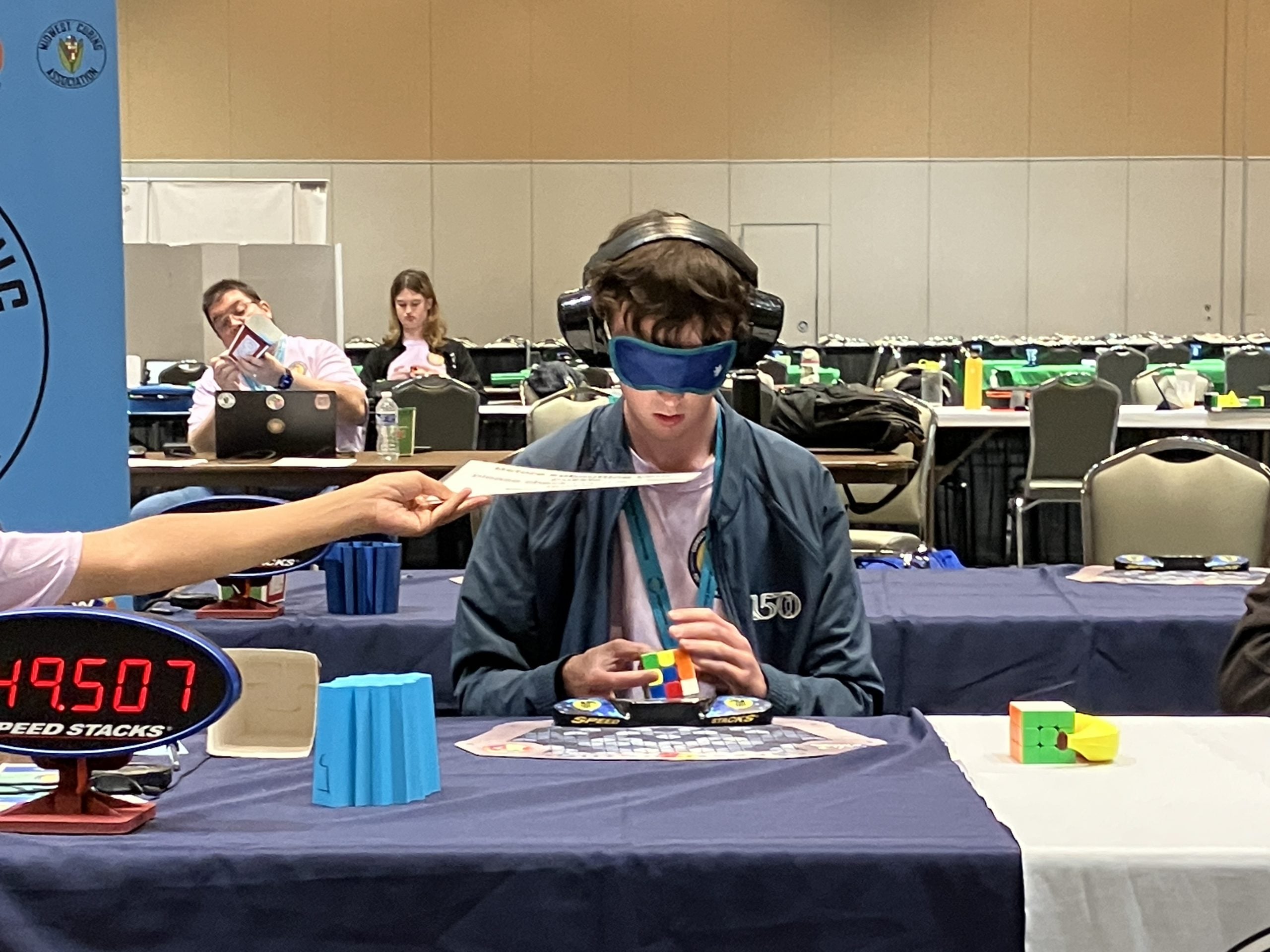
Cubing is back in the Copper Country! For the first time in over five years, a Rubik’s Cube competition, Copper Country Comeback 2026, was held on Saturday, September 19. This event was the latest World Cube Association (WCA) speedcubing competition in the UP. The WCA is a non-profit organization that hosts these cubing competitions worldwide through WCA delegates like Luke Selle, a Michigan Tech junior majoring in Mathematics. According to Luke, although these are competitions by name, they feel more like a way to meet other cubers and have fun sharing a love of cubing.
Of the event, Luke says, “While I’ve organized competitions back home, this was my first time holding one in the UP. It had been five years since the last Houghton competition, and I was worried that there may not be enough local interest to make future competitions feasible. Fortunately, many of the 19 competitors were from the area, and I’m looking forward to bringing more competitions to Michigan Tech and supporting the cubing community here!” The Department of Mathematical Sciences was well represented among those 19 competitors: In the main event, the standard 3×3 cube, Luke finished in second place and Philip Cuthbertson, PhD candidate in Mathematical Sciences, finished in third place.
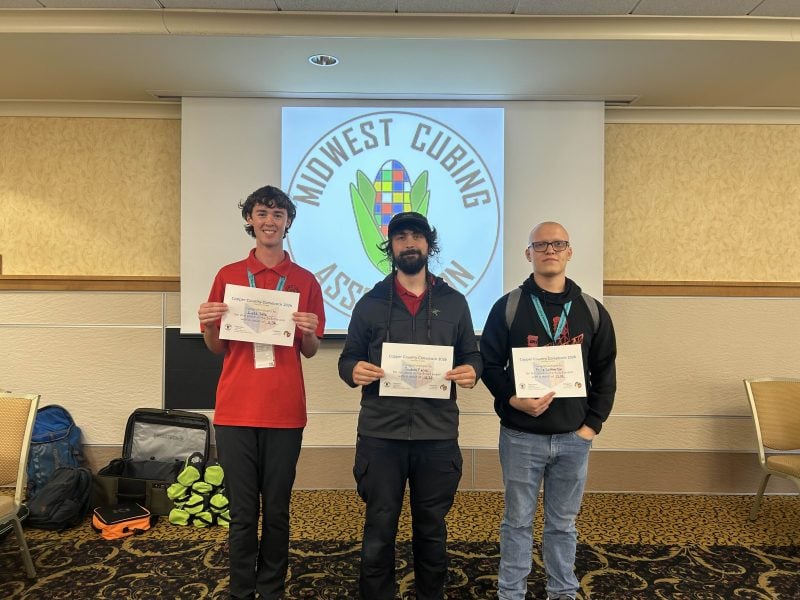
While more Houghton competitions have not been officially announced yet, Luke is actively planning events for this spring. They are open to anyone who can solve a cube, and Luke encourages cubers of all skill levels to give it a try. Spectators are also welcome to come and see what cubing is about. Keep an eye on the WCA competitions page to find out when the next one will be!
The Department of Mathematical Sciences is pleased to share the news of another book that our Prof. Jiguang Sun published this year. The monograph (that has been recently published by Springer) is titled Band Structure Calculation of Photonic Crystals. More information could be found at: https://link.springer.com/book/9783032231994
Please join us in congratulating Jiguang!

Prof. Robert Schneider was featured in Tech Today on August 12, 2026. The article highlighted Prof. Schneider’s Partnership with the AI startup, MathVision.
For the full article, visit Tech Today.
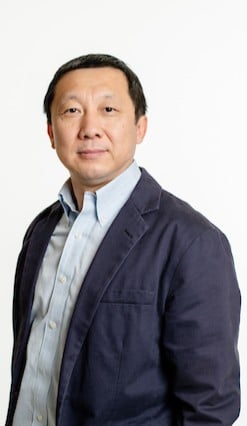
The Department of Mathematical Sciences is pleased to share the recent publication by Jinguang Sun, Endowed Professor of Mathematics. Dr. Sun, along with co-author Aihui Zhou, published the 2nd Edition of “Finite Element Methods for Eignevalue Problems” on May 10, 2026 through CRC Press.
“Finite Element Methods for Eigenvalue Problems” covers finite element methods for several typical eigenvalues that arise from science and engineering. Both theory and implementation are covered in depth at the graduate level. The background for typical eigenvalue problems is included along with functional analysis tools, finite element discretization methods, convergence analysis, techniques for matrix evaluation problems, and computer implementation. The book also presents new methods, such as the discontinuous Galerkin method, and new problems, such as the transmission eigenvalue problem.
A big congratulations to Dr. Sun!

Dr. William Keith
Congratulations to Associate Professor William Keith in the Department of Mathematical Sciences on receiving the 2026 Springer Nature Editor of Distinction Award (the Editorial Contribution category) for The Ramanujan Journal.
This award recognizes Prof. Keith’s role in “assessing new submissions and rigorously managing the peer review process, safeguarding the scientific accuracy of the published record, and ensuring authors’ work commands the highest level of trust.”
Please join us in congratulating Dr. Keith for this well-deserved distinction.
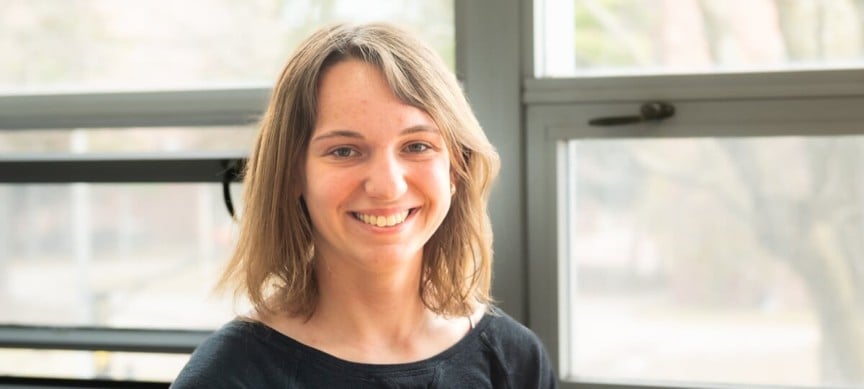
Statistics major, Aili Toyli, was featured in an article in the Unscripted Research blog. The article discusses Aili’s research into cardiovasular disease, which was recently published in the Journal of the American Heart Association. This is her third publication to date. Congratulations on all your hard work, Aili!

The Department of Mathematical Sciences hosted A Workshop on Applied and Numerical Mathematics, sponsored by generous gifts from Igor Kliakhandler and the Applied Mathematics Department at University of Colorado Boulder. The workshop was held June 8 – 10, 2026 in the U.J. Noblet Forestry Building. Held to celebrate the 80th birthday of renown mathematician, Bengt Fornberg, the workshop brought together leading international experts from across the field of numerical analysis, with a central focus on high-order methods for solving partial differential equations. The workshop was structured with a strong educational emphasis, particularly aimed at graduate students and early-career researchers across STEM disciplines. The mornings were devoted to lectures on modern high-accuracy numerical techniques, while the afternoons featured research talks covering a broad range of topics, including, but not limited to, recent advances in the discretization of differential and integral operators, as well as methods based on rational functions, radial basis functions (RBFs), and finite difference approaches.
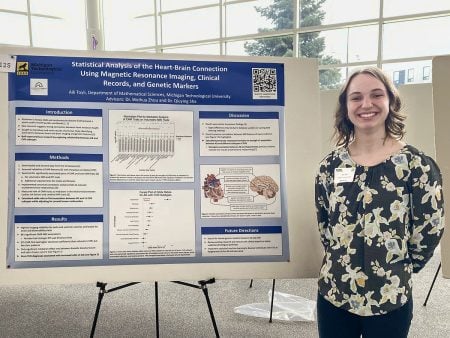
Check out this week’s College of Sciences and Arts Newsblog. Aili Toyli, who is completing her Undergraduate degree in Statistics, was featured in this week’s article.
Congratulations, Aili!