
Modern electronics rely on the flow of electrical charges to process information. The next generation of technologies may harness another fundamental property of electrons: spin. This idea forms the basis of spintronics, an emerging field that uses both electron spin and charge to store and process information. Spin-based devices could enable faster operation, lower power consumption, and tighter integration of memory and computing. They could also allow for emerging in-memory computing architectures, reducing the need to shuttle information between processing and memory units.
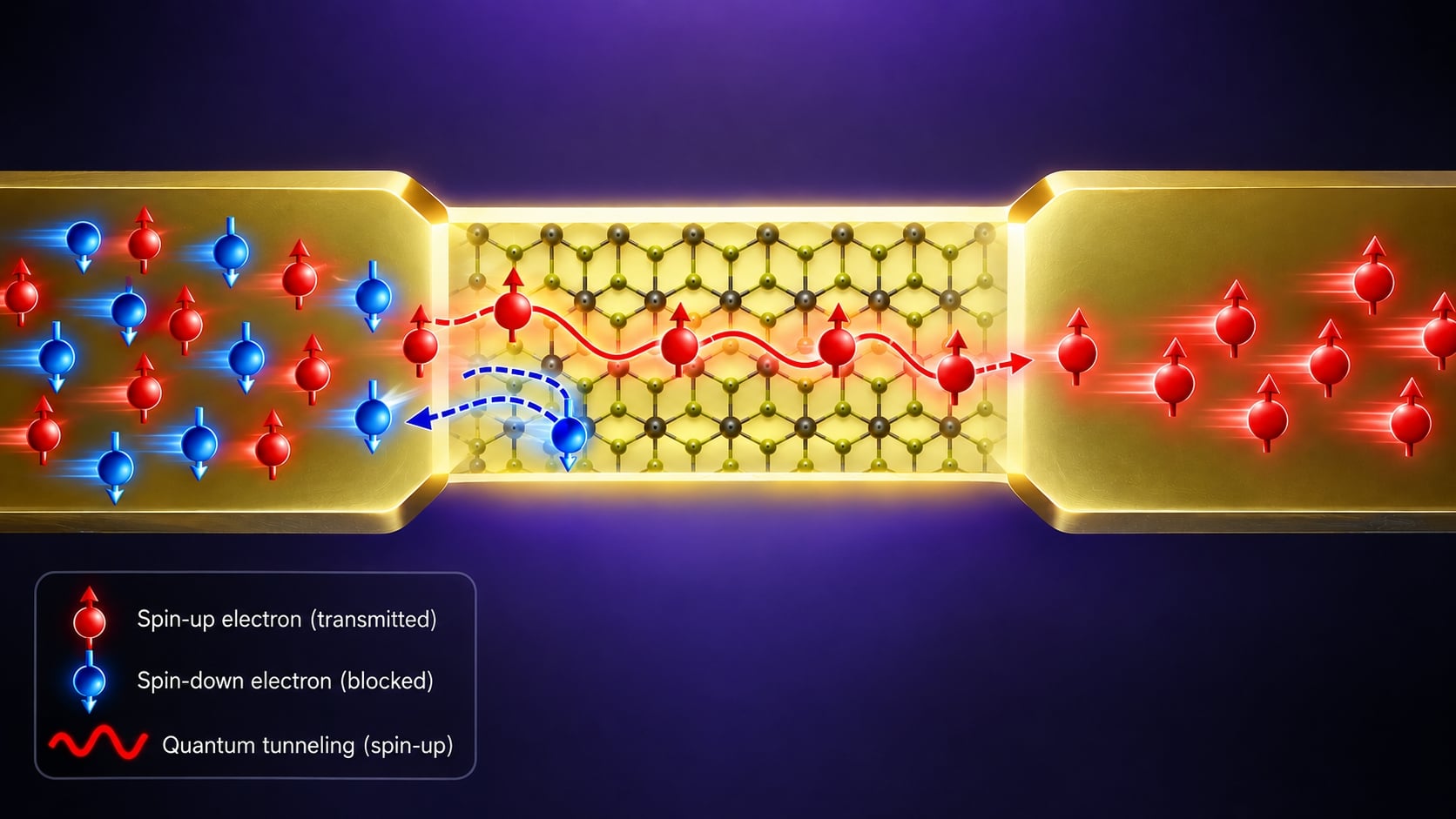
A major challenge in realizing practical spintronic technologies is developing materials that can selectively transmit electrons of one spin orientation while suppressing the other. Conventional approaches often rely on multilayered structures that combine magnetic metals as spin injectors with semiconductors as transport channels. Interfaces between these different materials can introduce spin scattering and depolarization, potentially degrading the spin information the devices are designed to preserve.
Researchers led by Ranjit Pati in the Department of Physics, have identified a promising route to address this challenge using an ultrathin CrSbSe₃ nanowire. This one-dimensional magnetic semiconductor, isolated from a quasi-one-dimensional van der Waals crystal, possesses an intrinsic ability to act as an almost perfect spin filter. Using state-of-the-art quantum-mechanical simulations, they show that the nanowire can transmit electrons with one spin orientation while strongly suppressing the opposite spin over a broad range of applied bias conditions, resulting in near-perfect spin selectivity.
Equally important, the nanowire retains its favorable electronic structure even when spin–orbit coupling, a relativistic interaction that can mix different spin states, is taken into account. This suggests that electron spins can remain coherent while passing through the nanowire, an important requirement for preserving information in practical devices.
By combining intrinsic magnetism, semiconducting behavior, and near-perfect spin selectivity in a single material, CrSbSe₃ nanowires could provide a promising building block for future spintronic technologies, and may ultimately contribute to more compact and energy-efficient devices for information storage, sensing, and emerging in-memory computing architectures.
The research is reported in the article “CrSbSe₃ Nanowire: A Platform for Near-Perfect Spin Selectivity,” published in Nano Letters on August 21, 2026. The authors are Alyssa Horne and Ranjit Pati from the Department of Physics at Michigan Technological University and Yongmei M. Jin from the Department of Materials Science and Engineering at Michigan Technological University.
This work was supported by the National Science Foundation under Grant CMMI-2212324.
About the Physics Department
Physicists at Michigan Technological University help students apply academic concepts to real-world issues. Our physicists take on the big questions to discover how the universe works—from the smallest particles to the largest galaxies. The Physics Department offers three undergraduate degrees and three graduate degrees. Supercharge your physics skills to meet the demands of a technology-driven society at a flagship public research university powered by science, technology, engineering, and math. Graduate with the theoretical knowledge and practical experience needed to solve real-world problems and succeed in academia, research, and tomorrow’s high-tech business landscape.
Questions? Contact us at physics@mtu.edu. Follow us on Facebook, Twitter, and YouTube for the latest happenings. Or read more at the Physics Newsblog.