Category: Uncategorized

Law Club Launches at MTU

A newly established Registered Student Organization (RSO) at Michigan Tech is helping students explore the legal field while making meaningful connections. Law Club at Michigan Technological University creates opportunities for students to explore legal careers, develop professional skills, and engage in meaningful discussions about law and policy.

Law Club MTU meets on Fridays from 5-6pm in the Social Science Annex Lounge in the Annex Building (Building 6, directly behind the Academic Office Building). Free parking is available in Lot 1 or 2, and no permit is necessary after 4pm.

Keep reading to learn more about the Law Club Officers and Advisor stewarding this new student organization.

President: Allie Millina

Allie Millina is a junior majoring in Policy and Law and minoring in Public Health. Allie has gained hands-on experience through a legal research internship with Legal Services of Northern Michigan, where she created case timelines for court, attended client interviews, and observed real settlement hearings and trials. She has worked on policy-focused research projects related to the Global South and interned with Global Detroit where she interviewed refugees about their resettlement process. She also volunteers with Vista Maria, an anti-human trafficking nonprofit.

As President of the Law Club, she is passionate about creating opportunities for students to explore legal careers, develop professional skills, and engage in meaningful discussions about law and policy.

Treasurer: Viviana Cotter

Viviana Cotter is pursuing a degree in Psychology with a concentration in Clinical/Counseling and a minor in Law and Society. She works in the Psychology and Human Factors Department, where she helps manage departmental spending. Additionally, she currently serves as the Treasurer for the Association of Psychology Students at Michigan Tech.

As Treasurer of the Law Club, she is committed to managing the club’s budget and ensuring that funds are allocated to support events, activities, and student initiatives.

Secretary: Gavin Rozak

Gavin Rozak is a junior Environmental Science & Policy major at Michigan Technological University, with a minor in Law & Society. By exploring the intersections between law, ecology, and environmental health, he hopes to engage with environmental justice and conservation. Passionate about building a more sustainable future, he aims to enroll in law school in pursuit of becoming an environmental attorney. Environmental volunteering, debate, and current experience working in arboriculture have reinforced his love for the environment and what it has to offer.

He is excited about the opportunities the Law Club has to offer students and the positive dialogue on legal issues it hopes to provide. In his role as Secretary, he wishes to learn alongside others about legal pathways and current events.

Advisor: Susanna Peters

Susanna Peters, MS, JD, taught at Wayne State University Law School before coming to Michigan Tech. Her research and teaching interests include constitutional law, intellectual property, cyberlaw, and prisons. She attended the University of Pennsylvania Law School and had the opportunity of clerking for United States District/Circuit Court Judge Morris Arnold and U.S. Magistrate Judge Komives. In private practice she has worked as a litigation associate at a Los Angeles law firm that specialized in labor law. Ms. Peters also has a M.S. in Agricultural Economics from the University of California at Davis, where her emphasis on resource economics stemmed from summers spent in the Alaskan fishing village of Yakutat. Since being at Tech she has taught Cyberlaw, Intellectual Property, Constitutional Law, Law and Society, Orientation to Legal Careers, American Government, and Perspectives sections entitled “Crime and Incarceration” and “The Work of the First Amendment: Selected Topics in First Amendment Law.

Contact Allie Millina, akmillin@mtu.edu, if you have any questions.
Social Sciences Graduate Students take home World Social Science Association Awards

Two graduate students from the Social Sciences Department recently attended and presented at the 67th Annual World Social Science Association Conference in Seattle. Both students presented their individual research and took home awards for their respective research papers. The WSSA holds its annual conference each year that attracts social scientists from diverse fields to present, share, collaborate and forge academic and intellectual connections.

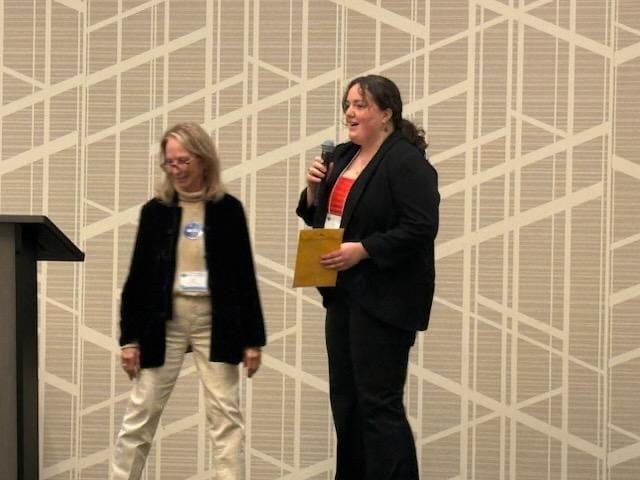
Lexi Tater, a graduate student in the Sustainable Communities program took home the “Best Graduate Student Paper” Award for her research titled “Climate Planning and Energy Sovereignty Among Michigan’s Tribal Nations.”

Lexi Tater receiving her award for best graduate student paper.

Abstract: Climate change will affect all communities in the world, and it will especially impact marginalized communities and communities with less government support for funding climate adaptation actions. In the current U.S. context, funding for large climate change mitigation and adaptation projects in Tribal Nations can be achieved through federal funding from the CPRG (Climate Pollution Reduction Grant), which requires an established PCAP (Priority Climate Action Plan) to guide decision making in alignment with identified priorities. These documents are intended to reflect what actions a community aims to prioritize to achieve effective climate mitigation and adaptation. These plans often lay out specific RE (renewable energy) and other energy related action plans, EV (electric vehicle) fleet and/or infrastructure investment plans, GHG (greenhouse gas) emissions and reduction solutions, and other forms of mitigation strategies that are written out to guide community decision making and as a first step toward obtaining federal funding through the CPRG opportunity. In this paper, I examine the PCAPs of Tribal Nations in the state of Michigan to see what goals they are identifying as priority and to consider the extent to which Tribal sovereignty, NbS (Nature based Solutions), and TEK (Traditional Ecological Knowledge) are being discussed or prioritized in these planning documents. The analysis shows that, oftentimes, a third party contractor is writing these plans for Tribal Nations, and these rarely include mention of sovereignty, NbS or TEK. I discuss the importance of Tribal sovereignty, NbS and TEK, as well as the potential implications of its inclusion and exclusion within climate planning documentation, and the direct and indirect mentions of sovereignty within PCAPs developed by the Tribal Nations in the state of Michigan.

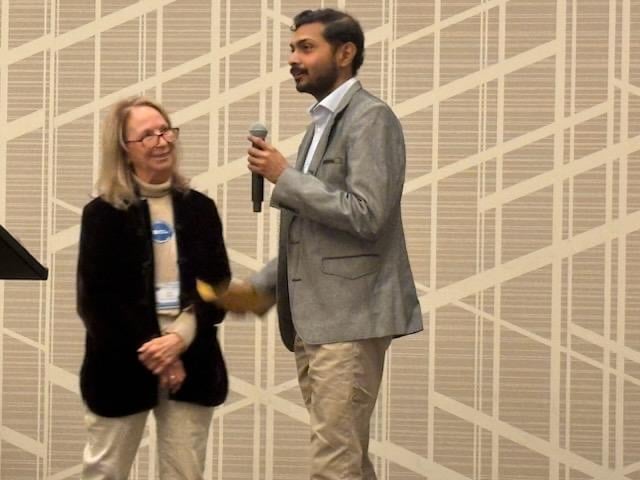
Aritra Chakrabarty, a PhD candidate in the Environmental and Energy Policy program received the “Runner Up to the Best Graduate Student Paper” Award for his research titled “Gender Empowerment through Renewable Energy Transition: A case study of a rural solar community program in India.”

Aritra Chakrabarty receiving his award for runner up to the best graduate student paper.

Abstract: The field of energy justice has increasingly recognized the importance of gender equity in access to and control over energy resources. However, there is a significant gap in the feminist energy justice (FEJ) scholarship regarding the understanding of gender-just energy programs. The energy justice scholarship has paid limited attention to the gendered impacts of these programs. Many programs fail to adequately address the specific needs of women, children, elderly, and other marginalized groups like tribal groups. My study contributes to the growing FEJ scholarship by examining the benefits and impacts for the users in a community solar program in a village in Jharkhand, India. I utilize a mini-ethnographic case study to study this program implemented in the rural area of Jharkhand, India. The research question guiding my study is : To what extent do community solar programs influence gender equity in the distribution of costs and benefits among rural households?  Findings show that normative expectations of gender in terms of gender division of labour influence the distribution of benefits of a solar community program for the users. I identify the extent of equity in distribution of energy uses across women and men users, and the capabilities derived from such uses. I contribute by empirically testing the FEJ framework through two parameters – gender equity and energy capabilities as dimensions of analysis. This study opens up opportunities for further research on how energy systems could be designed and implemented using a framework that recognizes the imbalance in distribution of burden and benefits from the use of solar.

Lexi and Aritra presented in the Environmental Policy and Natural Resource Management (EPN) section, which is chaired by Dr. Chelsea Schelly.

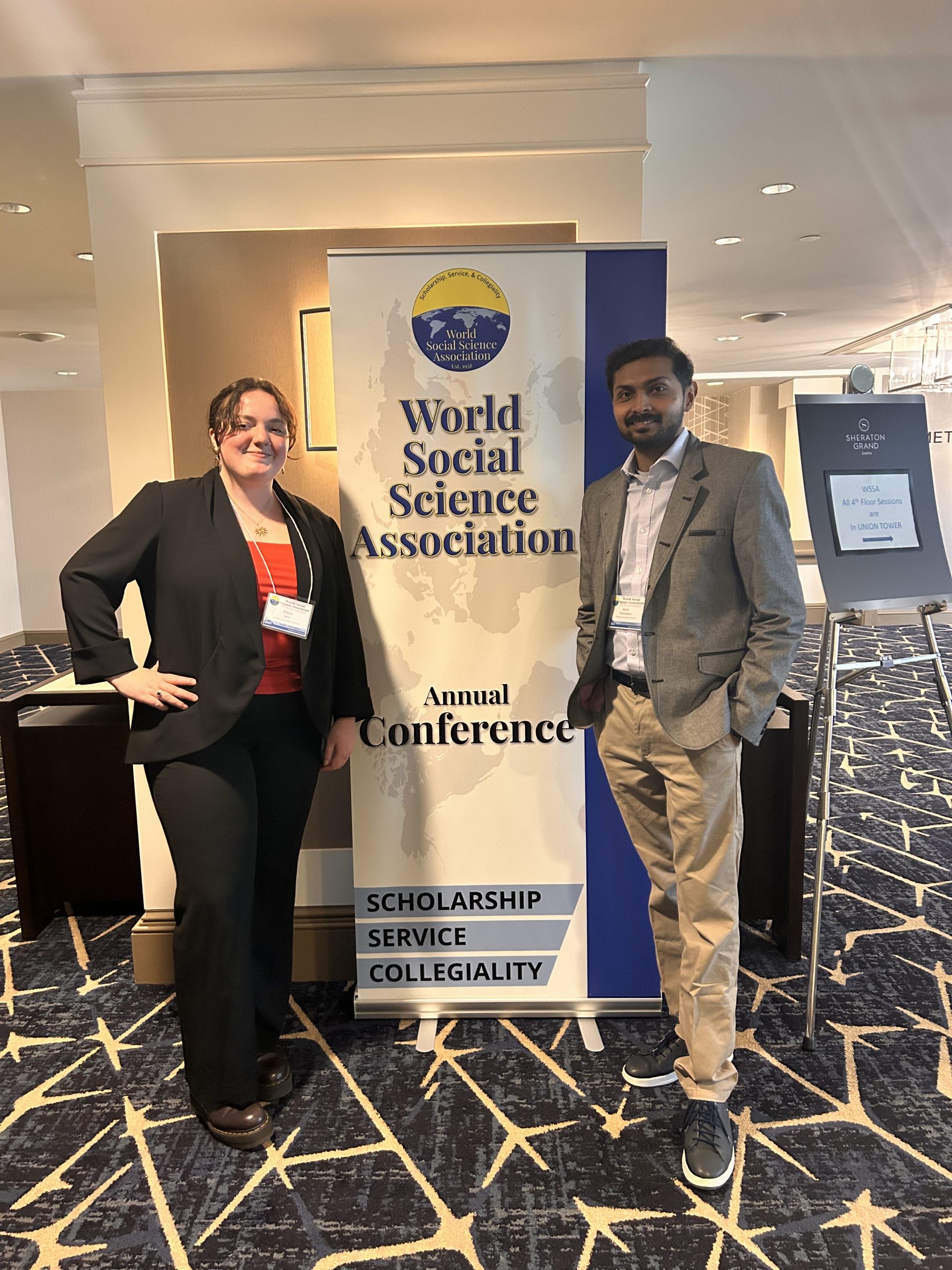
Lexi Tater (left) and Aritra Chakrabarty (right) at the 2025 World Social Science Association Annual Conference.