
Tag: NASA

From Campus to Cosmos: MTU Astro-Huskies Place Third in NASA Lunabotics Challenge

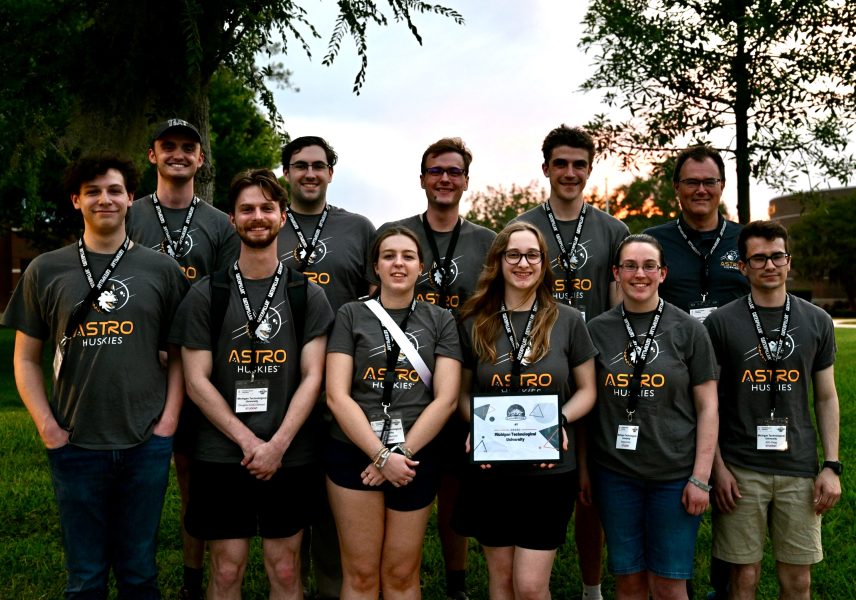
Ten Michigan Tech Astro-Huskies members stand together with a certificate and matching Astro-Huskies shirt.
Michigan Tech’s Astro-Huskies team traveled to Florida to compete in the 2026 NASA Lunabotics Challenge where they qualified for the finals and placed third overall. (Image courtesy of MTU MINE)

Michigan Tech students never shy away from a good challenge, and the Astro-Huskies of Tech’s Multiplanetary INnovation Enterprise (MINE) are no different. The Astro-Huskies team placed third in the 2026 NASA Lunabotics Challenge

The annual year-long competition puts collegiate teams to the test, designing, building, and testing prototype lunar construction robots. This year, 47 teams were selected to compete in the qualifying round at the University of Central Florida before the top 10 teams moved on to the three-day final at the NASA Kennedy Space Center on May 19-21. 
Astro-Huskies Take to the Moon in NASA Lunabotics Challenge

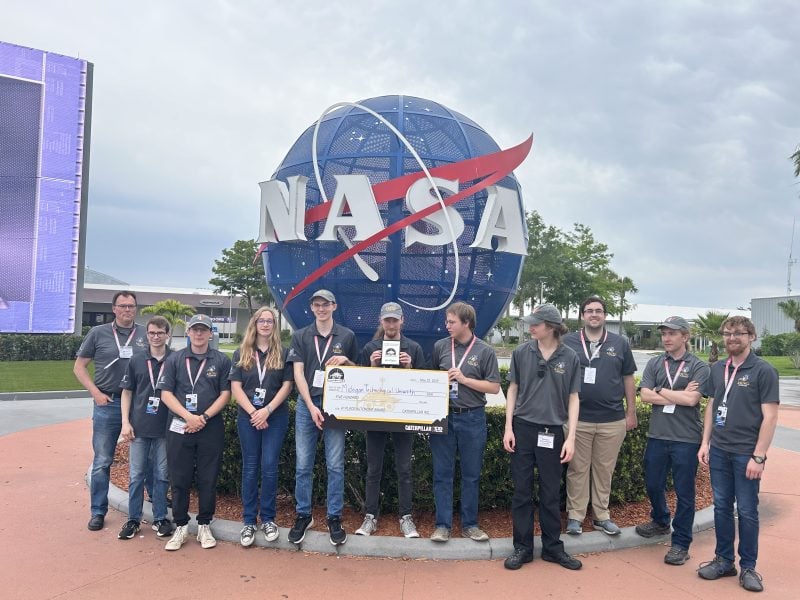
The MTU Astro-Huskies team poses in front of a NASA logo statue with their fourth place award at the Kennedy Space Center. The team is wearing gray Astro-Huskies polos and blue jeans.
10 members of MTU’s Astro-Huskies traveled to Florida to compete in the 2025 NASA Lunabotics Challenge, including Asher Zeyl, Connor Eddy, Joshua Prall-Stankewitz, Kade Nielsen, Katherine Rauscher, Ben Christians, John Dagg, Braeden Moore, Drew Knutson, Tanner McLean and faculty advisor Paul van Susante. (Photo courtesy of Astro-Huskies)

Michigan Tech students have a long history of shooting for the moon—and some Huskies get very close. This May, Multiplanetary INovation Enterprise’s (MINE) Astro-Huskies team placed fourth in the 16th annual NASA Lunabotics Challenge. Developed to highlight NASA’s systems engineering principles, the annual challenge tasks student organizations from universities around the country to design, build, and test a prototype off-world construction robot. 

Student groups spend a full academic year working on their prototype while meeting technical milestones and submitting materials to NASA ahead of the qualifying rounds at the University of Central Florida. The top ten teams from qualifying rounds go on to compete in the finals at the NASA Kennedy Space Center Visitor Complex.