
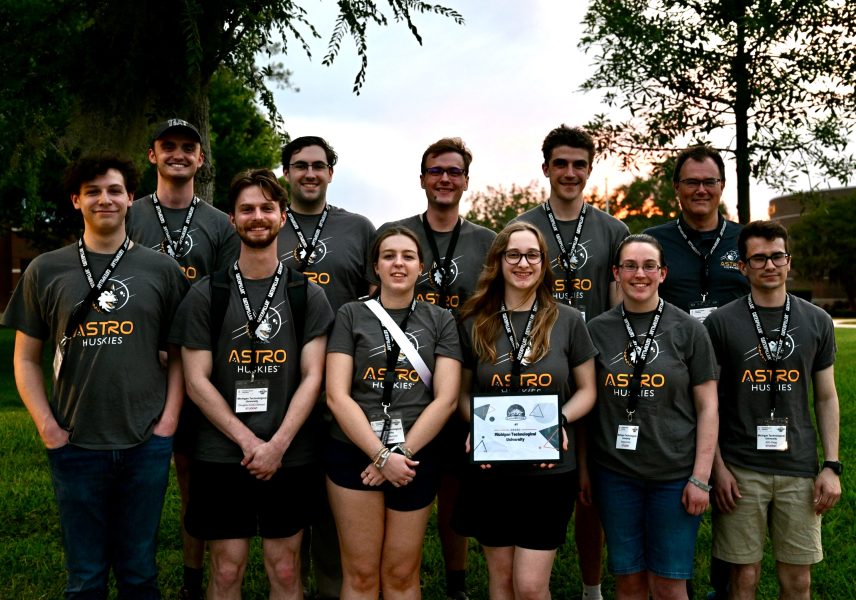
Michigan Tech students never shy away from a good challenge, and the Astro-Huskies of Tech’s Multiplanetary INnovation Enterprise (MINE) are no different. The Astro-Huskies team placed third in the 2026 NASA Lunabotics Challenge.
The annual year-long competition puts collegiate teams to the test, designing, building, and testing prototype lunar construction robots. This year, 47 teams were selected to compete in the qualifying round at the University of Central Florida before the top 10 teams moved on to the three-day final at the NASA Kennedy Space Center on May 19-21.
During the competition, the student teams and their robotic prototypes excavated and collected simulated regolith, sometimes referred to as lunar “soil,” transported it across challenging terrain, and constructed a protective berm, or raised mound from the material. Judges assessed berm size, robot weight, communications, energy use, and automation to determine overall scores.
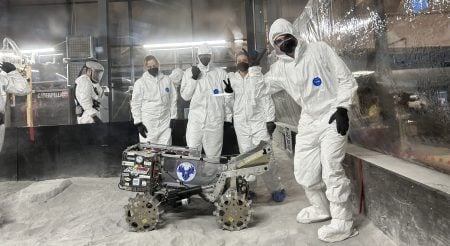
After two semesters of utilizing NASA’s system engineering principles and submitting several milestone reports along with building and testing their prototype, the Astro-Huskies and their robotic entry, MOOSE (Mobile Operations for Off-world Surface Excavation), received third place in construction, shared sixth place in autonomy, fourth place in communication and power, fifth place in systems engineering paper, and an honorable mention in presentation and demonstration, culminating in their third place overall finish in the competition.
The Astro-Huskies are no strangers to success at the NASA Lunabotics Challenge; the team has been competing in the challenge since 2022 and placed fourth in last year’s competition. This year, 53 students worked on the Astro-Huskies team. A dozen members were able to travel with MOOSE to Florida for the qualifying and final rounds. Katherine Rauscher, mechanical engineering senior and MINE’s Lunabotics project manager, was part of the travel team in both 2025 and 2026.
“I’m so incredibly proud of what the team achieved this year,” said Rauscher. “Making such large improvements to both our deliverables and our actual rover design was a lot of work, and we all had some pretty long weeks and late nights to make it happen. It was absolutely worth it to see everything pay off with our record-breaking performance at competition.”
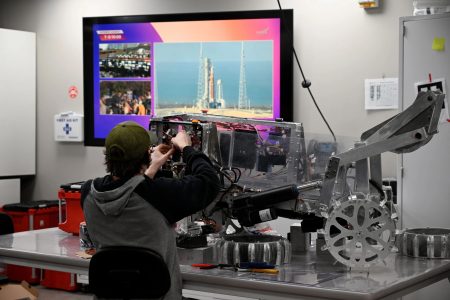
Associate Professor Paul van Susante, the Lou and Herbert Wacker Professor of Mechanical Engineering, is the MINE faculty advisor. The former NASA faculty fellow was involved in the NASA Lunabotics Challenge long before he came to Michigan Tech in 2012. While van Susante serves as a valuable resource for the team, he’s also proud to affirm that the Astro-Huskies are entirely student-run.
“I am extremely proud of the team for their excellent performance and the best finish at the NASA Lunabotics Challenge to date,” said van Susante. “It was a pleasure to work with and see the students grow during their time in MINE and during the process, take on ever more complex challenges and lead the team to success.”
The team’s success illustrates the benefits of Michigan Tech’s unique Enterprise Program which for more than 25 years has made it possible for students to work on multidisciplinary teams over multiple years on ambitious client-based projects that require time and progressive expertise to develop. The MINE Enterprise, which includes other projects applicable to planetary exploration, has been growing in size and experience since its founding in Spring 2016.
Rauscher graduated from Michigan Tech this May, but thanks to the design of the Enterprise Program, her Lunabotics expertise doesn’t leave with her. She’s looking forward to the Astro-Huskies team’s continued success in the future.
“I’m excited to pass the torch off to next year’s team since I have no doubt that they will be able to use what we learned this year to find even more success in the future,” she said.
About the College of Engineering
Michigan Tech’s College of Engineering offers more than 15 bachelor of science degrees in biomedical engineering, chemical engineering, civil, environmental and geospatial engineering, electrical and computer engineering, engineering fundamentals, geological and mining engineering and sciences, manufacturing and mechanical engineering and technology, materials science and engineering, and mechanical and aerospace engineering.
Our engineering graduate degree options include master’s and PhD programs, along with robust online certificate programs for busy professionals. Follow Michigan Tech Engineering on Facebook, Instagram, LinkedIn, and Twitter for the latest happenings.