
Michigan Tech students are earning NASA awards for work designed to make future Artemis missions more reliable!
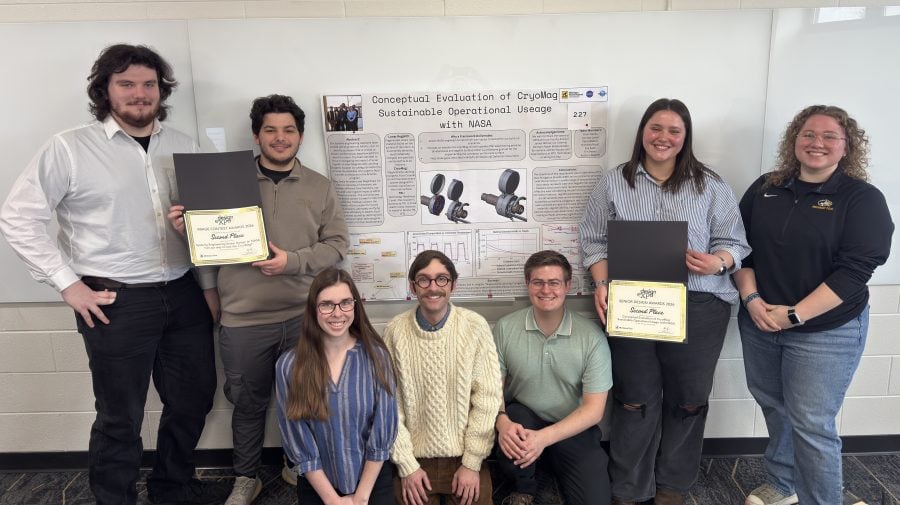
This summer, the Bachelor of Science in Engineering (BSE) capstone team received an “Awesome Performance in EXploration DIvision” 2026 APEX Award from NASA’s Johnson Space Center for their Senior Design project titled “Conceptual Evaluation of CryoMag Sustainable Operational Usage with NASA.” The team seeks to develop a framework to mitigate the impact of lunar regolith on CryoMag connectors to increase the reliability of cryogenic fluid transfer on lunar missions.
This year’s award-winning team was led by Katie Walters and includes Brian Marku, Connor Jones, Nicholas Wyatt, Ella Santi, Tim Peters, and Kathryn Bugbee.
The awards are presented by NASA’s EX Project Management and Systems Engineering Division in recognition of outstanding work in support of the division. NASA representatives noted the students’ strong performance throughout the spring 2026 semester and the positive response to their final project presentation.
“This recognition is a tremendous achievement for our students with a focus in systems engineering,” said James Bittner, assistant teaching professor in the Department of Engineering Fundamentals (EF) and the team’s faculty advisor. “Throughout the project, the team demonstrated exceptional accountability, resilience, and creativity while working through the complexity and uncertainty of a real NASA systems engineering challenge. The APEX Award from Johnson Space Center is a meaningful recognition of the quality of their work, their professionalism, and the true value of their strong teamwork.”
Open-ended projects like this one require student teams to identify a complex problem, propose a direction to NASA, and execute a solution in just 14 weeks. Their efforts culminate in a comprehensive final report and presentations to NASA and the Michigan Chapter of the International Council on Systems Engineering (INCOSE).
The senior capstone focused on systems engineering was begun by Robin Mikola ’04 in 2020, shortly after founding Michigan Tech’s Systems Engineering Association, an INCOSE student division. The request came from the students themselves, who were looking to put their systems engineering education into real-world practice.
“I developed and pitched this open-ended challenge to NASA that united students from across disciplines to tackle real problems supporting the future of space exploration,” said Mikola, an electrical engineering alumna. “NASA loved this idea and immediately volunteered their time weekly and provided access to experts across the organization to support answering any questions the students had.”
Mikola led the first year of the program as then-president and academic advisor of the INCOSE Michigan Chapter alongside Associate Professor Jon Sticklen. Mikola remains the academic advisor for INCOSE Michigan, supporting teams at Michigan Tech and the University of Michigan.
“Today, the program continues to provide students with a unique opportunity to apply systems engineering in a real-world, multidisciplinary environment with support from James Bittner,” said Mikola. “By addressing authentic challenges connected to NASA’s Artemis missions and future exploration efforts, students gain professional-level experience while making meaningful contributions to humanity’s return to the Moon, journey to Mars, and beyond.”
Sticklen, who previously served as the EF department chair, was faculty lead for the first three years of the collaboration with NASA and continues to work closely with the capstone students.
“I am incredibly proud of all our capstone teams and overjoyed to see their dedication recognized with this NASA APEX Award,” said Sticklen. “Through weekly collaborations with NASA experts and alongside the steadfast external mentorship of Robin Mikola and the invaluable, direct support from James Bittner, our students worked relentlessly. These students are a truly special group, and I firmly believe we will hear great things about them throughout their careers.”
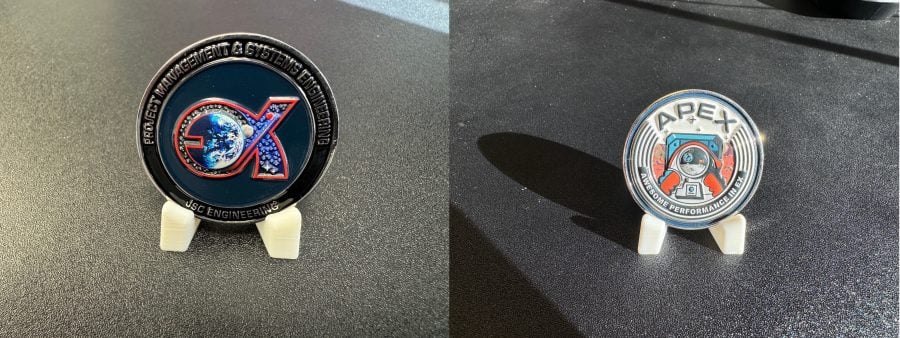
In addition to a certificate and commemorative coin from NASA, the team earned a second-place Senior Design Award and placed second in the Image Contest Award at Michigan Tech’s 2026 Design Expo.
“It has been an honor and privilege to support and mentor these exceptional future engineers over the years,” said Mikola. “I hope that we can continue to provide this excellent experience to future MTU students for many years to come.”
About the College of Engineering
Michigan Tech’s College of Engineering offers more than 15 bachelor of science degrees in biomedical engineering, chemical engineering, civil, environmental and geospatial engineering, electrical and computer engineering, engineering fundamentals, geological and mining engineering and sciences, manufacturing and mechanical engineering and technology, materials science and engineering, and mechanical and aerospace engineering.
Our engineering graduate degree options include master’s and PhD programs, along with robust online certificate programs for busy professionals. Follow Michigan Tech Engineering on Facebook, Instagram, LinkedIn, and Twitter for the latest happenings.