
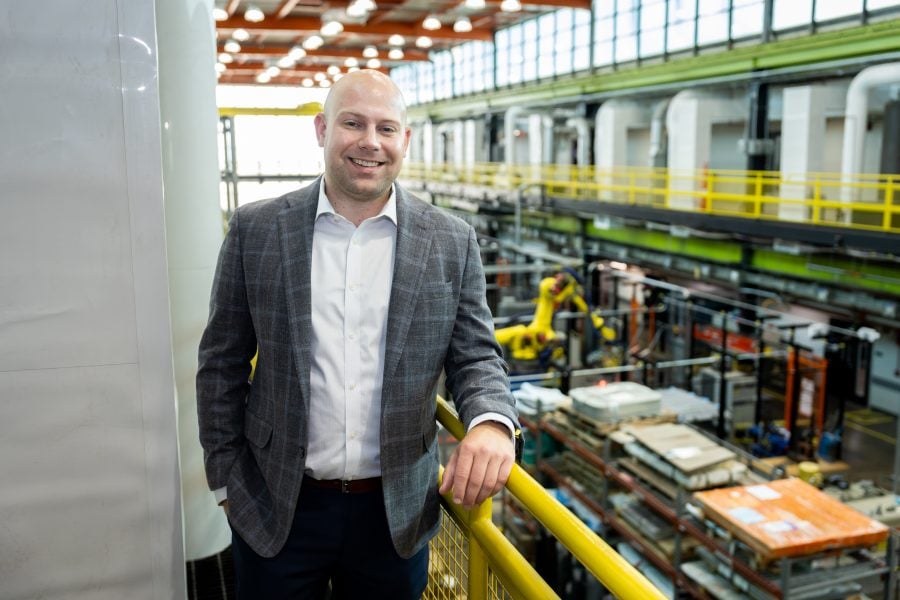
Huskies can’t help but make an impact! This fall, mechanical engineering technology alumnus Joseph Williams was named to the 2026 Society of Manufacturing Engineers (SME) 30 Under 30 list, honoring his standout career success and recognizing his future leadership potential in the manufacturing field.
Williams, who joined the manufacturing workforce only a few years ago, has already become a leader in manufacturing technology. In his current position as robotics technology development manager with General Motors, he’s found that innovation applies to more than just the technology a team produces. It also applies to the team itself.
“The challenge does not end when we create something unique and novel,” said Williams. “The real opportunity begins when we ask: ‘How do we transition this technology into the facility? How do we develop others to use it, improve it, and make it their own? How do we educate and empower the workforce to bring these innovations to life?’ ”
Originally from the Detroit metropolitan area, Williams came to Tech looking for adventure. He graduated from the Department of Manufacturing and Mechanical Engineering Technology (MMET) in 2022, but didn’t stay away from the close-knit community he’d come to treasure for long. He returned to earn his Master’s of Business Administration online from Tech’s College of Business in 2024. He’s currently back in his home department pursuing a Ph.D. in manufacturing engineering.
“There is a real sense that everyone is in it together, because you have to support one another and figure things out,” he said. “That shared experience is a big part of the adventure and the sense of resilience that comes from attending Tech.”
In a College of Engineering Q&A, Williams shares what this award means for him and how he’s carrying his Husky pride forward.
Q: Congratulations on this tremendous honor! What does it mean to you to receive this recognition?
JW: Receiving this recognition is truly an honor, especially at this point in my career. It is deeply meaningful to know that my work has had a positive influence, not only on the industry and the companies I have had the privilege to work for, but also on the lives and careers of others. Knowing that I have encouraged, supported, and inspired people around me is especially rewarding. To have my peers, mentors, and leaders recognize those contributions is incredibly humbling. This honor is both a reflection of the journey so far and motivation to continue making a meaningful difference in the future.
Q: What led you to Tech?
JW: What led me to Michigan Tech is a good question. I think it was a combination of adventure, taking a leap of faith, and stepping outside the comfort zone. The Keweenaw’s beautiful surroundings definitely played a role, but so did the tough weather and long winters. The snow and difficult conditions were challenging at first, but over time, I came to really enjoy them. They became part of what made the experience unique and helped build the tenacity that Michigan Tech graduates are known for.
I also enjoyed the close-knit community. There is a real sense that everyone is in it together, because you have to support one another and figure things out. That shared experience is a big part of the adventure and the sense of resilience that comes from attending Tech.
Q: Now that you’re part of the manufacturing workforce, and what do you see as most valuable about your education? Are there moments from your time at Tech that really stand out as influential on your career today?
JW: The most valuable part of my education has been the technical depth of the professors in the MMET department, such as my PhD advisor Associate Professor David Labyak. They brought real-world industry experience, practical examples, and a lot of enthusiasm to the classroom. That made the coursework feel connected to what we would encounter in the real world and helped prepare us to hit the ground running in internships and early-career roles.
“I can’t point to one specific moment at Tech that shaped my career. Instead, I think it was the combination of the challenging academics, hands-on learning, unpredictable weather, and supportive community that has stayed with me and continues to influence me today.”
— Joseph K. Williams ‘22 ‘24, Society of Manufacturing Engineers 30 Under 30
Q: You’ve held many positions in the industry, from technician to leader. Is there a role that taught you the most about working in this industry? What did you learn?
JW: The various positions I have held throughout my career have each contributed to valuable lessons and collectively shaped my professional trajectory.
My experience on the manufacturing floor gave me a practical understanding of how work is accomplished in real-world conditions. It exposed me to the challenges, the importance of preparation, and the factors required for a team to be successful.
As I transitioned into engineering, I gained a deeper appreciation for the responsibility associated with developing technical documents, systems, and processes. The decisions engineers make—and the way they communicate those decisions—directly influence the work of others. Engineering is not only about designing products and systems; it’s also about creating solutions that people can trust, use effectively, and take pride in supporting.
This experience strengthened my appreciation for the people-centered and leadership aspects of engineering. Team members are among the most essential members of an operation. They recognize subtle changes in a process or machine, make critical adjustments, and provide practical insight into how equipment should be improved. Their experience often transforms a system that works in theory into one that performs successfully in practice.
I view these contributions as distinct forms of craftsmanship: machining as the skilled shaping of metal, team members as the individuals who bring the process to life, and technicians as experts who refine and sustain the process. There is something remarkable about seeing people and machinery work together in a coordinated symphony to create something through skill, persistence, and pride. That collaboration represents more than manufacturing; it demonstrates how meaningful progress is achieved by people who understand their work, support one another, and are committed to creating products that serve a broader purpose.
Q: You continued your studies with an MBA from Michigan Tech in 2024, taking evening classes while working in manufacturing roles. How did you make the decision to advance your education with a business focus? How did taking classes influence your work as you were doing both?
JW: I’ve always had an entrepreneurial mindset and a strong interest in understanding how different business functions work together. I took accounting courses in high school and throughout my undergraduate studies, which helped me recognize the value of understanding business, financial trends, and the decisions behind them.
I often compare financial statements—such as balance sheets and income statements—to engineering drawings. Both are structured methods of communication that provide insight into how something is designed, operates, and performs.
One professor who had a significant influence on me was Sheila Milligan, former senior lecturer in accounting. Her enthusiasm for teaching and her perspective on the world inspired me to develop the tools and confidence needed to pursue success. She reinforced the importance of understanding both personal and business finance and applying that knowledge in practical ways.
This perspective has directly informed my professional practice, enabling me to apply principles of financial reporting, internal controls, financial risk management, and strategic decision-making to assess how corporate performance affects my area of the business and make more informed resource-allocation decisions across projects.
As I moved into management, I also became increasingly interested in organizational behavior and corporate strategy. Concepts such as entering new “blue ocean” markets, competing in established “red ocean” markets, and distinguishing between incremental and transformational innovation helped me evaluate when organizations should optimize existing opportunities and when they should pursue transformative growth.
Q: You’re currently a robotics technology development manager for General Motors. What excites you about the work you’re currently doing? How has your time at Tech prepared you for a role like this?
JW: While I could talk about the innovative work we are doing and creating today, I will leave that to GM News. What excites me most about my career is the pursuit of the fundamental question: identifying the core innovation the market truly needs.
Is the right answer an incremental innovation that creates a step change in current technology, or does the opportunity require something more transformational, something that transforms not only how a single company manufactures, but how the world manufactures? I find genuine fulfillment in seeing the team engage with these questions and in surrounding myself with some of the most innovative and brilliant minds in the industry as we pursue what is possible.
“The challenge does not end when we create something unique and novel. The real opportunity begins when we ask: How do we move this technology into the facility? How do we develop others to use it, improve it, and make it their own? How do we educate and empower the workforce to bring these innovations to life?”
— Joseph K. Williams ‘22 ‘24, Society of Manufacturing Engineers 30 Under 30
I believe opportunities like this require a combination of technical engineering expertise and business acumen. My hands-on MET education, MBA, and experience have prepared me to approach innovation from both perspectives. The initial question is often, “What education do you have?” The next logical question is, “Where have you applied it, and what were the outcomes?” That intersection of education, application, and measurable contribution is what we typically call experience—and it is what prepares us to take on opportunities like this.
Q: You’ve returned to Michigan Tech again, as a manufacturing engineering PhD student. What led you to pursue a PhD at this point in your career? How do you envision your research benefitting the industry in the years to come?
JW: What ultimately led me to pursue a PhD at this stage of my career was a combination of curiosity and empathy for the researchers and advanced-development professionals I have led. I wanted to better understand the educational journey they had undertaken, including literature reviews, research proposals, theses, defenses, and publications. Pursuing a PhD has allowed me to experience that process firsthand while also exploring a subject in which I have a genuine interest.
I also recognized a unique opportunity to bridge the gap between academic research and industrial application. Many graduate students enter the workforce without extensive hands-on experience on the manufacturing floor. My industry experience provides a valuable perspective and credibility that can help translate research into meaningful innovations.
My proposal focuses on how team members interact with machines. Currently, industrial environments often follow one of two approaches: robots operate in cages, physically separated from people, or humans and robots work together without comparable barriers. I’m interested in exploring whether there is a more effective middle ground. Can we develop adaptable technologies that support both scenarios? What challenges emerge from different human-machine interaction models, and how should these environments be designed?
Ultimately, I believe this work can benefit the industry and improve the employee experience by creating systems that adapt to team members, not systems that require team members to adapt to them.
Q: The SME 30 Under 30 recognizes past success but also recognizes potential for future leadership in manufacturing. What do you think makes a good leader in your industry?
JW: Many of the greatest manufacturing leaders share a common foundation: they began on the manufacturing floor. That experience—working in what I call “the fire”—builds character, respect, persistence, and tenacity. These qualities are essential to effective leadership in manufacturing and beyond.
Great leaders are driven by curiosity. They do more than accept the status quo, they challenge it by asking, “How can we improve?” “What must be true?” and “What can we do to turn possibilities into reality?”
Q: What advice would you give current Michigan Tech students interested in manufacturing careers? Is there anything you wish you knew as a student that you know now?
JW: My advice to current Michigan Tech students interested in manufacturing careers is to remain curious and actively pursue opportunities that interest them. Engage with professors and fellow students in the manufacturing department to learn about emerging technologies, innovative applications, and the work being done across the field.
One of the most inspiring aspects of manufacturing engineering is its ability to make the impossible possible—at scale, with quality, and with consistency. The most fascinating part is not simply designing a product; it is also understanding how to bring that design to life.
Achieving this requires thoughtful consideration of product features, materials, processes, machining, assembly, infrastructure, and quality systems. Together, these elements make it possible to produce millions of products reliably and efficiently.
That is what makes manufacturing such an exciting field: transforming ideas into reality, building repeatable systems and processes, and creating solutions that can transform the world.
About the College of Engineering
Michigan Tech’s College of Engineering offers more than 15 bachelor of science degrees in biomedical engineering, chemical engineering, civil, environmental and geospatial engineering, electrical and computer engineering, engineering fundamentals, geological and mining engineering and sciences, manufacturing and mechanical engineering and technology, materials science and engineering, and mechanical and aerospace engineering.
Our engineering graduate degree options include master’s and PhD programs, along with robust online certificate programs for busy professionals. Follow Michigan Tech Engineering on Facebook, Instagram, LinkedIn, and Twitter for the latest happenings.