
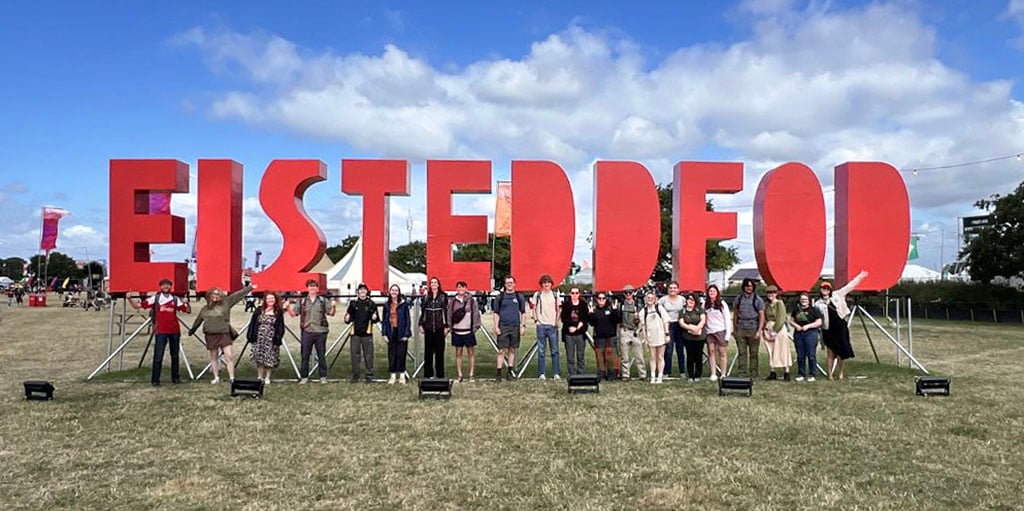
Tech’s semiannual study abroad trip to Wales, supported by the social sciences department, takes a new focus on critical copper connections in 2027, following the receipt of a $10,000 Pioneering Institution Grant from the Gilman Program. Mark Rhodes, an associate professor of geography, has led the study abroad program since its inception as an ethnographic research trip in 2022. That year, a combination of 14 graduate students and community members attended.
“While our primary goal was collecting data, in the back of my mind, I was already starting to plan out a program,” said Rhodes.
In 2024, it grew from a research trip to a full study abroad program with two community members, two graduate students, and 14 undergraduates, co-led by Kathryn Hannum, assistant teaching professor and coordinator of student programs. The group spent two weeks visiting seven national museums in Wales, rounding off the trip back in Michigan, where each student attended and presented an individual research poster at the annual Vernacular Architecture Forum Conference hosted at Tech.
Vernacular is certainly an important part of students’ exposure to new concepts in Wales. “One thing that never ceases to surprise students is the language,” said Rhodes. He explained that while he practices the language with students before they leave for the trip, Welsh is very dissimilar to English. “What really surprises them is how much it’s spoken in Wales, particularly the parts of Wales we visit, where 70% of the people are first-language Welsh speakers,” said Rhodes.
The 2025 trip included a teaching assistant, three graduate students, and 15 undergraduates. Their journey started at the Welsh Studies Conference in Rio Grande, Ohio, and added a week in Wales so students could attend the National Eisteddfod, the country’s largest festival.
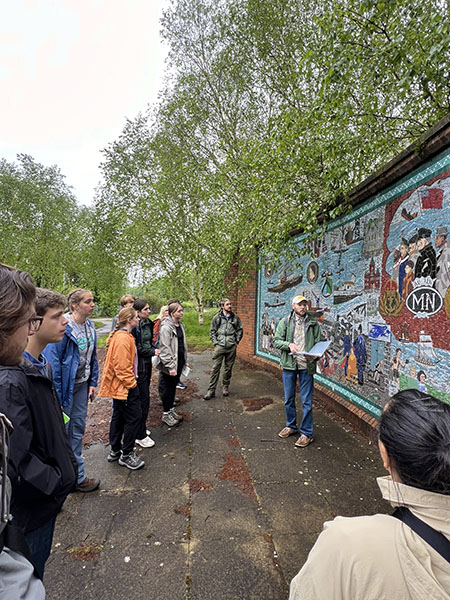
“It was very rewarding to see the students interact with the same people across different spaces. We would meet people at the conference or at guided tours or museums, and then the students would see them again at the festival at the end of the program, illustrating both how small Wales is and the importance of the national festival to the country,” said Rhodes.
The pattern of beginning or ending the trip with an academic conference is intentional, emphasizing the program’s academic relevance to students and connecting theory and conference debates to their experiences in Wales. It’s a strategy Rhodes intends to continue in 2027, guiding students to approach foreign concepts through the lens of social sciences.
“We tend to only think about study abroad as a means of exposure to cultures other than our own,” said Rhodes. “I want to ensure that our students explicitly experience new ideas.”
That’s exactly the type of initiative that the Gilman Program seeks to support as part of its 25th anniversary. The program awarded Pioneering Institution Grants to ten U.S. colleges as part of a new initiative from the U.S. Department of State’s Benjamin A. Gilman International Scholarship Program. In addition to the $10,000 award funded by the Institute of International Education in partnership with The Forum on Education Abroad, representatives from recipient campuses also receive training and resources to support program development and student advising.
The grants recognize institutional leadership in connecting study abroad with career readiness in forward-looking fields critical to the United States’ prosperity and advancement. Institutions will receive structured support before, during, and after study abroad with career-focused workshops and engagement with industry partners and alumni.
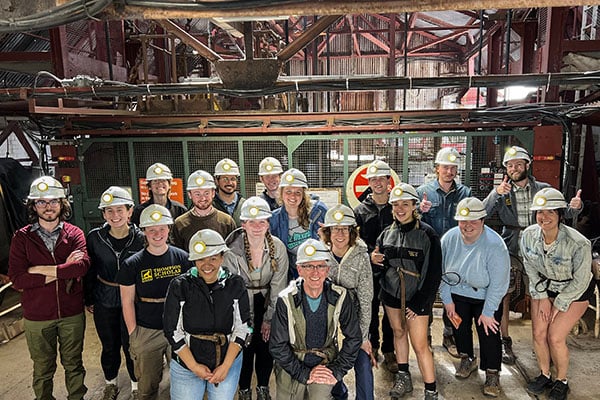
“I think the strength of this program, and really any study abroad that I’ve been involved with, comes from exposing students to careers they’d never even considered,” said Rhodes.
In line with the grant’s purpose, Tech’s trip to Wales in 2027 will focus on the parallels between copper mining in Wales and Michigan. Wales and Michigan’s Upper Peninsula both experienced industrial-era copper booms, with Wales once leading the world in copper production before Michigan. Wales’ decline in copper production and need to navigate post-industrial challenges also precedes Michigan’s confrontation with those same hurdles.
“Michigan Tech would not exist without copper, or at least it wouldn’t be in Houghton,” said Rhodes. “How can our heavily post-industrial region learn from both the successes and failures of Wales’s own navigation of deindustrialization? At the same time, both Wales and Michigan are exploring a rebirth of our copper industries. There’s a lot to learn from one another.”
The next trip will include the study abroad program’s first visit to Cornwall, where travelers will focus on the life cycle of mining and its legacies in Michigan, Wales, and Cornwall. For the first time since the trip’s inception, students will also turn their attention to active mining occurring or planned across the three regions.
“I hope students do some critical thinking about mining and the global impacts of our resistance to or advocacy for mining,” said Rhodes. “At the end of the day, I hope students engage in generative conversations with the people they interact with throughout the program and bring back creative ideas to campus, the Keweenaw, and to their hometowns.”
About the College of Sciences and Arts
The College of Sciences and Arts is a global center of academic excellence in the sciences, humanities, and arts for a technological world. Our teacher-scholar model is a foundation for experiential learning, innovative research and scholarship, and civic leadership. The College offers 33 bachelor’s degrees in biological sciences, chemistry, humanities, kinesiology and Integrative physiology, mathematical sciences, physics, psychology and human factors, social sciences, and visual and performing arts. We are home to Michigan Tech’s pre-health professions and ROTC programs. The College offers 25 graduate degrees and certificates. We conduct approximately $12 million in externally funded research in health and wellness, sustainability and resiliency, and the human-technology frontier.
Follow the College on Facebook, Instagram, LinkedIn, X and the CSA blog. Questions? Contact us at csa@mtu.edu.