
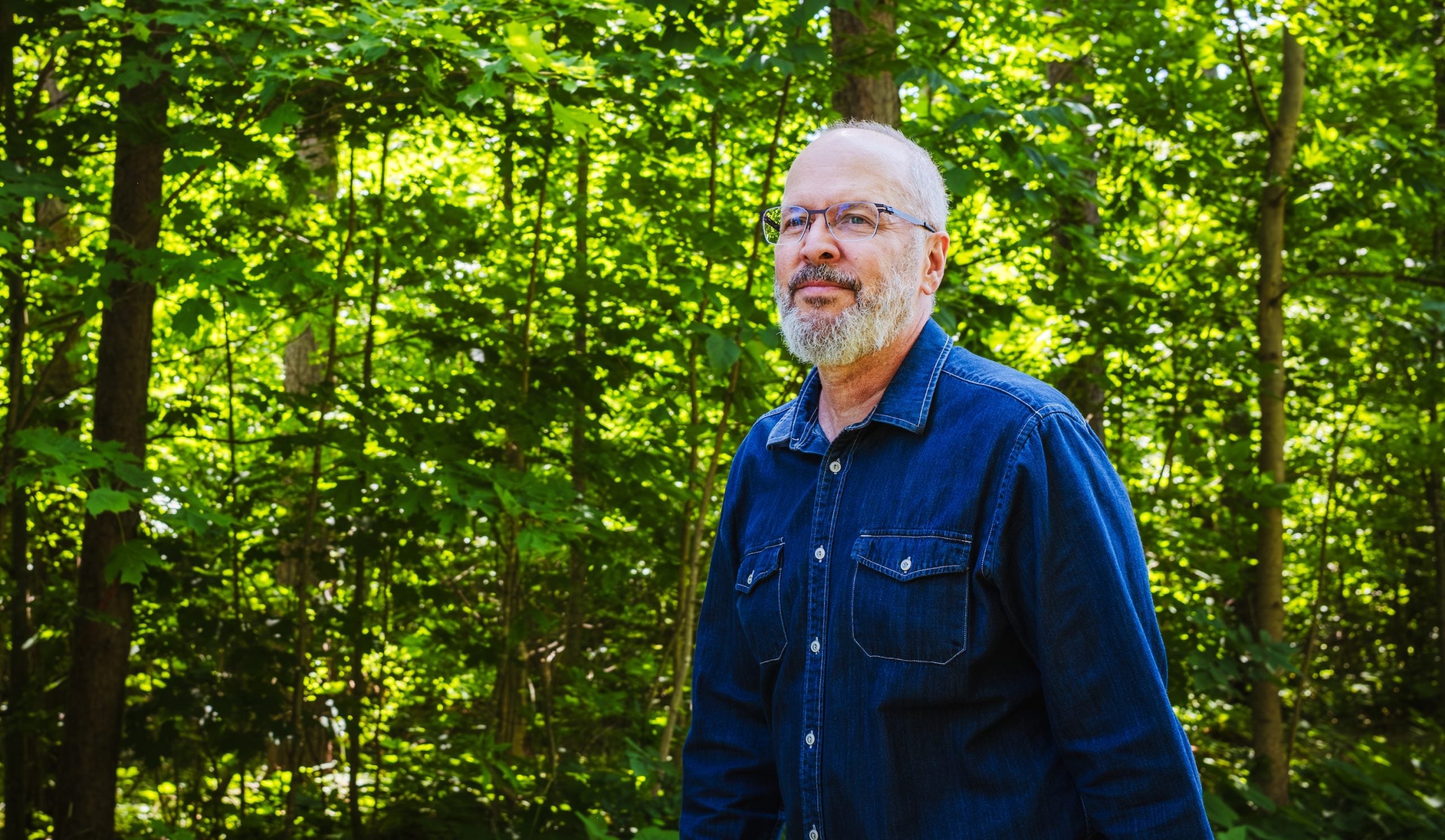
The effects of climate change on ecosystems are often studied and discussed in terms of long-term changes in factors such as temperature averages. Michael Paul Nelson, humanities department chair, reframes this approach to climate change in light of extreme heat events in the paper “Extreme heat and the limits of tree and forest resilience,” recently published in Nature Climate Change.
“How we think about the drivers of vegetative impacts has a lot to do with how we think we can or should respond to those drivers and impacts,” said Nelson. “Our concept of tree and forest resilience, for example, is tied to a way of thinking that this research challenges.”
The paper, coauthored with Christopher Still of Oregon State University, uses the 2021 Pacific Northwest heat dome as a case study for extreme climate events. During the dome, evergreen forest canopies browned extensively across the region. The damage was not the result of drought brought on by heat as is usually anticipated during heat waves, but due to temperatures outside the forests’ short-term heat tolerance.
Nelson, who experienced the heat dome first-hand, started working on the project after hearing several of Still’s talks about the heat dome, extreme events, and plant physiological responses. He said he was jarred by the devastating facts of Still’s research and realized that the findings run contrary to some common conservation narratives, including the narrative of resilience.
“I heard the stories of millions of living things dying all at once,” said Nelson. “I watched the plants in my own yard struggle, some dying right away, and others later on. I understand the connection between events like this and other conditions that we’ve created in the world that exacerbate, if not cause, such events.”
The publication takes a more narrative format than typical for scientific journals while challenging existing frameworks for ecological care. It advocates for climate scientists and ecological caretakers to think beyond preservation, recognize species’ short-term exposure limits, and prepare for difficult intervention decisions in a new ethical light. Nelson and Still’s work doesn’t abandon the relevance of forest resilience, but reframes it as the ability to respond wisely to disruption rather than maintaining stability at all costs.
While Still and other climate researchers continue to examine rapidly evolving climate events, Nelson intends to continue finding unique and creative ways to bring the meaning of that research to the world.
“For me, what’s next includes finding ways to write in this mode more often,” said Nelson. “Not science writing or science journalism per se, and not some form of humanities written for an insular audience, but something adjacent—something that I suppose I’ve spent my career honing in my own way.”
About the College of Sciences and Arts
The College of Sciences and Arts is a global center of academic excellence in the sciences, humanities, and arts for a technological world. Our teacher-scholar model is a foundation for experiential learning, innovative research and scholarship, and civic leadership. The College offers 33 bachelor’s degrees in biological sciences, chemistry, humanities, kinesiology and Integrative physiology, mathematical sciences, physics, psychology and human factors, social sciences, and visual and performing arts. We are home to Michigan Tech’s pre-health professions and ROTC programs. The College offers 25 graduate degrees and certificates. We conduct approximately $12 million in externally funded research in health and wellness, sustainability and resiliency, and the human-technology frontier.
Follow the College on Facebook, Instagram, LinkedIn, X and the CSA blog. Questions? Contact us at csa@mtu.edu.