
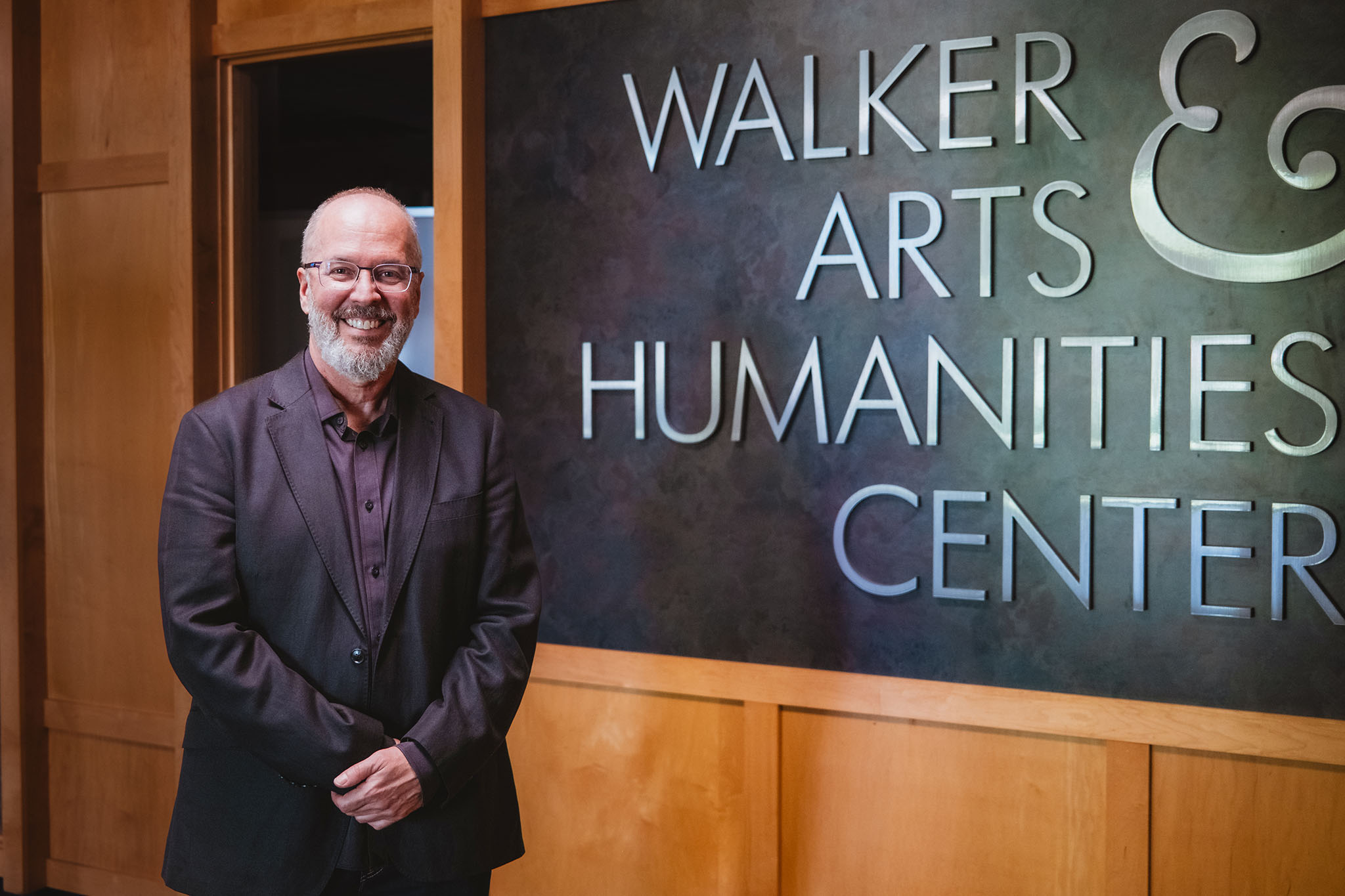
Michigan Tech’s College of Sciences and Arts welcomes Michael Nelson as the new chair of the Department of Humanities, effective July 1. Nelson comes to Michigan Tech from Oregon State University’s College of Forestry, where he was a professor of environmental ethics and philosophy and director of the Center for the Future of Forests and Society.
“If disciplinarity were a sport, Michael’s version is extreme interdisciplinarity,” said LaReesa Wolfenbarger, dean of the College of Sciences and Arts. “Michael joins us at a pivotal time as the Humanities Department forms more collaborations within the College and with departments outside the College. I’m confident his experience across diverse disciplines and working with a variety of governmental and non-governmental organizations will accelerate that collaboration.”
Nelson’s expertise is called upon regularly by various government agencies and conservation organizations to assist with understanding the ethical implications of natural resource management decisions. He earned his PhD in philosophy from Lancaster University in the United Kingdom and has more than 30 years of experience in teaching and research. His focus is on environmental ethics and philosophy, ranging from topics in wildlife ecology and conservation biology to questions about science and advocacy, and the philosophical work of Aldo Leopold.
Nelson is author and editor of four books the area of environmental ethics including The Great New Wilderness Debate (1998), The Wilderness Debate Rages On: Continuing the Great New Wilderness Debate (2008), American Indian Environmental Ethics: An Ojibwa Case Study (2004), and the award-winning Moral Ground: Ethical Action for a Planet in Peril (2010) with Kathleen Dean Moore.
“I absolutely love thinking about research, what questions can be asked and answered and for what reason,” said Nelson. “I love empowering students with not just knowledge, but with tools to help them navigate the world as empowered agents but also as caring and humble community members.”
Nelson became familiar with Tech through his 20-year collaboration with the Isle Royale Wolf-Moose Project in Lake Superior, the longest continuous study of a predator-prey system in the world. He has also served as the lead principal investigator for the H.J. Andrews Experimental Forest Long-Term Ecological Research Program and held the Ruth H. Spaniol Endowed Chair of Renewable Resources at Oregon State University.
“At a university known for creating the future, the humanities ask the questions that determine what kind of future is worth creating,” said Nelson. “Ideas drive everything we build—and our greatest challenges will not be solved by invention alone, but by the courage to rethink what we value and who we want to become.”
About the College of Sciences and Arts
The College of Sciences and Arts is a global center of academic excellence in the sciences, humanities, and arts for a technological world. Our teacher-scholar model is a foundation for experiential learning, innovative research and scholarship, and civic leadership. The College offers 33 bachelor’s degrees in biological sciences, chemistry, humanities, kinesiology and Integrative physiology, mathematical sciences, physics, psychology and human factors, social sciences, and visual and performing arts. We are home to Michigan Tech’s pre-health professions and ROTC programs. The College offers 25 graduate degrees and certificates. We conduct approximately $12 million in externally funded research in health and wellness, sustainability and resiliency, and the human-technology frontier.
Follow the College on Facebook, Instagram, LinkedIn, X and the CSA blog. Questions? Contact us at csa@mtu.edu.